
11-20 of 232 results
-
Federal Aviation Administration (FAA): A11L.UAS.97: Propose Right-of-Way Rules for Unmanned Aircraft Systems (UAS) Operations and Safety Recommendations
PI M. Ilhan Akbas
The overall purpose of this project is to inform rulemaking and standards development regarding potential Right of Way (RoW) concepts for manned and unmanned aircraft in the low altitude environment.
The overall purpose of this project is to inform rulemaking and standards development regarding potential Right of Way (RoW) concepts for manned and unmanned aircraft in the low altitude environment.
There are various RoW standards, which apply to specific types of UAS. However, there is ambiguity for other UAS and rules have yet to be developed for interactions between two unmanned aircraft or for UAS swarms. RoW rules impact UAS Detect and Avoid (DAA) requirements and the development of industry standards. This research project explores RoW for diverse UAS operations and make safety-based recommendations for consideration by FAA and UAS standards bodies. Our collaborators in this project are University of North Dakota and University of Kansas.
Categories: Faculty-Staff
-
Using Interpretable Artificial Intelligence (AI) for Validation of Autonomous Vehicle Decision Making in Simulation
PI M. Ilhan Akbas
Autonomous Vehicle Validation and Verification AV V&V testing produces multi-variate time series data as output, which is evaluated to determine testing coverage.
Autonomous Vehicle Validation and Verification AV V&V testing produces multi-variate time series data as output, which is evaluated to determine testing coverage. The recent surge in interpretable Artificial Intelligence (AI) research has resulted in Python interfaces for modern interpretable AI implementations. In this project, various modern interpretable AI implementations will be applied to AV V&V testing data to interpret parameter impact, and generate an informative report of AV V&V scenario using data generated from a traffic simulator and AV V&V test scenarios.
Categories: Faculty-Staff
-
PolyVerif: Open-Source Environment for Autonomous Vehicle Validation and Verification
PI M. Ilhan Akbas
Validation and Verification (V&V) of Artificial Intelligence (AI) based cyber physical systems such as Autonomous Vehicles (AVs) is currently a vexing and unsolved problem.
Validation and Verification (V&V) of Artificial Intelligence (AI) based cyber physical systems such as Autonomous Vehicles (AVs) is currently a vexing and unsolved problem. PolyVerif is an open-source solution focused on V&V researchers with the objective of accelerating the state-of-the-art for AV V&V research. PolyVerif provides an AI design and verification framework consisting of a digital twin creation process, an open-source AV engine, access to several open-source physics-based simulators, and open-source symbolic test generation engines. PolyVerif’s objective is to arm V&V researchers with a framework which extends the state-of-the-art on any one of the many major axes of interest and use the remainder of the infrastructure to quickly demonstrate the viability of their solution.
Categories: Faculty-Staff
-
TurtleTech: Sea Turtle Surveillance By Edge Computing on Unmanned Aerial Vehicles
PI M. Ilhan Akbas
To better understand the behavior of multiple sea turtle species along Florida’s Space Coast, we teamed up with Northrop Grumman and the Brevard Zoo to launch a drone-based surveillance effort.
To better understand the behavior of multiple sea turtle species along Florida’s Space Coast, we teamed up with Northrop Grumman and the Brevard Zoo to launch a drone-based surveillance effort. The Turtle Tech project, leveraging two different unmanned aircraft systems (UAS), aim to provide conservation insights by fine-tuning the operations and computer vision systems for identification of individual sea turtles, including their species, gender and even unique markings.
Categories: Faculty-Staff
-
Novel n x n Bit-Serial Multiplier Architecture Optimized for Field Programmable Gate Arrays (FPGA)
PI Akhan Almagambetov
CO-I David Feinauer
CO-I Holly Ross
Bit-serial multipliers have a variety of applications, from the implementation of neural networks to cryptography. The advantage of a bit-serial multiplier is its relatively small footprint, when implemented on a Field Programmable Gate Array (FPGA) device. Despite their apparent advantages, however, traditional bit-serial multipliers typically require a substantial overhead, in terms of component usage, which directly translates to a large area of the chip being reserved while many of those resources are unused.
This research addresses the possibility of an efficient two's complement bit-serial multiplier (serial-serial multiplier) implementation that would minimize flip-flop and control set usage on an FPGA device, thereby potentially reducing the overall area of the circuit. Since the proposed architecture is modular, it functions as a "generic" definition that can be effortlessly implemented on an FPGA device for any number of bits.
Categories: Faculty-Staff
-
Increasing student learning and engagement using a TV series: Leadership in the Final Frontier
PI Anke Arnaud
Educators are continuously concerned with developing innovative and effective teaching methodology to increase student learning and engagement. This study is designed to assess the effectiveness of an innovative instructional methodology, using a TV series to teach and develop leadership understanding, skills and knowledge.
During a semester long class on leadership, students were taught abstract leadership concepts and theories using Episodes from the Star Trek Series. We used inductive reasoning methodology, watching an episode of Star Trek and then developing leadership theory, and deductive reasoning methodology, learning about a leadership theory and then analyzing the theory using an episode of Star Trek, to develop leadership understanding, skills and knowledge. Student journal entries, questionnaires on student engagement and learning, and end of course evaluations were used to assess the effectiveness of the teaching methodology. Results support our expectation that student learning and engagement can be enhanced using the effective application of TV episodes.Categories: Faculty-Staff
-
Automated Homework System: Improving Teaching Quality by Utilizing Technology
PI Farshid Azadian
One of the essential elements in improving the students' skills and abilities and helping them to better understand the course materials is homework assignments. A well designed and purposeful homework not only enhances the student's understanding but also may provide valuable feedback to instructors.
However, the process of designing and grading homework assignments are laborious from the instructor's perspective for large classes. Moreover, similarity of the assignments for all students set the stage for potential plagiarism which when is left undetected can set an undesirable ethical precedence.
In this research, our objective is to provide an automated procedure that assists instructors to utilize homework assignments more productively and reduces the possibility of unethical practices. Our main idea is to create a tool that uses the existing teaching resources to produce individual (non-identical) homework assignments for each student, automatically grade them and provide feedback to students.Categories: Faculty-Staff
-
Gravitation
PI Quentin Bailey
CO-I Andri Gretarsson
CO-I Brennan Hughey
CO-I Michele Zanolin
CO-I Preston Jones
Einstein’s theory of General Relativity offers a remarkable description of gravity as curved space and time. Many of the consequences of this theory have been confirmed, and some are used daily, such as the gravitational redshift effect on GPS satellite atomic clocks. In 2015, the first observation of a gravitational wave from two inspiraling black holes occurred using the gravitational wave observatories as part of the worldwide LIGO-VIRGO collaboration. This discovery won the Nobel prize, and the observations of these events have continued, including a multi-messenger event of two colliding neutron stars.
Embry-Riddle Prescott faculty and student researchers are part of the LIGO-VIRGO collaboration and work on aspects of detecting and studying gravitational waves. Faculty and students also study more broadly tests of the foundational principles of General Relativity, such as spacetime symmetries like Lorentz symmetry. These tests include gravitational wave observation but also solar system tests like short-range gravity and lunar laser ranging. One of the long-standing problems in gravity research is the connection between gravity and quantum field theory. Our faculty is actively working on this problem and, in particular, the relation between gravity and electromagnetism. There are both theorists and experimentalists among the faculty at ERAU Prescott. Most faculty receive funding from the National Science Foundation and regularly publish articles in to journals, many with students involved.
Categories: Faculty-Staff
-
Sporadic-E ElectroDynamics (SEED)
PI Aroh Barjatya
The NASA SEED mission aims to do comprehensive measurements of the electrodynamics associated with Es layers observed at the low latitude location of Kwajalein Atoll in Marshall Islands
 “Sporadic-E (Es)” (90-125km) is a generic term used to describe thin (one to several km) ionization layers that are typically formed in the E region ionosphere. The density within the Es layers is several factors to a few orders of magnitude higher than the background ionosphere and can sometimes get higher than the F-region densities. One can think of these layers as "clouds of enhanced ionization." Similar to troposphere clouds, the Es clouds can be patchy puffs or a blanketing overcasting layer. These layers are generally believed to be a result of wind shears in the E-region ionosphere, but this mechanism is overly simplified and does not explain all the observed layer features. And despite decades of observations and modeling efforts of Es layers, there is a lack of complete understanding of Es layers and the role they play in E-F region coupling, especially at low latitudes. Degradation of RF communications and operational anomalies/failures during ionospheric disturbances are a crucial space weather influence on modern life. Es layers are the sole ubiquitous space weather source in the ionosphere that produce scintillations during nighttime and daytime, affecting operational RF transmissions such as HF, VHF and UHF communication links, as well as over-the-horizon radar and communications.
The NASA SEED mission aims to do comprehensive measurements of the electrodynamics associated with Es layers observed at the low latitude location of Kwajalein Atoll in Marshall Islands. In particular, SEED aims to investigate density-temperature anti-correlations as shown below and reported by Barjatya et al [2013]. The figure below shows a unique double Es layer situation wherein the electron temperature heats up above and below an Es layer but not within the layer. The bottom Es layer (107 km) is clearly located at a wind shear, but the top layer seems to be associated with electric fields. We believe this is a result of field-aligned currents, and SEED aims to investigate this hypothesis.
SEED is a comprehensive experiment to address a series of specific but interlinked science questions related to the Es layer phenomena, especially high altitude (>100 km) Es layers, at a low-latitude location (Kwajalein) during solar-min. Progress on these three questions will also contribute to the broader science goal of understanding the role of Es layers in ionosphere coupling:
- Are low-latitude/equatorial Es layers associated with field-aligned currents (FAC) of a magnitude of 1 to 2 uA/m2 in the presence of a nighttime F region dynamo?
- How do electric fields and winds modulate temperatures and conductivities in the E region via field-aligned currents?
- How consistent are the in-situ measurements across two distinct night observations?
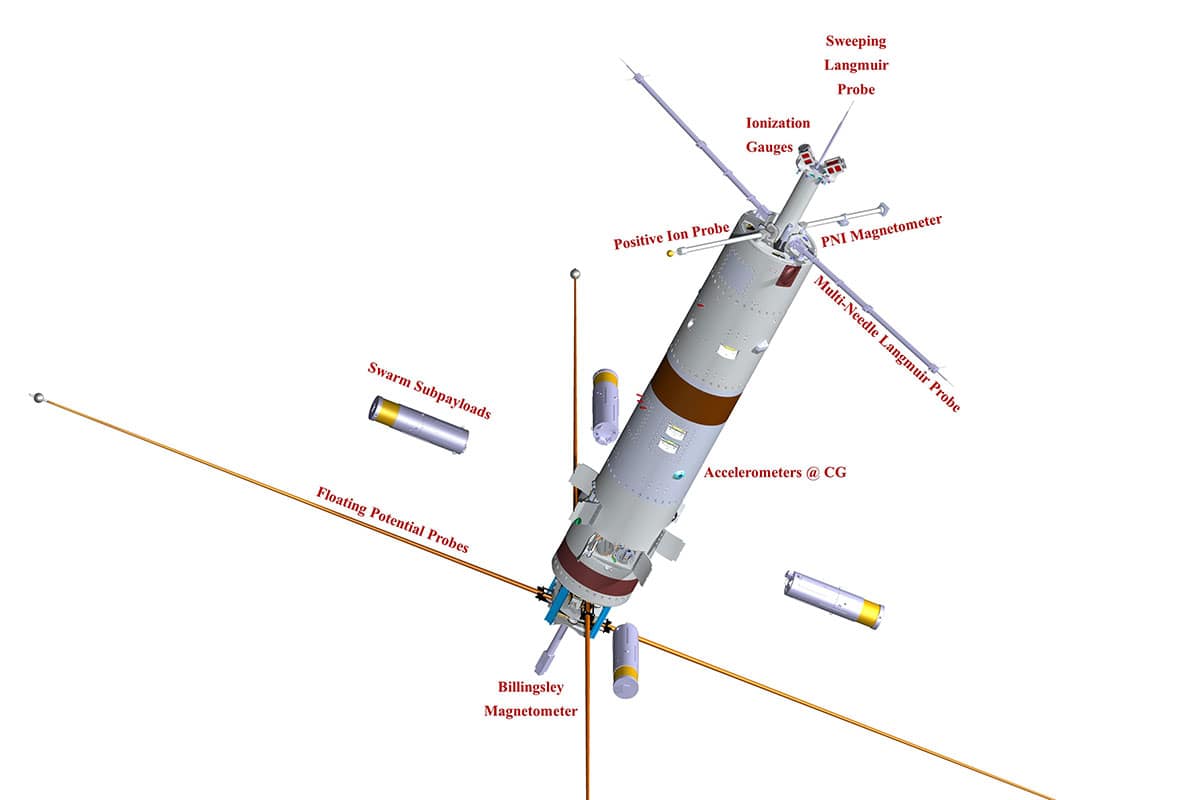
The SEED mission consists of two comprehensively instrumented rockets, which will be launched on two separate nights, from Kwajalein Atoll in the Marshall Islands, during the summer of 2025. The figure below presents a conceptual diagram of the payload with a conceptual layout for the proposed instrumentation (Note: TMA payload that will separate along with rocket motor is not shown). Under the nose cone, there is one fixed boom for a Sweeping Langmuir Probe (SLP) and four folding deployed booms that will have two sets of multi-needle fixed bias DC Langmuir Probes (mNLP), a Positive Ion Probe (PIP) and a pair of magnetometers from PNI Sensors Corp. Under the aft skirt will be four telescoping stacer booms for the floating potential measurements (FPP), as well as a Billingsley Ultra Miniature Flight Magnetometer at the end of a fixed boom. The two sets of 180 degrees opposite FPP booms then consist of a typical double probe electric field measurement while each of the four also gives payload-charging measurements.
Categories: Faculty-Staff
-
Incorporating ANSYS Simulation Tools Into Engineering Programs at Embry-Riddle Aeronautical University
PI Fady Barsoum
CO-I Arka Das
CO-I Heidi Steinhauer
CO-I William Engblom
CO-I Chad Rohrbacher
This project aims to introduce and implement ANSYS computer modeling and simulation tools into the Engineering Programs at Embry-Riddle.
This project aims to introduce and implement ANSYS computer modeling and simulation tools into the Engineering Programs at Embry-Riddle. Utilizing ANSYS in the undergraduate curriculum significantly enhances learning outcomes. It allows students to visualize complex physical phenomena, providing clarity on theoretical concepts. Additionally, hands-on experience with the software aligns students with industry standards, preparing them for future careers. Project-based learning fosters essential problem-solving skills. Finally, interactive simulations boost student engagement, making engineering topics more appealing.
Categories: Faculty-Staff
11-20 of 232 results