

- Category
- Impact
- Date
- February 4, 2026
Hello! My name is Tatiana Gomez, and I am a senior Forensic Biology student at Embry‑Riddle Aeronautical University in Prescott, Arizona. This summer, I had the incredible opportunity to intern in the forensic toxicology program at the Center for Forensic Science Research & Education (CFSRE). This experience further confirmed my passion for toxicology and shaped my career goals. Through a mix of mock casework and thorough practice, I gained firsthand exposure to all aspects of the lab, ranging from chain of custody and analytical workflows to data review, report writing and even courtroom-style testimony.
Practicing Lab Techniques and Using Advanced Instruments
One of the most exciting parts of my internship was learning more techniques commonly used in the lab, such as solid‑phase extraction (SPE) and liquid-liquid extraction (LLE), which are commonly used in sample preparation. I also had access to cutting-edge instrumentation, including the liquid chromatography–quadrupole time‑of‑flight mass spectrometer (LC-QTOF), liquid chromatography tandem mass spectrometry (LC/MS/MS) and gas chromatography mass spectrometry (GC/MS). These instruments allow for the screening, identification and confirmation of thousands of compounds.
Seeing the Bigger Picture Beyond the Lab
Throughout my internship, we also visited the Armed Forces DNA Identification Laboratory (AFDIL) and listened to talks from industry professionals, gaining insights into forensic workflows, interdisciplinary collaboration and advances in the field. These experiences were invaluable in expanding my understanding of toxicology beyond the lab.
Confirming a Career Path in Forensic Toxicology
Overall, this internship confirmed my interest and passion for forensic toxicology. The hands‑on training, exposure to real‑world casework and access to advanced instrumentation solidified my desire to remain in this field.
While at Embry‑Riddle, the toxicology and instrumental analysis courses prepared me best for this internship, primarily by teaching how to use the instrumentation as well as terminology and testing methods used in forensic toxicology. I’m now committed to pursuing a career in a crime lab toxicology unit where I can contribute meaningfully to investigations and continue growing as a forensic scientist.
Forensic Biology in Action
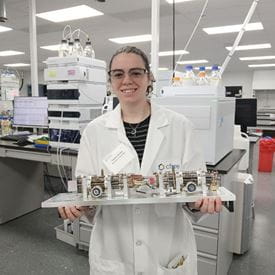
Tatiana Gomez puts her training into action as she works with a quadrupole component from an LC/MS/MS instrument during her toxicology internship at the Center for Forensic Science Research & Education. The hands-on lab experience strengthened the connection between her coursework and real-world forensic workflows, showing her how classroom knowledge translates directly into advanced analytical techniques.
At Embry‑Riddle, the B.S. in Forensic Biology program emphasizes applied science and experiential learning, equipping students with the confidence and technical skills needed to transition seamlessly from the classroom to professional forensic laboratories.
Related Stories


