


Diving into Space and Engineering Physics with Dori Stein

Amelia Stutsman
When considering her future after high school, Dori Stein (’27) envisioned a career where she could combine her love for space with her aptitude for math and engineering.
“When I was researching schools that matched my interests and long-term goals in the space field, Embry-Riddle stood out because of its industry connections and its strong reputation in aerospace and space-focused research,” she said.
Though Dori originally began her studies as an Astronomy and Astrophysics student, she eventually transferred to the Engineering Physics program with a minor in Astronomy and Astrophysics, hoping to focus more on the practical applications of the theory behind subjects like astronomy and astrophysics.
“Engineering Physics felt like the best bridge between deep physics and real engineering applications, especially because the program at Embry-Riddle is aligned with spacecraft systems, in addition to rockets,” she said.
Taking the Plunge
During the beginning of Dori’s time at Embry-Riddle, she joined the Sailing Club, serving as the public relations officer for two semesters.
“In that role, I worked on social media, outreach and networking, which helped me build communication skills and confidence connecting with new people, while also learning a sport I’d always wanted to try,” she shared.
She also took the initiative to present a research poster at Embry-Riddle's Discovery Day as a first-year student. Her research focused on gyrochronology, a method used to calculate a star’s age based on its rotation period and brightness variations.
“In simple terms, we use repeating brightness variations in a star’s light curve, often caused by starspots rotating in and out of view, to estimate how fast the star is rotating, and that rotation can be used as a proxy for age in certain stellar populations,” she explained.
“What drew me to this topic was the novelty and the idea that something as ‘small’ as extracting rotation from light curves can contribute to the bigger picture of how we date stars and understand stellar evolution.”
Research Across the Disciplines
At the beginning of 2025, Dori took on a research position at Embry-Riddle's Laboratory for Solar-Magnetosphere-Ionosphere Research (LASMIR), where she worked alongside a Ph.D. student to analyze extremely- and very-low frequency (ELF/VLF) whistler-mode wave data, or natural electromagnetic emissions in planets’ magnetospheres.
“Working at LASMIR was an important introduction to space physics research and helped me deepen my data analysis toolkit while becoming more comfortable in an academic research environment,” she said.
This research also led to professional opportunities. Dori attended the Polar Aeronomy and Radio Science (PARS) Summer School in Alaska, which included work at the High Frequency Active Auroral Research Program (HAARP).
She also had the opportunity to present research at the International Union of Radio Science’s annual National Radio Science Meeting in Colorado.
“These experiences made the space physics community feel real, accessible and incredibly tight-knit,” she shared.
Wanting to focus on engineering in addition to space physics, Dori also joined the Space Technologies Laboratory (STL) in early 2025, where she has assisted with “plate solving and distortion correction for star tracking in wide field-of-view imagery” for EagleCam 2.0, a miniature satellite whose predecessor became the first university student-built payload on the lunar surface.
“These experiences showed me that physics and engineering truly go hand-in-hand. Physics gives the foundation, but I’m most intrigued by the tangible, creative, hands-on side of building and improving systems. That’s why I’m intentionally leaning more toward engineering-focused work moving forward.”
One Step Closer to Space
Last semester, Dori joined the Advanced Space Technologies Research and Applications (ASTRA) Lab, contributing to the NASA Human Lander Challenge (HuLC). Teams participating in the 2026 HuLC are tasked with developing solutions to improve Environmental Control Life Support System (ECLSS) performance.
“This project is strengthening my engineering design mindset, working within constraints, thinking about usability and reliability in a space environment and collaborating as part of a team that’s building toward a real deliverable,” she said.
Through the Daytona Beach Campus’s Department of Civil Engineering, Dori also got involved with a SpaceX-affiliated research project that intends to determine and mitigate any impacts of rocket emissions on air quality in Cape Canaveral, Florida.
“Together, these new roles reflect exactly where I’m heading: applying technical skills to real-world aerospace problems, building engineering experience and contributing to projects that connect spaceflight activity to measurable, practical outcomes,” she said.


A Path Forward
Throughout her time at Embry-Riddle, Dori has been driven by her future goals of working in the space industry and her passion for discovery. Extracurricular experiences have also had a major impact — preparing her for the future and giving her insights into industry experience.
“I’ve also been fortunate to learn from mentors, graduate students and faculty who have helped guide me early in my career,” she shared. “Being surrounded by people who take their work seriously has pushed me to raise my own standards and confidence.”
After earning her degree, Dori hopes to work in a role where she can create solutions for spacecraft systems, space technology or applied space research — with an engineering focus.
“I’m also open to pursuing a master’s degree in a higher engineering discipline, such as Mechanical Engineering or Aerospace Engineering, depending on what opportunities and interests are strongest at that point,” she said. “Ultimately, I want to keep building experience that puts me on a path toward meaningful work in the space industry.”
“My best advice is to keep your eye on your end goal, especially during the moments when school feels difficult or overwhelming,” she said. “At the same time, try to stay present and enjoy the journey because the experiences, people and lessons you collect along the way matter just as much as the destination. Be willing to say yes to opportunities even if they feel intimidating at first, because that’s often where the biggest growth happens.”
Insights
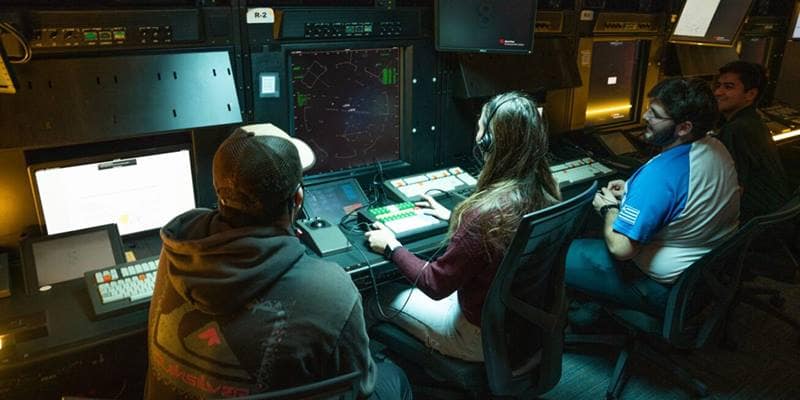 Worldwide College of Aviation Associate Professor Dr. Linda Vee Weiland shares insights and knowledge on the air traffic industry.
How to Become an Air Traffic Controller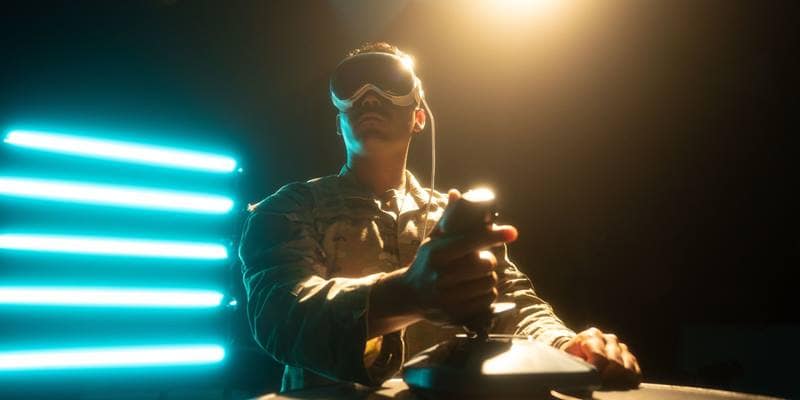 Explore human factors psychology, a field that blends psychology, engineering and design to improve safety, efficiency and user experience.
What is Human Factors Psychology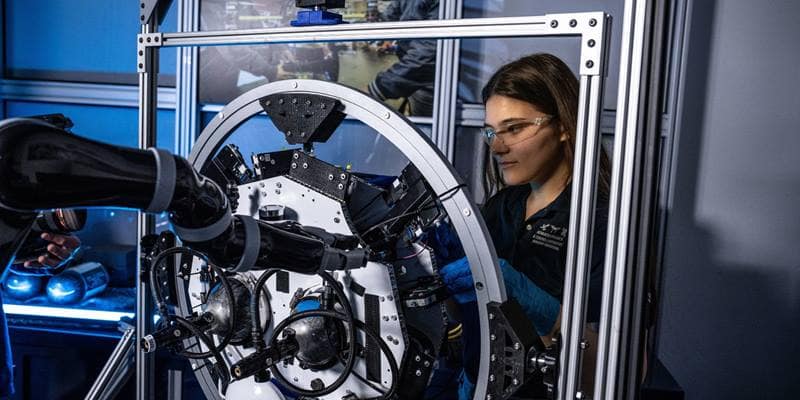 Learn how to become an aerospace engineer at Embry-Riddle Aeronautical University. Discover diverse careers, hands-on experiences and specializations in the aerospace industry.
How to Become an Aerospace Engineer
