


Embry-Riddle Alumna Advocates for Microgravity Research

Christina Lewandowski
Space for Teachers Launches Groundbreaking Research
Space for Teachers is an organization that supports teachers seeking a deeper understanding of space research. They enable teachers to develop experiments with their students, participate in microgravity research and bring their experiences back to the classroom.
Shay guided teachers through payload (on-board cargo or equipment intended for a specific purpose) design, flight operation preparedness and safety requirements.
“It was incredibly rewarding to see classroom concepts turn into real flight experiments that teachers could bring back to inspire students,” she shared.
Shay shared additional insights from Space for Teachers CEO Laura Tomlin.
“Microgravity research flights truly have a profound impact on both educators and students. For Space for Teachers, the flight is the culmination of a full year spent working alongside mentors through technical reviews, design revisions, problem solving and setbacks, all leading to the moment when a teacher tests student-built work in microgravity,” Laura said. “Throughout that process, teachers and students share the challenges and successes together, and the experience becomes an important lesson in scientific research, engineering and perseverance.
“One of the most valuable lessons for both teachers and students is the authenticity of the work: Research does not always go as planned. It requires preparation, problem solving under pressure and learning to rely on a team.”
Diligence and a willingness to pivot are both values that have played a key role in Space for Teachers’ story as well as Shay’s professional advancement.
“My education directly translated into my first role in the industry,” Shay explained. While she could not have imagined all she would accomplish so soon in her career, her education has already molded career-defining moments.
The Path to Space Operations
Shay had maintained a childhood interest in aerospace by the time Embry-Riddle came on her radar. After attending an information session and having a one-on-one conversation with a university rep, she knew it was the place to pursue her passion.
“By the end of that conversation, I was completely sold — not just on Embry-Riddle, but specifically on Daytona Beach,” she said. “Looking back, that moment shaped the entire direction of my education and career.”
Originally an Aerospace Engineering major, Shay found a closer fit with Spaceflight Operations (now Space Operations).
"It allowed me to develop a broad understanding of space systems and become well-versed in space operations, which directly prepared me for cross-functional roles in the industry.”
Upon receiving her bachelor’s degree, Shay decided to pursue an M.S. in Aviation with a specialization in Space Studies.
Coursework that Translates to Career
The diverse coursework Shay interacted with grew increasingly relevant as she stepped into roles in the space industry.
“Courses like Human Factors, Payload Integration, Programming and Spaceflight Operations directly shaped my work at Zero-G,” she explained. “Aviation classes gave me insight into FAA regulations, improving [my] operational decision-making.”
Shay completed her master’s degree during her time at Zero-G, converting knowledge into application overnight.
“While completing my master’s, I often learned about parabolic flight in class and applied those concepts at work the very next day,” she said.
Her education would continue to influence the microgravity consulting business she would soon found, Reduced Gravity Solutions.


Bridging the Research Gap
Only five years after earning her first degree, Shay has expanded her interdisciplinary background and gained a unique perspective on the world of microgravity.
Alongside developing her business, Shay jumped into a new position earlier this year supporting NASA's Gateway Program. While broadening her operations expertise with government systems engineering processes, Shay continued identifying opportunities for increased microgravity research and was growing well-equipped to tackle them.
“I aim to expand Reduced Gravity Solutions into a global platform providing access to microgravity across multiple systems, including parabolic flight, drone-based platforms, drop towers and eventually suborbital opportunities.”
Access is a significant priority for Shay. Her goal is to “create a scalable ecosystem that makes microgravity research more accessible worldwide.”
Why Access to Microgravity Research Matters
Increasing access to microgravity goes beyond the research itself — for Shay, it is about inspiring future generations and striving for limitless human capability. Her work with programs like Space for Teachers is not limited to coordinating and hosting flights.
"I’ve also worked with AstroAccess, where individuals with disabilities experienced reduced gravity — moments like seeing someone in a wheelchair stand and move freely highlight its transformative potential.”
Shay reiterates how substantial early exposure to space education can be. She wants to bring her projects to the Embry-Riddle community, a nod to the symbiotic relationship her studies and work have had thus far.
“I’m working toward creating an education-led parabolic flight program that would allow Embry-Riddle students to gain this experience earlier in their careers.”
Shay is inspired by the prospect of increasing access for students early on and providing opportunities for refining intuition, which she believes is imperative for advancing space exploration.
Embry-Riddle's Lasting Influence
Leading Zero-G campaigns, building her business and everything in between illuminated the value of every class Shay took at Embry-Riddle. She credits her mentors for encouraging her to take the steps that formed the accomplished professional she is today.
“Beyond academics, mentors like Amy Deahl and Karin Gollin shaped my growth,” she shared. “They helped me step out of my comfort zone, build confidence and develop leadership skills while encouraging my creativity.”
Shifts, including switching majors and pivoting into new roles, meaningfully contributed to the success Shay has already experienced. She emphasizes that changing your mind can set you in the right direction.
“You do not have to have everything figured out right away. You will make mistakes and change directions — that’s part of the process,” she reiterates. “Follow what excites you and take full advantage of opportunities at Embry-Riddle.”
Related Stories
 UAS student Adrian Bates-Domingo's (‘22, ‘23) participation in Embry‑Riddle's summer programs gave him field experience he couldn’t get anywhere else.
Uncrewed Aircraft Systems (UAS): I Know What You Flew Last Summer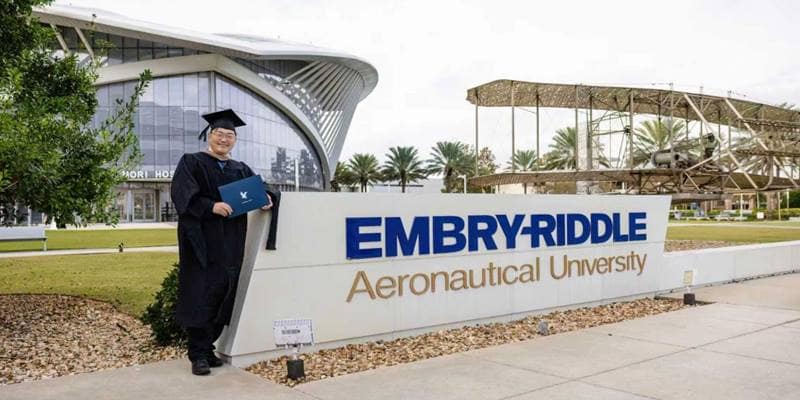 Qilong Guo (’25) left a leadership role to pursue Aviation Finance at Embry-Riddle, using ISTAT connections to build a global career bridging Asia and North America. His journey shows that reinvention is possible with the right mindset and courage.
Mid-Career Reset Leads to Aviation Finance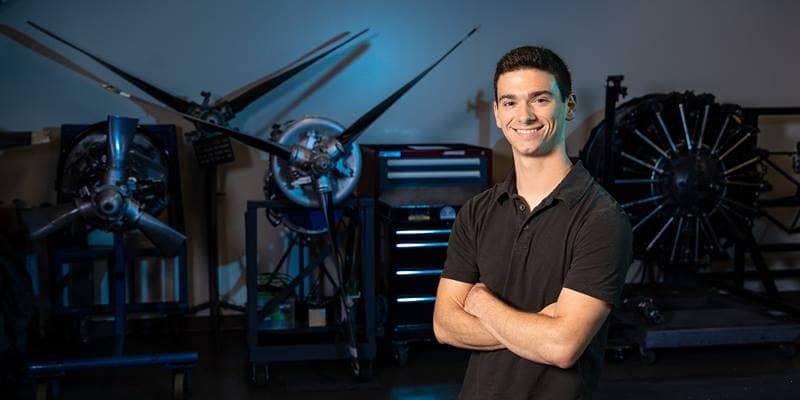 Nicolas Napoleoni’s Embry‑Riddle journey started on the flight deck and has moved to the hangar as part of the Aviation Maintenance Science program.
Aviation Maintenance Science Major Finds Embry-Riddle Offers Best of All Worlds
