
- Category
- Innovation
- Date
- December 22, 2025
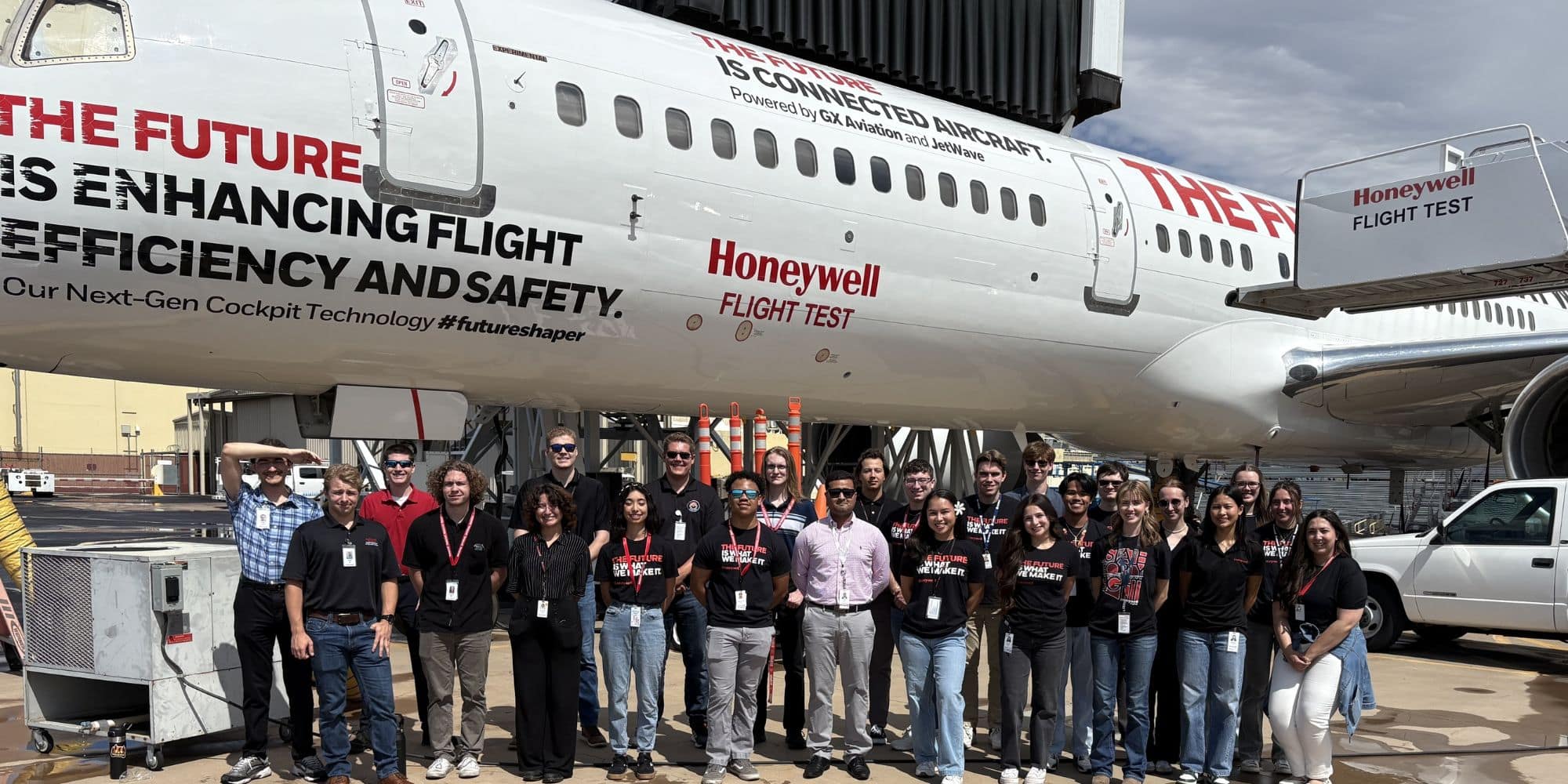
From May to July, students from the Daytona Beach and Prescott campuses worked on high-impact engineering projects, received one-on-one mentorship and participated in professional development events aimed at launching full-time careers.
The experience continues to facilitate a powerful pipeline for future aerospace leaders at Honeywell Aerospace from Embry‑Riddle Aeronautical University.
Among this year’s interns were Christopher Sorensen (’25), a senior in Aerospace Engineering at the Prescott Campus, Om Acharya (’27), a Daytona Beach Campus Aerospace Engineering student with a passion for artificial intelligence (AI), and Anise Romo (’26), a Mechanical Engineering major from the Prescott Campus focused on propulsion. Each brought unique goals and left with career-shaping experiences.
Om Acharya: Blending Engineering and AI
Acharya’s passion for software, electronics and AI, along with inspiration from Honeywell’s Anthem cockpit program, led him to the Retrofits, Modifications and Upgrades (RMU) Department. The RMU team supports both technical analysis and program management in support of aftermarket certification programs.
“I built risk registers, integrated schedules and digital dashboards,” he said. “I also created software configuration files, supported AI-related projects and developed tools using Python, Power BI and SmartSheets.”
Acharya led digital transformation initiatives and collaborated with cross-functional teams to improve the pipeline-to-execution process. One of his key accomplishments was introducing workflow automation, a blend of technical innovation and process improvement that had a real impact. This was followed by his development of an AI-powered concept, showing patent potential after collaboration with interns.


Anise Romo: Stepping Into the Unknown
Romo was just exploring at a career fair when she thought to explore opportunities with Honeywell.
“My friend Nicola interned the year before and spoke highly of the avionics program, so I decided to follow his lead,” she said. “I also wanted to stay close to family, and Honeywell had a strong presence in Arizona.”
Romo was placed on the Honeywell Anthem program, Honeywell’s next-generation integrated flight deck system designed to redefine flight with its always-on, always-connected experience that enhances flight efficiency, operations, safety and comfort.
As a systems engineer on the Aircraft State team, Romo’s day-to-day work included debugging test benches, reviewing Simulink models and writing code to test requirements like velocity, GPS data and altitude.
Though her background is in mechanical engineering, Romo quickly adapted to a software-heavy team.
“School gives you technical knowledge, but what really matters is being a good engineer,” she said. “Soft skills like resilience, curiosity and hard work go a long way. I didn’t have a software background, but I asked a lot of questions and learned fast.”

Christopher Sorensen: A Career-Defining Experience
For Sorensen, the internship was more than a summer job — it was a launchpad. He has already received a job offer from Honeywell as a systems engineer and plans to start after graduation.
Back for his second summer as an intern on Boeing’s Flight Management Systems team, Sorensen performed hands-on lab testing to verify FMS requirements and test procedures for the Boeing 777x, 777-8F and 787. He also automated the test procedure process within the software language itself.
“I shadowed meetings, spoke with project directors and learned about different career paths at Honeywell, from technical roles to leadership and management,” he said. “It helped me understand how large programs come together.”
Sorensen expressed deep appreciation to Honeywell for the opportunity, saying he wouldn’t be where he is today without the company’s support.
A Culture of Mentorship and Mobility
Interns said Honeywell’s culture of mentorship and open access to leadership were among the most valuable aspects of the program.
“The mentorship component was huge,” Sorensen said. “Having someone to talk through goals with and get a sense of how they navigated their career at Honeywell really helped shape my own direction.”
Acharya agreed. “Being surrounded by professionals who were willing to share their experiences inspired me to keep pushing myself,” he said. “I’ve adopted a ‘forever learning’ mindset, one that reminds me growth never stops.”
Interns also connected with Embry‑Riddle alumni now working at Honeywell, including a networking lunch hosted by Ken Hurt, vice president, Honeywell Anthem Program.“The alumni panel was one of my favorite parts,” Sorensen said. “Seeing how recent graduates like Drew Yoshida have progressed made it feel more attainable. There’s an instant connection when you share that Embry‑Riddle background.”
A Company That Invests in People
Across the board, students expressed appreciation for Honeywell’s investment in early-career talent and emphasis on cross-functional collaboration and internal mobility.
“One of the biggest takeaways for me was seeing how interconnected all the roles are,” said Sorensen. “You may start in one area but end up somewhere completely different. Honeywell’s size gives you the freedom to find the right fit.”
Acharya added, “Beyond the technical work, I appreciated learning from senior engineers and program managers who were genuinely invested in our growth.”
Advice for Future Interns
Looking ahead, the interns offered practical advice for students preparing for career fairs or applying to internships.
“Recruiters are people too,” Romo said. “Yes, a strong resume matters, but so does your personality. Networking and being genuine go a lot further than people think.
Acharya emphasized the importance of adaptability and communication.
“Success in engineering isn’t just about technical ability,” he said. “It’s also about systems thinking, communication and staying open to new ideas.”As these students return to campus or transition into full-time roles, their summer at Honeywell stands as a testament to the company’s commitment to growing future aerospace leaders and to the strength of Embry‑Riddle’s industry connections.
Related Stories


