Displaying 121-132 of 177 Results

NASA and Embry‑Riddle researchers recently posed with three sounding rockets that are part of the APEP (Atmospheric Perturbations around Eclipse Path) mission. Lead researcher Dr. Aroh Barjatya is at the top left. (Photo: NASA/Berit Bland)
Embry‑Riddle Researchers to Launch Rockets Into Solar Eclipse as Part of NASA Mission
Drs. Aroh Barjatya (left) of Embry‑Riddle’s Space and Atmospheric Instrumentation Laboratory and Wenjun Dong of the Center for Space and Atmospheric Research recently received major research grants focused on advancing our understanding of space. Drs. Samantha Wallace and Robert Clayton also received NASA awards.
Four New Research Grants to Help Solve Key Mysteries of Space
A view of Earth from space with a lunar lander in the foreground, showing structural components and instruments against a black background.
Embry‑Riddle Celebrates Historic Moon Landing
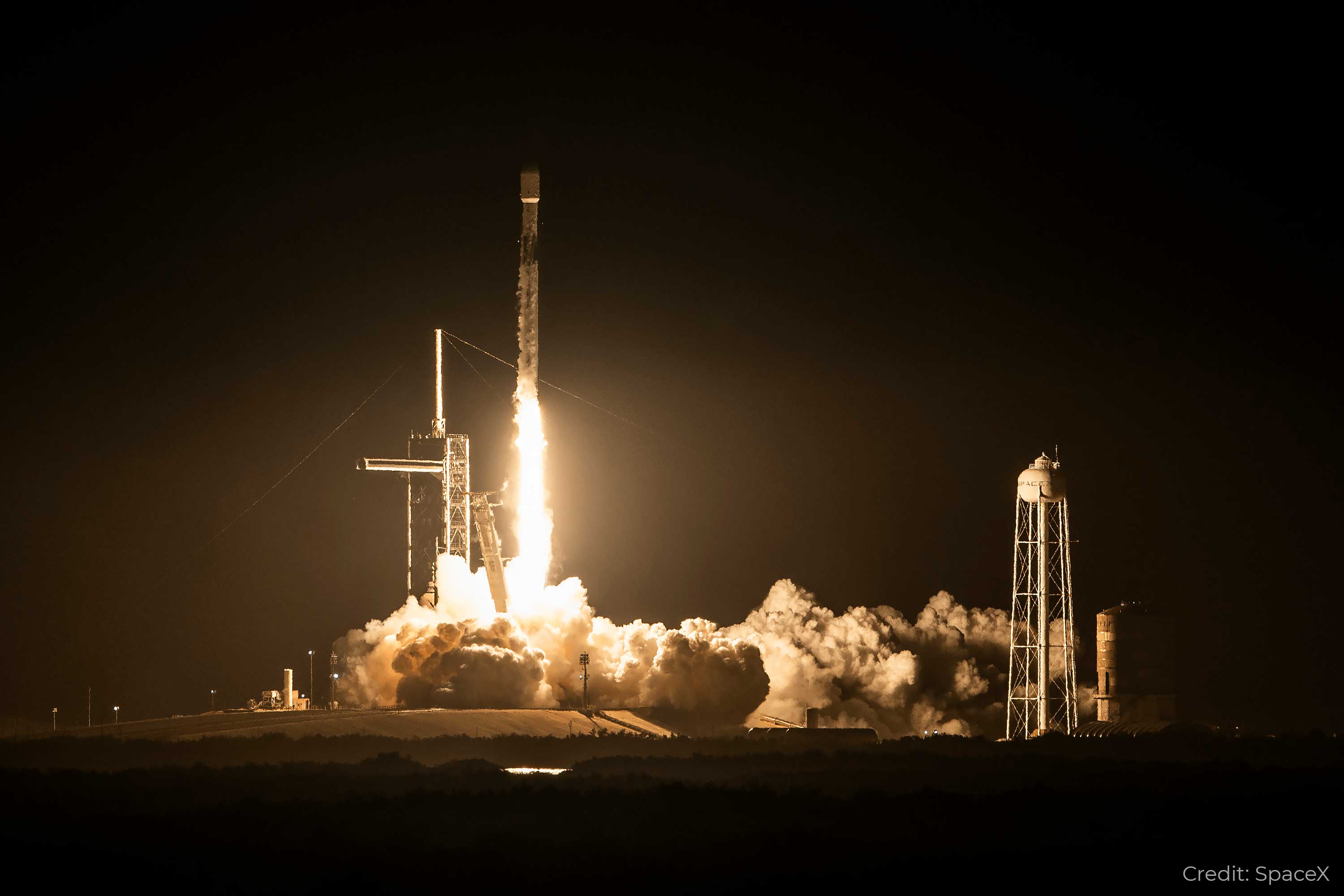
The Intuitive Machines (IM)-1 mission launched at 1:05 a.m. Thursday, Feb. 15, 2024, from NASA’s Kennedy Space Center, in Florida, with hardware built entirely by Embry‑Riddle students onboard. (Photo: SpaceX)
We Have Liftoff! EagleCam Successfully Launches Into Space, Bound for the Moon
Intuitive Machines’ Nova-C Lunar Lander will carry Embry‑Riddle’s EagleCam CubeSat aboard on its upcoming mission to the moon. (Photo: Intuitive Machines)
Launch Imminent: SpaceX Mission to the Moon Will Have Embry‑Riddle Payload Onboard
The new 20-inch telescope on Embry‑Riddle's Prescott Campus recently captured an image of the Horsehead Nebula. Lit up by a belt star of Orion, the dark cloud resembling a horse's head is a place where stars are forming. Color was artificially added for contrast. (Photo: Noel Richardson)
Students Teaching Students: How to Study the Stars
Student research assistant Isaac Kay (left) prepares for an experiment to simulate microgravity at Embry‑Riddle, as test subject James Palmer, has his harness tightened by Dr. Christine Walck, and student data analyst Megan Parker stands by. (Photo: Embry‑Riddle/David Massey)
Embry‑Riddle Researchers Work to Improve Astronauts’ Ocular Health
Three college students stand in front of building.
Micro Drones, Autonomous Composting Bins and Mixed-Reality Gaming Top Embry-Riddle’s Annual Entrepreneurship Expo
Embry‑Riddle Aeronautical University’s ninth-annual TREP Expo presented its first Veteran Entrepreneurs Award to Limitless Aeronautics for the company’s micro uncrewed air vehicle (UAV) swarm system, Nov. 16 on the Daytona Beach Campus.
Embry-Riddle professors stand back to back in front of a building framed by palm trees.
Research Park Tenant ‘SpaceLoon’ Aims High
The startup company is exploring a balloon-based concept intended to achieve more efficient, cost-effective capture of data from the mesosphere.
10 students stand on a green athletic field with desert mountains and stormy skies in the background.
Eagles Selected by NASA to Fly Weather Balloons During Solar Eclipses
Using weather balloons, undergraduate students at Embry‑Riddle Aeronautical University’s Prescott, Arizona, campus will capture real-time data during a partial solar eclipse.
Dr. Jeremy Riousset headshot.
Embry-Riddle Researchers Study Lightning Effects on Mars
Backed by an NSF CAREER grant of $676,000, Dr. Jeremy Riousset, assistant professor in Embry‑Riddle Aeronautical University’s Physical Sciences Department, studies atmospheric electricity on Mars, which has implications for the safety of missions to the planet and even on the search for extraterrestrial life.
Three students stand in front of whiteboard.
Professor Brings Rare Astrophysics Research Opportunities to Eagles
As a young girl, Dr. Pragati Pradhan used to point out different planets and constellations in the night sky to her mother from their terrace in Darjeeling, India, high up in the Himalayas.