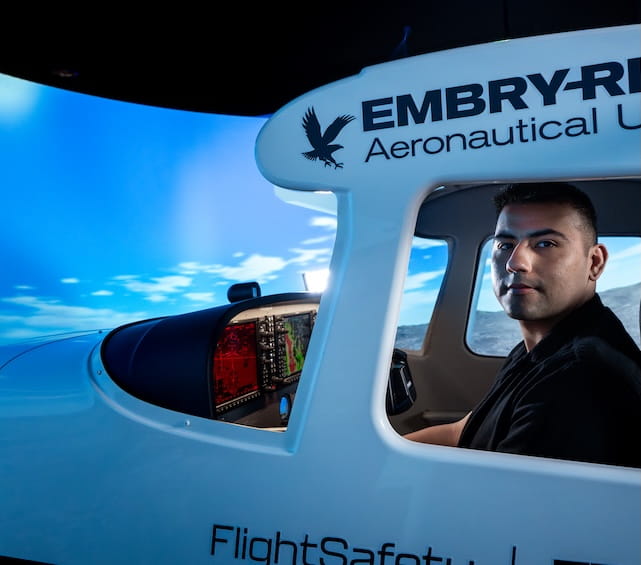
The Prescott Department of Flight serves as the immersive, real-world laboratory for the Aeronautical Science program at Embry-Riddle’s Prescott Campus. This is where textbook theory becomes proficiency — where students take to the skies and develop the judgment, precision and command presence that define great aviators.
Operating from three independent parking and dispatch facilities at Prescott Regional Airport, the department holds safety, excellence and professionalism as core values. The new, state-of-the-art ramp and dispatch operation further elevates an already exceptional training environment.
Under the guidance of a distinguished team of faculty and instructor pilots — professionals who bring extensive industry experience to every flight — students master the technical skills and aeronautical judgment needed to succeed in any aviation career.
Excellence Takes Flight
The Department of Flight offers structured, FAA Part 141 pilot training in one of the most demanding and rewarding flight environments in the country — high altitude, diverse terrain and year-round flying weather that builds pilots of exceptional skill.
Immersive Labs
Aeronautical Science students train with professional-grade tools, including advanced simulators for emergency and complex flight practice. With modern maintenance hangars and direct access to Prescott Regional Airport, the program offers an immersive, career-focused environment.
Embry-Riddle’s Golden Eagles Flight Team is a nationally recognized championship program, earning 38 straight regional titles and 16 national championships. More than 30 student pilots train and compete in NIFA SAFECON events, building elite skills, teamwork and aviation excellence.
Eagle Lands Scholarship Through Participation in Women in Aviation Groups
Discover how getting involved can open doors. One Prescott flight student turned her participation in Women in Aviation groups into a major Boeing scholarship—gaining mentorship, industry connections and real momentum toward her pilot career.
Embry-Riddle's Prescott Flight Department operates seven days a week, closing only for the short break between Christmas and New Year's Day. Normal hours of operation are 5:30 a.m. to 11:30 p.m.
Embry-Riddle is one of the largest aviation training universities in the nation, and the Prescott campus sits inside roughly 5,000 square miles of uncongested airspace. Our local practice area reaches as far north as the mountains in Flagstaff, east toward Sedona and south into the Bradshaw Mountains, giving students more room to work without waiting in line.
During cross-country training, our students can fly anywhere from the Southern California coast to the beautiful national parks of Utah and as far east as the mountains in Durango, Colorado.
Our fleet is equipped with the same avionics and flight instrumentation found in today's airliners. Supporting that is a variety of flight training devices that let students experience the hard stuff before they fly it for real, including: full-motion Frasca simulators for both the Cessna 172 and the DA42, and a variety of free resources students can book on their own time, including Redbird trainers, VR simulators and procedure trainers. With new aircraft constantly flowing into the program, students have access to the newest and safest equipment.
Department Location
The Flight Department is located on the edge of Prescott Regional Airport (Ernest A. Love Field). It's a short 10-minute drive from campus, and free shuttle service running frequently to get students where they need to go.
Operating out of two dispatch facilities on the field allows Embry-Riddle to support hundreds of daily launches and recoveries efficiently. Prescott is an air traffic-controlled field with three runways and a mix of traffic that includes flight training aircraft, helicopters, business jets and scheduled airline service. Students learn to work with air traffic control from their first flight.
Then, there is the environment itself. With 277-plus days of sunshine a year, our students spend more time in the air and less time grounded waiting for weather to clear. It doesn't hurt that the view out the window is one of the best in the country, the red rocks of Sedona off to the east, the San Francisco Peaks on the horizon and the Grand Canyon less than an hour away. Because the field sits at 5,045 feet, our students learn real performance planning and mountain flying as a matter of routine, not as an add-on course. Graduates leave Prescott already comfortable with the kind of terrain.
Professional and Commercial Airline-Style Approach
Flight students at Embry-Riddle fly an airline-style training program from day one. The structured system teaches each student the importance of thorough preflight preparation, safety-minded flight operations and a rigorous academic approach to understanding the theory and principles that make flight possible.
Students aren't passengers in this process. They plan, brief, debrief and hold each other to the same professional standard the airlines expect, and that habit is what carries them forward. Each of our graduates is fully prepared for the airline environment because they've been living it for the last four years.
Nothing is more satisfying than taking novice flight students and turning them into commercial pilots who are ready for the airlines. We look forward to each new class and to demonstrating why Embry-Riddle has put more pilots in the cockpits of major airlines than any other flight school in the country.
The Prescott Flight Department develops aviation professionals through safe, student-centered flight education that prepares graduates to lead and serve the aviation industry. We are committed to student success by exercising responsible stewardship of our people and resources, fostering a culture of teamwork and professionalism, and pursuing continuous improvement in every aspect of our training and operations.
We accomplish this mission by:
Prioritizing safety as the foundation of every flight and learning experience.
Providing high-quality, student-centered instruction that develops technical competence, sound judgment and leadership.
Building a collaborative culture among students, faculty and staff that values professionalism, respect and shared accountability.
Continuously improving our curriculum, operations and instructional practices through assessment, innovation and industry best practices.
Partnering with industry and government to expand educational, research and career opportunities for our students.
Preparing graduates to serve with integrity and professionalism in commercial, military, corporate and emerging aviation sectors.
Exercising responsible stewardship of aircraft, facilities, technology and financial resources.
Yes. Embry-Riddle students and immediate family members are permitted to observe any flight training activity. Any person participating in a training flight must be in proper attire — long pants, shirt with sleeves, socks and closed-toe shoes. Check in at the flight desk and inform the dispatcher that you wish to observe a training flight.
Student parking is available at the Flight Department, and for those without a car, shuttle service runs from campus to the Flight Department at regular intervals during peak hours. The shuttle is also available on-call during nights, weekends and holidays when the Flight Department remains open.
Yes. You are required to have a headset, electronic flight computer, iPad and a flashlight. These items may be acquired through the Embry-Riddle Bookstore or other commercial sources.
Private Pilot (FA 121) Training Start Dates
At Embry-Riddle, students are phased into our training at different start dates for capacity and safety reasons. Training start dates are assigned on a first come, first served basis depending on your matriculation date to the university. You can identify your start date by looking at your flight block registration (FA 95S). Each section will line up with the start date listed in the chart below (based on the semester you are registered for):
FA 95S Sections
Semester
50, 51 & 53
60, 61 & 63
70 & 71
80 & 81
Fall Semester Start Date
Week 1
Week 5
Week 9
Week 13
Spring Semester Start Date
Week 1
Week 5
Week 9
Week 13
Summer A Start Date
Week 1
Summer B Start Date
Week 1
Week 5
Start dates for instruments occur on a first come, first served basis as well. However, students are assigned daily as room in the flight block section (FA 95I) permits.
The flight courses required for graduation (up to Commercial Pilot Multi-Engine) are designed to be completed by the end of the junior year. If you are highly motivated and available to fly or stay through summer breaks, you can easily finish in less time if you put forth the time and effort.
When you register for classes, you will choose a flight block consisting of three hours when you have no other classes Monday through Sunday each week. You can expect to be scheduled for a mixture of activities for a minimum of three days a week within that flight block. Activities may be ground orals, simulators or flight depending on your progress through the course. You may be scheduled for extra activities in a week if your instructor has extra time and resources are available.
Yes. For safety reasons, any person occupying Embry-Riddle aircraft must wear long pants, a shirt with at least short sleeves (NO shirts with cutoff sleeves or sleeveless shirts), socks and closed-toe shoes.
After you finish your Commercial Pilot Multi-Engine course, you may enroll in a Certificated Flight Instructor (CFI) course for issuance of CFI Airplane and CFI Instrument certificates. We also offer Extreme Attitude Recovery Training (XART) in our fully aerobatic American Champion Super Decathlon aircraft. XART training is growing in the industry as a way of training pilots to recover aircraft from extreme attitudes that may result from aircraft malfunctions or bad weather.
Students who are not well enough to fly must call or report to the Health Services on campus to have themselves medically grounded at least 30 minutes prior to the activity start time for the absence to be excused. Students must also report to Health Services to be cleared when they are feeling better and ready to fly. Students may be only restricted from flying in cases where they are well enough to do ground activities but not safe enough to fly. After two medically excused absences in a semester, a student will be required to present a doctor's note to a training manager to be excused.
If you come to Embry-Riddle with a Private Pilot Certificate you’ll be enrolled in a transition course to familiarize you with the area, our aircraft and our operations to ensure that you can meet the same standards as a student who just finished getting their certificate from Embry-Riddle.
We know that every student who gets their certificate before they come to Embry-Riddle has flown under differing circumstances than those at Embry-Riddle. Our goal is to try to ensure that as you move on to other advanced courses, you have the same knowledge as any other student going into that course. The training time in the transition course also counts toward the FAA minimums for issuance of a Commercial Pilot Certificate.
The Embry‑Riddle Prescott Flight Department allows owners of private aircraft to park on the Riddle Ramp with prior permission only. If you are interested in parking on the Riddle Ramp, please email details regarding your request. Requests are not guaranteed and may be approved dependent on available ramp space.
During flight check in, students should inform the Embry-Riddle representative that they have previous flight experience. At that time, an appointment will be scheduled with the Chief Instructor or his representative to review the students' logbook and determine which ground and flight course the student will be placed in.
If the student has already been endorsed for a check ride and has an endorsement in their logbook, they may petition the flight department chair for permission to train elsewhere and complete their check ride. Students must have prior written permission for this option.
Students are expected to stay and fly their first summer to complete their initial certificate or rating. Students are encouraged to fly during school breaks.