
Displaying 133-144 of 182 Results

Polaris Dawn Crew Meets Eagles, Inspects Camera System to Use in 2024 Space Mission
While engineering a camera to capture a spacewalk, notoriously one of the most dangerous feats carried out by astronauts, a team of Embry-Riddle Aeronautical University students focused on a single button.
October 16, 2023

Eagles Selected by NASA to Fly Weather Balloons During Solar Eclipses
Using weather balloons, undergraduate students at Embry‑Riddle Aeronautical University’s Prescott, Arizona, campus will capture real-time data during a partial solar eclipse.
October 13, 2023

Embry-Riddle Researchers Study Lightning Effects on Mars
Backed by an NSF CAREER grant of $676,000, Dr. Jeremy Riousset, assistant professor in Embry‑Riddle Aeronautical University’s Physical Sciences Department, studies atmospheric electricity on Mars, which has implications for the safety of missions to the planet and even on the search for extraterrestrial life.
September 25, 2023

Professor Brings Rare Astrophysics Research Opportunities to Eagles
As a young girl, Dr. Pragati Pradhan used to point out different planets and constellations in the night sky to her mother from their terrace in Darjeeling, India, high up in the Himalayas.
September 13, 2023

Eagles Gain Real-World Experience Pitching Space Innovation to NASA Pros
A group of students from across Embry‑Riddle Aeronautical University’s three campuses was recently chosen as one of only 15 teams from around the world to present space innovations at NASA’s annual Revolutionary Aerospace Systems Concepts – Academic Linkage (RASC-AL) competition.
August 21, 2023

Three Eagles Earn Fellowships to Contribute to NASA's Artemis Mission
NASA’s Artemis program, which will send humans to the moon for the first time since the Apollo days, will land the first woman and the first person of color onto the lunar surface, equipping them with innovative technologies to explore and discover more than any astronaut has before. But NASA won’t do it alone.
August 10, 2023

Six Eagles Earn Department of State Scholarships to Study Abroad, ‘Make a Difference’
Six Embry‑Riddle students have been selected this year to receive Gilman Scholarships, which will fund opportunities for them to study internationally.
August 8, 2023

Embry-Riddle Breaks Ground on New Eagle Learning Complex
Community leaders and elected officials on July 11 joined Embry‑Riddle Aeronautical University’s Dr. Anette Karlsson, chancellor of the Prescott, Arizona campus, in breaking ground for an advanced learning complex designed to prepare future innovation leaders.
July 12, 2023

Embry-Riddle Researchers Awarded Nearly $2 Million in NASA, NSF Grants
Embry‑Riddle researchers, led by Katariina Nykyri, have been awarded a total of $1.48 million in grants from NASA ($992,000) and the National Science Foundation (NSF: $485,000) to study space phenomena that can harm technological systems and even threaten human health.
June 26, 2023

Eagles Earn ‘Life-Changing’ Scholarships to Pursue Careers in Tech
For recent Embry‑Riddle Aeronautical University graduate Hannah Hodge, scholarship funding is a game-changer.
June 12, 2023

Air Force Grant Propels Eagle Efforts to Test Robotic Arm for In-Space Servicing and Assembly
Researchers at Embry‑Riddle Aeronautical University recently received $450,000 to participate in an Air Force Small Business Innovation Research project with ControlX Engineering. The goal: Optimize and test a space vehicle with a robotic arm capable of performing in-space servicing, assembly and manufacturing (ISAM) on spacecraft.
June 12, 2023
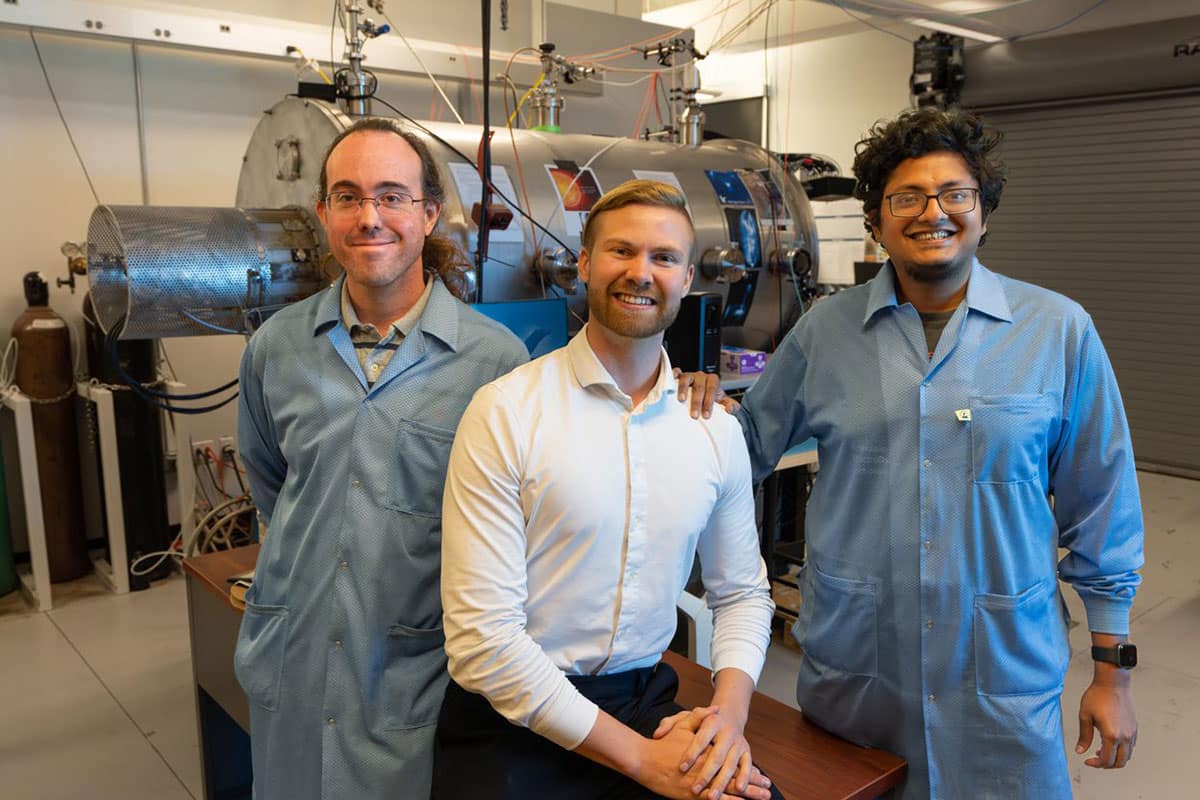
Embry-Riddle Earns $2.25 Million in NASA Funding to Build New Space Instruments and Conduct Space Weather Research
Researchers in Embry-Riddle Aeronautical University's Space and Atmospheric Instrumentation Lab (SAIL) have been selected to receive a combined $2.25 million across two NASA grants.
May 23, 2023