

- Category
- Engineering
- Date
- August 31, 2026
The National Science Foundation (NSF) has awarded Embry-Riddle Aeronautical University faculty member Dr. Omar Ochoa a nearly $500,000 grant to direct undergraduate students interested in researching the use of AI in safety-critical systems, such as aviation, transportation and healthcare.
“As AI becomes more integrated into these systems, there is a growing national need for a workforce prepared to develop safe, dependable and responsible technologies,” said Ochoa, associate professor and program coordinator in the Department of Electrical Engineering and Computer Science.
The program is part of NSF’s Research Experiences for Undergraduates (REU), which funds opportunities for undergraduate students to conduct research in science and engineering alongside faculty mentors during the summer months. Ochoa said the most valuable aspect of the program is that providing undergraduates with opportunities to do research is a “strong pathway to graduate education.” He said REU participants from previous years have often gone on to advanced research and degrees.
Doctoral student Caleb Hall is a good example.
Hall participated in an REU in the summer of 2023 with Ochoa as his mentor. It was his first experience with academic research.
“Of course I’d written papers for classes,” Hall said, “but this was my first foray into the scale and rigor required for publication. It was honestly overwhelming.”
Ochoa and the other faculty overseeing his REU program “provided the anchor and guidance I needed to keep steady,” said Hall, who went on to join Ochoa’s research group.
The summer program, Hall said, “also prepared me for graduate school and led me to join the Ph.D. program” at Embry-Riddle, where he focuses on cybersecurity and machine learning.
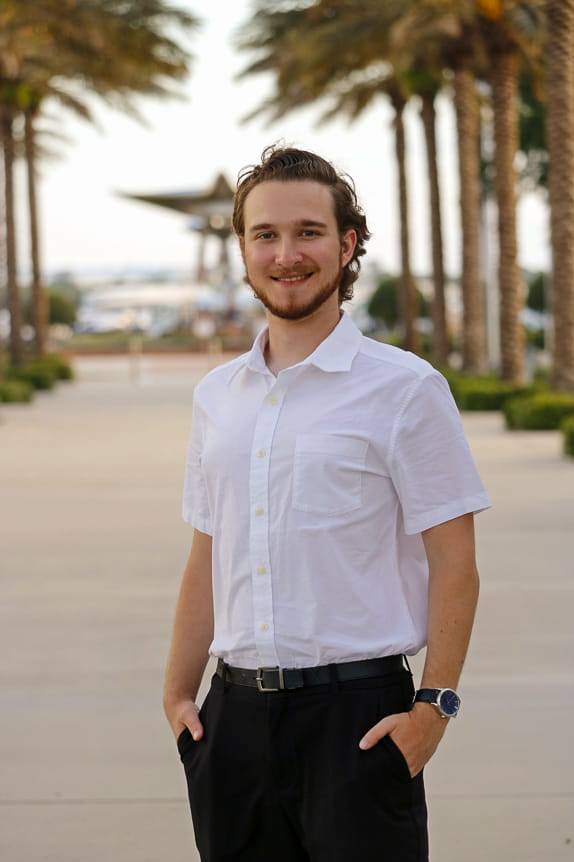
He said the skills he learned during his master’s degree were “one of the major factors” in his hiring by SpaceX. He said that without the content and the “hands-on experience” of his graduate courses, “I do not believe I would have stood out enough to compete for my job.”
For Ochoa’s upcoming research experience, the students will investigate AI projects, such as using reinforcement learning (RL) for decision-making in complex environments like those encountered by self-driving vehicles and aircraft. They will experiment with safe RL techniques for preventing catastrophic outcomes.
The participants will be introduced to methods commonly used in industry that emphasize collaboration, adaptability and iterative progress. Through the structured, step-by-step process, participants will work in teams using methods that promote rapid prototyping, testing, validation and problem-solving — often resulting in expedited and improved research outcomes.
“Agile methods are widely used across industry,” Ochoa said. “Recognizing their importance, we integrate agile practices into our students’ education, preparing them to contribute effectively from the start of their professional careers.”
Also involved in the program are co-principal investigator Dr. Alex Vargas, assistant professor, and Dr. Richard Stansbury, professor. Both are in the Department of Electrical Engineering and Computer Science.
Dr. Jeremy Ernst, vice president for research and doctoral programs, called the REU a great example of how research and education come together to provide meaningful experiences.
“By combining emerging areas of AI with faculty mentorship, the program gives undergraduates valuable research experience that can further paths to graduate education and future STEM careers,” he said.
Ochoa’s grant will support nine undergraduate participants each summer for the next three years. The 27 students, who will come from schools across the country, receive a stipend, housing, meals and up to $600 to cover travel expenses.
The NSF also supports an REU program at Embry-Riddle on cybersecurity research focused on uncrewed aircraft systems. That REU — led by Dr. Laxima Niure Kandel, assistant professor in the Department of Electrical Engineering and Computer Science — was recently awarded an NSF grant to continue for the next three years.
Related News


