
- Category
- Research
- Date
- July 22, 2026
The 2026 Atlantic hurricane season is ramping up, and Embry-Riddle Meteorology professor Dr. Josh Wadler is working on new ways to fly drones inside the storms to harvest data that could help predict when, where and how strongly they will hit.
Wadler — who has repeatedly flown into massive storms aboard Hurricane Hunter aircraft to drop sensor-equipped drones — says his team’s drone data will be integrated into National Oceanic and Atmospheric Administration (NOAA) forecast models for the first time this season.
“Putting data from the drones into operational forecast models this year is a big step,” Wadler said. “I’ve worked for years with Black Swift Technologies, the company that makes the drones, to validate the data.”
Using the drone data in forecasting improves the accuracy of hurricane intensity predictions by 10%, according to NOAA, and will be used in combination with Hurricane Hunter flight data, estimated to improve forecast accuracy by 20%.
NOAA began experimenting with air-launched drones in hurricanes about a decade ago. Since 2022, Wadler has used drones, or small uncrewed aircraft systems (sUAS), to measure wind speeds, pressure, temperature and humidity inside the storms.
The drones are dropped through a chute on the Hurricane Hunter P-3 aircraft to take measurements close to the ocean's surface, where it would be unsafe for the plane to fly. This data allows Wadler to explore the physics of what makes hurricanes intensify.
Measurements from the area closest to Earth are important because “this is the area that affects life and property,” Wadler said. Getting those low-altitude readings from the ocean’s surface is especially valuable, he said, because “the most fundamental processes in a hurricane are the exchanges in momentum, heat and moisture between the atmosphere and ocean. Without the ocean, we don't have a storm.”
In April, Wadler first tested dropping two drones at once during a flight, which will amplify scarce data from below 1 km of altitude.
Having two drones will provide important comparisons between different parts of the storm. Wadler anticipates “stacking” drones, with one close to the ocean and one at a higher altitude, to “answer the big question” of what a certain wind speed at the higher altitude means for the wind speed closer to Earth.
“It’s a challenging problem, since it’s hard to get measurements at different heights at the same time,” he said, “and it’s directly tied to how the intensity of a storm is determined.”
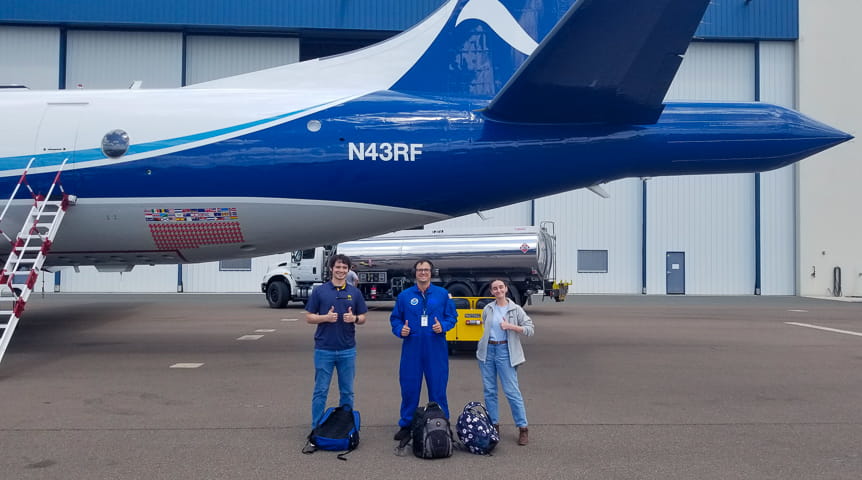
Lauren Baez, a junior pursuing a double major in Meteorology and Aeronautical Science, joined Wadler on the test flight when two drones were dropped. As part of a summer fellowship funded by Embry-Riddle’s Office of Undergraduate Research, Baez will be analyzing the data from the testing.
In collaboration with NOAA, Dragoon Technology, the University of Miami and Embry-Riddle, Baez helped test a drone, called the Coriolis, that can be launched from land to investigate the conditions within a hurricane.
“It can fly without the aid of the P-3, which makes the Coriolis quite special,” Baez said. The land-launched drone can also travel close to the boundary layer over the ocean between air and sea, “a notoriously dangerous flying zone,” and can monitor large areas because of its long endurance, she said.
Fewer hurricanes are predicted for 2026 than occurred in recent years, although NOAA officials emphasize preparedness, because the factors affecting the formation of the storms are complicated and somewhat conflicting. A weather pattern known as El Niño, a global climate phenomenon that emerges from variation in winds and sea surface temperatures over the tropical Pacific Ocean, is predicted and tends to result in fewer storms in the Atlantic. At the same time, the water in the Atlantic is expected to climb to slightly warmer than normal temperatures and trade winds are expected to be slightly weaker than average, which can indicate the possibility of more storms.
A NOAA news release said the agency’s integration of drones and other advanced technologies “will deliver actionable science to safeguard the lives and livelihoods of the American people,” according to NOAA Administrator Dr. Neil Jacobs. These new capabilities, said Jacobs, “will produce the most accurate forecasts possible to protect communities in harm’s way.”
Related News


