

- Category
- Research
- Date
- September 2, 2026
What do fish schools, human opinion formation and vehicle traffic have in common?
All have been studied by Dr. Subhradeep Roy, assistant professor of Mechanical Engineering at Embry-Riddle Aeronautical University, to understand how their individual components interact to produce complex, coordinated behavior.

“Our research addresses a fundamental question about how animals move together as coordinated groups,” Roy said, citing schools of fish and flocks of birds that move “in remarkable harmony without anyone being in charge.”
Scientists know the coordination occurs because each individual responds to the movements of nearby neighbors. What was unclear, Roy said, was which neighbors each individual appeared to respond to and how far each individual could “see” its neighbors’ movement.
Roy and McKinney’s new computational method — which leverages advances in tracking technology that make it possible to record the movements of thousands of animals simultaneously — can determine directly from the tracking data how far away neighboring animals are interacting with individuals and at what viewing angles.
Roy said the researchers measured how closely the average direction of nearby fish matched the future direction of an individual fish.
“By repeating this process while testing different assumptions about how far a fish could ‘see’ and how wide its field of view is, we identify the interaction region that best explains the observed behavior,” he said.
Roy said he is fascinated by natural systems — such as schools of fish, flocks of birds and swarms of bats — because millions of years of evolution have made the systems remarkably robust. “They continue to function even when some individuals make mistakes or leave the group,” he said.
He said that by understanding how the systems work, the principles behind them could be applied to engineering.
“For example, they can inspire distributed robotic swarms, autonomous drone teams and other artificial systems that can coordinate without relying on a single centralized controller,” Roy said.
Dr. Eduardo Divo, vice provost for faculty affairs and professor of Mechanical Engineering, said Roy’s work “beautifully” combines complex systems, optimization and biomimetics to show how insights from nature can inspire robust engineered systems.
“This prestigious publication, emerging from his NSF CAREER Award, affirms both the significance of his research,” he said, “and the value of investing in expertise that expands the intellectual boundaries of a department.
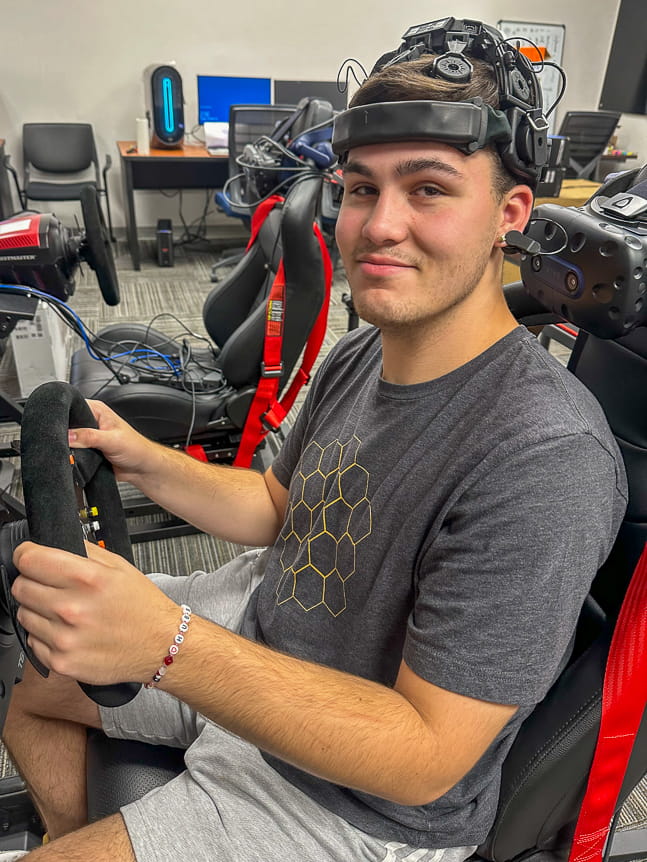
McKinney credited Roy and Complex Dynamical Systems Laboratory (CDSL) lab manager Poorendra Ramlall with being “amazing mentors to help me get to this point.”
McKinney now works as a systems engineer at General Dynamics Electric Boat. While his work does not involve complex, dynamical systems, he said working with Roy helped him develop in many valuable ways.
“Possibly the most impactful has been gaining a sense of what is required to formulate a concept and take it from cradle to a formal end point, which is very important in my R&D-oriented engineering work,” he said, adding that the research also helped him develop skills in technical communication, modeling and simulation, and empirical time series analysis, which examines real-world measurements recorded over time.
“These are all skills that I regularly use, and further develop, in my day-to-day,” McKinney said.
Related News


