Displaying 145-156 of 285 Results

Drs. Krishna Sampigethaya, Richard Prazenica and Kaela Martin, of Embry Riddle, were named to the American Institute of Aeronautics and Astronautics’ (AIAA) Class of 2025 Associate Fellows. (Photo: Embry Riddle/Connor McShane and Daryl Labello)
Three Embry‑Riddle Faculty Named AIAA Associate Fellows for Aerospace Excellence
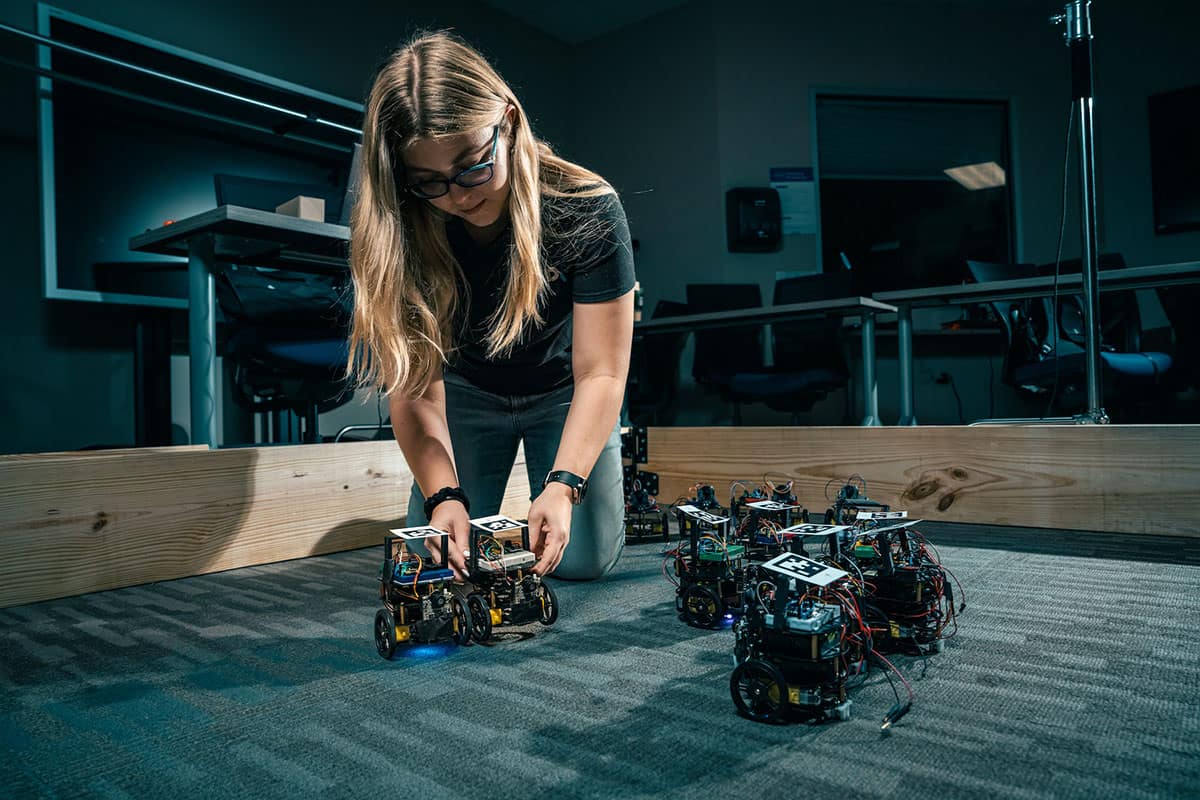
Student researcher Noa Teed, a senior majoring in Software Engineering, adjusts robotic vehicles programmed to interact at timed intervals and change each other's internal codes. (Photo: Embry‑Riddle/William Fredette-Huffman)
Learning From Ants to Make Networks Safer
In this year’s U.S. News & World Report rankings, Embry‑Riddle’s Prescott campus earned five top-five distinctions, including No. 1 nationally in the Best Undergraduate Aerospace Engineering Programs category for schools without a Ph.D. option. Here, a student holds a cube satellite (CubeSat) designed, developed and tested by students at Embry‑Riddle’s College of Engineering. (Photo: Embry‑Riddle/Connor McShane)
U.S. News & World Report Names Embry‑Riddle’s Prescott Campus No. 1 in the West for Vets and Innovation
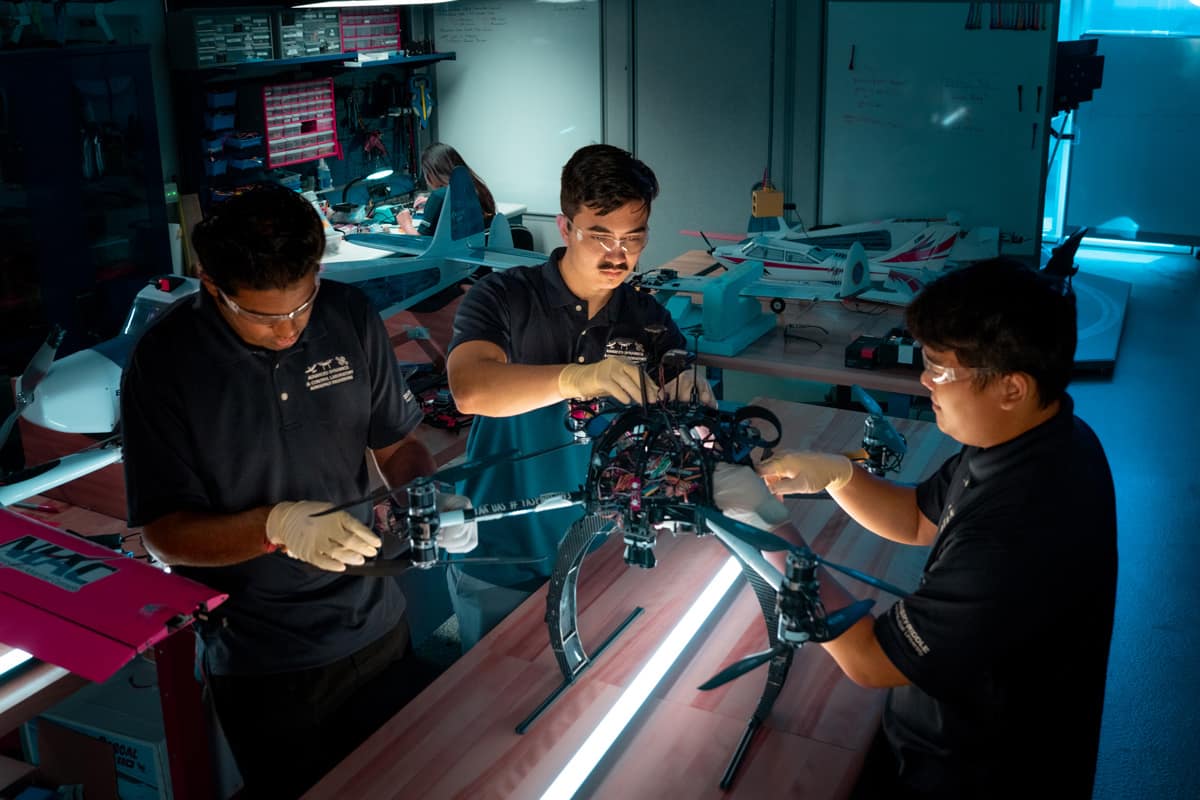
U.S. News & World Report recognized the Aerospace Engineering program at Embry Riddle’s Daytona Beach Campus as among the five best doctoral-granting programs in the country, according to this year’s ranking of residential campuses. Here, students work on an uncrewed aerial system in the Advanced Dynamics and Control Laboratory, which supports research activities to advance aviation and space technologies. (Photo: Embry‑Riddle/Bill Fredette-Huffman)
Embry‑Riddle Earns Nine Top-Five Honors, Including for Engineering and Overall Quality, in Latest U.S. News & World Report
Embry‑Riddle Aerospace Engineering student Teshome Shenkut Teshome is active in several campus groups and currently serves as vice president of the Student Government Association at the Daytona Beach Campus. (Photo: Teshome Shenkut Teshome)
International Student Finds New Flight Path at Embry‑Riddle
Embry‑Riddle alumnus Jared Isaacman (Worldwide ’11) performs the first-ever civilian spacewalk. (Photo: SpaceX)
Embry‑Riddle Alumnus Jared Isaacman Performs First-Ever Civilian Spacewalk During Historic Polaris Dawn Mission
Polaris Dawn Mission Pilot Scott Poteet (right) inspects the LLAMAS camera unit, engineered by Embry‑Riddle students under the direction of Dr. Troy Henderson, associate professor of Aerospace Engineering and director of the Space Technologies Lab. Alongside Poteet are fellow crewmembers Anna Menon, Embry‑Riddle alumnus Jared Isaacman ('11) and Sarah Gillis. (Photo: Polaris Program/John Kraus)
Polaris Dawn Mission Carries Two Embry‑Riddle Projects Aboard
Dr. Marwa M.H. El-Sayed visited the U.S. Department of Energy's Pacific Northwest National Laboratory (PNNL) in Washington State, as well as its Environmental Molecular Sciences Laboratory, this summer. (Photo: PNNL/Genoa Blankenship)
Eagle Professor Earns Early Career Award for Environmental Engineering
Drs. Foram Madiyar, Ronnie Mack and Samantha Bowyer of Embry‑Riddle are launching a major new NSF-funded initiative to draw more teens and their teachers as well as undergraduate students into the science, technology, engineering and mathematics (STEM) pipeline. (Photos: Embry‑Riddle/Daryl Labello)
New $1 Million NSF Grant to Help Embry‑Riddle Develop STEM Leaders
Undergraduate student researchers who took part in this year’s Interdisciplinary Research Experiences for Undergraduates (REU) program reflect Embry‑Riddle’s bigger-picture goal to widen and enhance the U.S. STEM pipeline. (Photo: Embry‑Riddle/Ginger Pinholster)
NSF-Funded Program at Embry‑Riddle Promotes Undergraduate Research Nationwide
Students of the Rocket Development Lab (RDL) team holding their rocket with their faculty advisor, professor Mark Benton, at the 2024 Spaceport America Cup near Las Cruces, New Mexico. (Photo: Dave Teague)
Embry‑Riddle’s Rocket Development Lab Makes Debut at Spaceport America Cup
(L-R) Embry‑Riddle faculty member Dr. Seetha Raghavan, with her lead doctoral student Laura Johann, hope that their efforts to create sensors from lunar and planetary regolith will help advance in-space manufacturing and make STEM education more broadly accessible to all students. (Photos: Embry‑Riddle/Daryl LaBello and UC-Berkeley)
Making ‘Moon Dust Sensors’ May Set the Stage for In-Space Manufacturing Advances