Displaying 25-36 of 53 Results

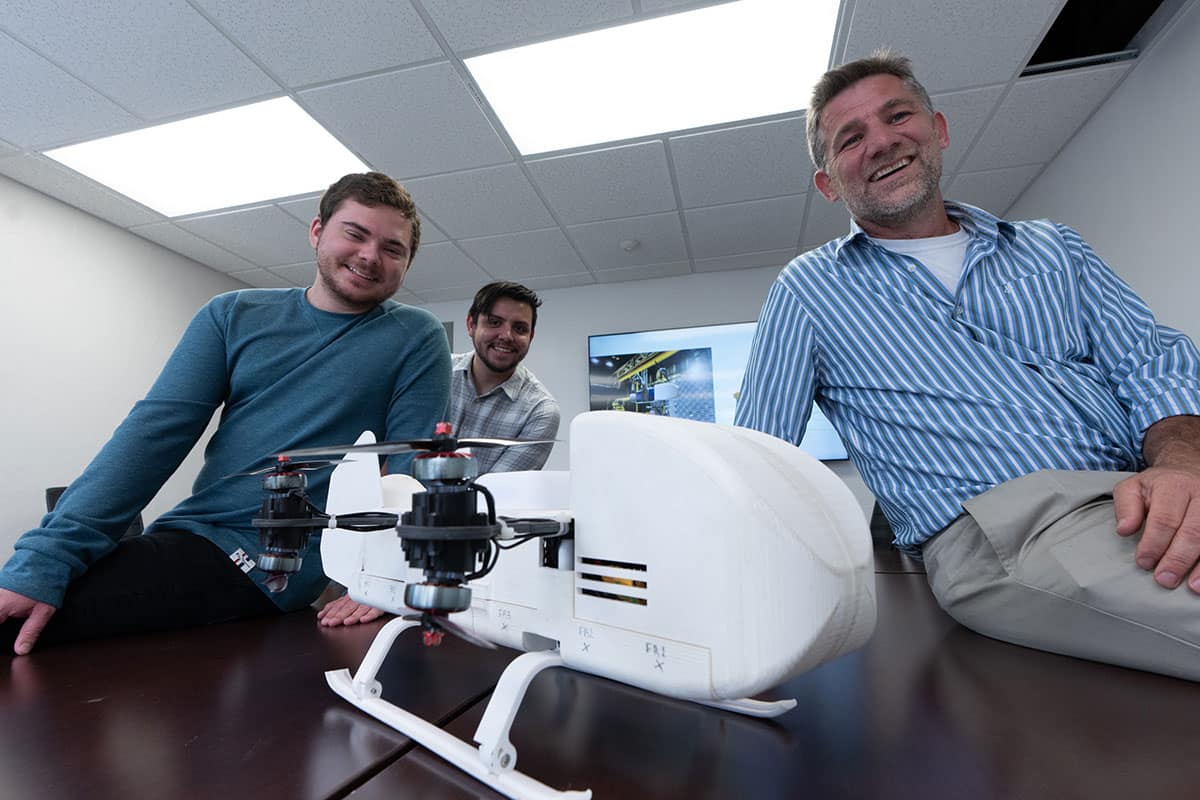
An Embry‑Riddle team is supporting NASA’s Dragonfly Mission to Saturn’s moon Titan. The team includes (from left) Ph.D. candidate Jackson Asiatico, master’s student Sebastian Lopez and Dr. Michael Kinzel, who pose with a prototype of the Dragonfly rotorcraft lander. (Photo: Embry‑Riddle/David Massey)
Embry‑Riddle Team Contributes to Design of NASA Rotorcraft Destined for Saturn’s Moon Titan
Embry‑Riddle researchers are leading a NASA project to enhance safety in advanced air mobility aircraft, which includes aircraft like vertical-takeoff air taxis. (Photo: Getty Images)
Embry‑Riddle Team to Lead $6.7 Million NASA Project to Advance Safety of Next-Generation Air Mobility
Embry‑Riddle meteorologist Dr. Josh Wadler (right) aboard a hurricane hunter aircraft, where he deploys drone technology to probe atmospheric conditions inside hurricanes. (Photo: CBS News/Jake Barlow)
Embry‑Riddle Drone Teams Measure Least Known Parts of Atmosphere, Most Violent Features of Hurricanes
A student conducts a drone certification test at Embry‑Riddle Aeronautical University. (Photo: Embry‑Riddle/Bill Fredette-Huffman)
Aviation Week Op-Ed: Embry‑Riddle President Addresses Air Safety in Age of Drones
Caption: Research projects for the FAA leverage the expertise of a multi-disciplinary team from across Embry‑Riddle, including Dr. Ryan Wallace, Dr. Stephen Rice, Dr. Scott Winter, Dr. Daniel Burow, Dr. Mihhail Berezovski, Dr. Chuyang Yang, Dr. Kevin Adkins, Dr. Dothang Truong, Dr. Michael New, Dr. Richard Stansbury, Dr. Brent Terwilliger, Dr. Sean Crouse and graduate research assistant Sang-A Lee. (Photo: Embry‑Riddle/Connor McShane)
Charting a Data Flightpath for Uncrewed Aerial Systems: Eagle Researchers Receive Nearly $4 Million From Two FAA Funding Streams to Track and Integrate Nationwide Drone Activity
An Embry‑Riddle team — comprised of Anna Golendukhina, Dr. Flavio Mendonca, Savanna Box, Nicholas Buckalew and (not pictured) Raymon Ayres and Jose L. Cabrera — recently won first place for a research project focused on using uncrewed aircraft systems, or drones, to help mitigate the risk of wildlife hazards at airports. (Photo: ACRP Media Team)
‘Game-Changer’: Drones Can Reduce Wildlife Strikes at Airports, According to Award-Winning Eagle Research
Embry‑Riddle student Matthew Davis works on a Censys Technologies Corporation’s Sentaero 5 drone, which was used to collect data for post-storm assessment after Hurricane Milton. (Photo: Embry‑Riddle/Censys Technologies Corporation)
Above the Flooding, High-Tech Drones Capture Storm Damage and Data
 Dr. Josh Wadler (bottom) shows off an Embry‑Riddle decal in the Lockheed WP-3D Orion plane used by NOAA to fly through hurricanes. Next to him (left) is NOAA Flight Director Sofia de Solo, an Embry‑Riddle alumna, and undergraduate Christopher DeLoach (back).
Braving the Storm: Embry‑Riddle Professor Flies Into Hurricane Milton to Conduct Research
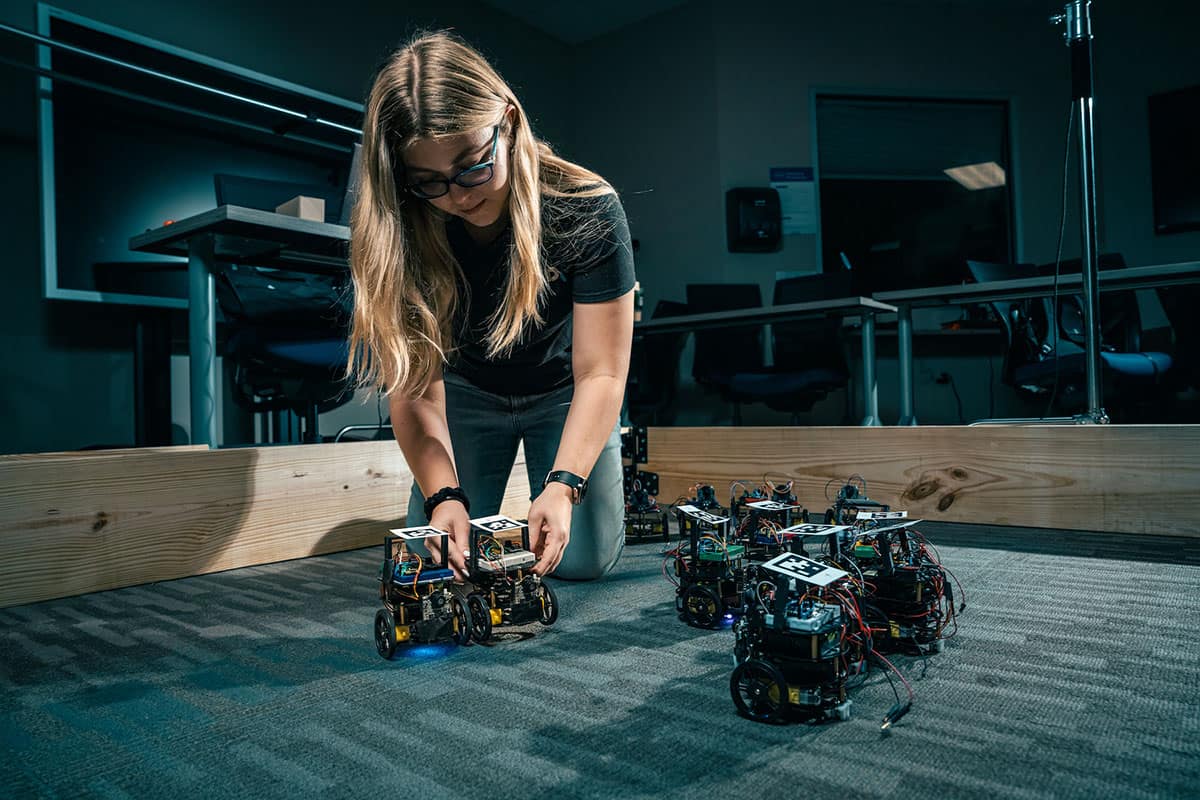
Student researcher Noa Teed, a senior majoring in Software Engineering, adjusts robotic vehicles programmed to interact at timed intervals and change each other's internal codes. (Photo: Embry‑Riddle/William Fredette-Huffman)
Learning From Ants to Make Networks Safer
Dr. Dan Macchiarella and Embry‑Riddle student Tyler Deal greet guests at Science Sunday at the Brevard Zoo. (Photo: Dan Macchiarella)
Eagles Use Drones to Support STEM Education, Wildlife, Our Environment
As part of the NSF-funded Research Scholars Program at Embry‑Riddle Aeronautical University’s Worldwide Campus, graduate student Nazish Chunara presented her work at the 2023 National Conference for Undergraduate Research and gained confidence in her identity as a researcher. (Photo: Nazish Chunara)
NSF-Funded Program Empowers Online Student Researchers
Aerial view of Indian River Lagoon
Researchers Plan Drone Study of ‘Green’ Stormwater Solutions
Embry-Riddle Aeronautical University researchers will leverage drones to help assess eco-friendly stormwater solutions in the City of Cape Canaveral, Florida.