
Displaying 37-48 of 48 Results

Researchers Work to Advance Urban Air Mobility, Supported by $1.4 Million NASA Grant
High noise levels during flight have long been a barrier to the advancement of urban air mobility (UAM) vehicles, or “air taxis.”
April 19, 2023
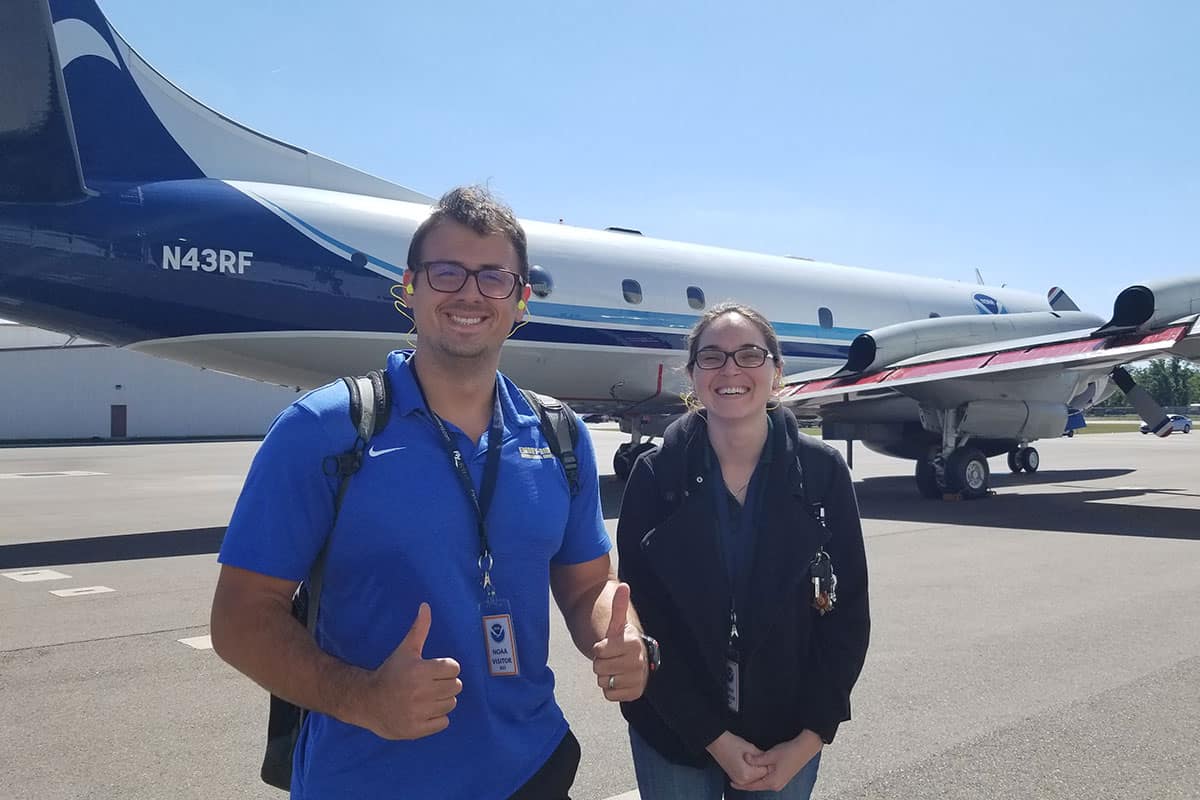
Embry-Riddle Undergrads Test-Launch New Instruments from Hurricane Hunter Plane
Late last month, two Meteorology undergraduates from Embry‑Riddle Aeronautical University experienced a rare research opportunity.
April 17, 2023

Eagle Researchers Advance Drone Technology for Tracking Wildfires
Embry‑Riddle Aeronautical University student Patrick Hunter has his career sights set on remote piloting drones to utilize uncrewed aircraft systems in exciting, new ways. Already, as a student in the Master of Science in Unmanned Systems program, he has been involved in a project using drones to track endangered turtles.
January 13, 2023

Alumnus Gift Allows Eagles to Improve Anti-Poaching Surveillance Systems
When an animal’s life is at stake, every second counts. Nowhere is this felt more keenly than southern Africa’s game reserves, where increasingly sophisticated poaching squads are decimating elephant and rhino populations on a daily basis.
October 28, 2022

Eagles Partner with Alumna-Owned Drone Firm to Fight Wildfires, Protect First Responders
As a student, Embry-Riddle Aeronautical University alumna Rocio Frej Vitalle ('12) worked in the Eagle Flight Research Center, which helped land her first job modeling and simulating uncrewed flights for FAA NextGen projects.
September 21, 2022

Turtle Trackers Fly Drones Out of Sight
In a first, an uncrewed aircraft system, or drone, operated by an Embry‑Riddle Aeronautical University team has begun searching for threatened and endangered sea turtles beyond visual sight lines.
June 21, 2022

Eyes in the Sky: Eagles Use Drones to Improve Tactical Response Against Active Shooters
Researchers at Embry-Riddle Aeronautical University are investigating the use of drones in active shooter scenarios, to help law enforcement more quickly identify assailants and their weapons.
April 1, 2022

Eagles Use Drones to Track Invasive Pythons in the Everglades
An unknown number of invasive Burmese pythons, some measuring up to 18 feet long, slither throughout Florida's Everglades, eluding wildlife workers who seek to manage their population.
March 7, 2022

Chasing Air Taxis: Eagles Simulate Drone Routes to Advance NASA Research
Researchers at Embry-Riddle Aeronautical University helped bring the goal of widespread drone delivery service and air taxis closer to fruition, by flying small uncrewed aircraft systems (sUAS) along simulated delivery routes in Florida.
February 14, 2022

Faculty Conduct Remote Drone Operation in Oregon
The goal of fully integrating unmanned aircraft systems (UAS) or "drones" into the national airspace system is still a long way off, but four members of the Embry‑Riddle Worldwide Campus Department of Flight visited that future over the summer while conducting UAS operations in Pendleton, Oregon.
August 2, 2021

Worldwide Campus Leads Drone Research, Passes Flight Milestone
Worldwide Campus researchers recently partnered with marine biologists at Starry Hill Observatory in Eatonville, Washington, to lead tests measuring the noise impacts of ten different drones on nearby wildlife.
June 17, 2021

Worldwide College of Aeronautics Instructor Highlights Augmented Reality Pros and Cons in Rotor Drone Pro Article
Military pilots have been using augmented reality (AR) systems to enhance their situational awareness since World War II. Heads-Up Displays (HUDs) allow the pilot to see vital information regarding their aircraft's attitude and performance while simultaneously maintaining visual contact with a target outside the cockpit.
March 9, 2021