
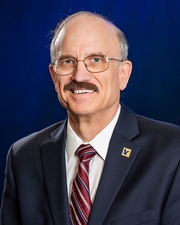
Mark G. Benton Sr. is an associate professor of Aerospace Engineering, where he teaches undergraduate courses in spacecraft rocket propulsion, spacecraft systems engineering and preliminary and detailed spacecraft design.
Before joining Embry-Riddle in 2023, Benton spent more than 35 years working on advanced aerospace vehicle and national security space programs across industry and government. His career includes contributions to the U.S. Air Force and NASA X-30 National Aero-Space Plane, NASA X-33 Reusable Launch Vehicle, Space Shuttle Flyback Booster, second-generation Reusable Launch Vehicle, Orbital Space Plane and NASA Constellation Program Altair Lunar Lander initiatives.
Benton held engineering and leadership positions with Rockwell North American Aircraft, Rockwell/Boeing North American Space Systems, Northrop Grumman Integrated Systems, Hughes Space and Communications and Boeing Satellite Systems. His roles included vehicle design integration manager, vehicle design team lead, spacecraft integration and test integrated product team lead, chief engineer and production manager. His work supported commercial, NASA, Department of Defense and classified satellite programs.
From 2017 to 2023, Benton served as a senior engineer and space segment subject matter expert at Naval Information Warfare Center Pacific in San Diego. His work focused on U.S. and adversary intelligence, surveillance and reconnaissance space systems, space domain awareness systems and space control programs.
Benton also served more than 31 years in the U.S. Navy, retiring in 2015 at the rank of captain. His active-duty service included assignments as an electronics technician and reactor operator instructor at the Naval Nuclear Propulsion Training Unit and as a reactor operator aboard the ballistic missile submarine USS John Adams (SSBN 620). He later served for more than 25 years as a Navy Reserve Engineering Duty Officer, qualifying as a military satellite communications operations planner and Battle Watch Captain. He also served as national coordinator for U.S. Navy Reserve scientific and technical support to Navy command, control, communications, computers and intelligence and space commands.
An AIAA Associate Fellow, Benton serves as vice chair of the AIAA Space Exploration Integration and Outreach Committee and is a member of the AIAA Space Transportation and Space Settlements technical committees. He is also an INCOSE Expert Systems Engineering Professional.
Benton has authored 27 technical papers addressing advanced aerospace vehicle design and human space exploration. His research and technical work includes airbreathing hypersonic vehicles, reusable launch vehicles, crew transfer vehicles and crew, cargo and rover landers designed for exploration of the moon, Mars, Ceres and major airless moons of Jupiter and Saturn.
In 2026, Benton was inducted as an AIAA Associate Fellow in recognition of his contributions to interplanetary spacecraft and planetary landers for human exploration, reusable launch vehicles and hypersonic vehicles.
M.S. - Master of Science in Aerospace Engineering, University of Maryland-College Park
B.S. - Bachelor of Science in Aerospace Engineering, University of Maryland-College Park
Senior Member, American Institute of Aeronautics and Astronautics (AIAA), 1986 to Present
- Member, AIAA Space Exploration Integration Committee, 2012 to Present; Vice Chair, 2026 to Present
- Member, AIAA Space Transportation Technical Committee, 2008 to Present
- Member, AIAA Space Colonization Technical Committee, 2006 to Present
Member, International Council on Systems Engineering (INCOSE), 2017 to Present
- Expert Systems Engineering Professional (ESEP) Certification (No. 04538), 2018 to Present
- Associate Fellow of the American Institute of Aeronautics and Astronautics (AIAA): Inducted in the Associate Fellow Class of 2026 with the citation: “for outstanding contributions to the advancement of the state of the art in interplanetary spacecraft and planetary landers for human exploration, reusable launch vehicles, and hypersonic vehicles.”
