

Dr. Mark A. Ricklick is an Associate Professor in the Aerospace Engineering department at Embry‑Riddle Aeronautical University, as well as director of the Gas Turbine Laboratory and co-director of the Thermal Laboratory in the College of Engineering. Dr. Ricklick has more than 15 years of experience working on gas turbine- and heat transfer-related technologies. He obtained his doctorate degree and served as a Post-Doctoral Researcher at the University of Central Florida. From 2012 until 2013, he supported companies in the turbomachinery, automotive, aerospace and agricultural industries with CAE investigations as an Applications Engineer. Dr. Ricklick is author/co-author on more than 70 publications, including an ASME Best-Paper Award. His research interests lie primarily in the area of thermal management of propulsion and energy systems. He has extensive experience in experimental and computational investigations of the analysis of convective and conjugate thermal systems, as well as the development of relevant design tools.
Research facilities in the Gas Turbine Laboratory (~1000 sq ft) within the Engineering Lehman Building and in the Thermal Laboratory (~1600 sq ft) within the MicaPlex facility are dedicated to research in the area of heat transfer and thermal management. Dr. Ricklick’s research team combines experimental and computational approaches to investigate novel thermal management solutions for a variety of applications, from conventional energy and propulsion to advanced HVAC cycles, hybrid and electric propulsion, and novel energy solutions.
International Research Experience for Students (NSF IRES)
This 8-10 week summer program funded by the National Science Foundation (NSF) for graduate and undergraduate students is dedicated to conducting research on the theme of advanced combustion and materials technologies. Through a partnership with the German Aerospace Center (DLR), students will gain research experience at a state-of-the-art facility in Cologne, Germany, with leading industry scientists and develop professionally in an international environment. IRES: U.S.-Germany will also include cultural activities, industrial visits, housing and a competitive stipend. This program will be offered each summer through 2025, with the application period taking place during the previous fall semester.
This summer research experience offers:
- Ten weeks of research experience with DLR scientists
- Professional development in an international environment
- STEM outreach with K-12 students in the U.S
- Exposure to a new culture
- Provided housing
- Competitive stipend
Program Annual Timeline
For 2021-2025
- Application deadline: Nov. 26, 2024
- Interviews: Early December
- Notification of acceptance: Early January
In order to facilitate the pre-departure preparation, accepted students will be asked to confirm their involvement in the program within one week of notification of acceptance and commit to 10 hours of research per week during the spring semester.
- Spring research collaboration and preparation for departure: January-April
- Departure: May
- Return: Early August
Requirements
- U.S. citizen or permanent resident
- Registered as a graduate student or an undergraduate interested in pursuing graduate studies
- Available at least 10-20 hours per week during the spring term
- Available for departure for 10-12 weeks from May to August
For more information, contact Dr. Mark Ricklick.
This website is based in part upon work supported by the National Science Foundation under Grant No.1952523. Any opinions, findings and conclusions or recommendations expressed in this website are those of the author(s) and do not necessarily reflect the views of the National Science Foundation (NSF).More About the Program
Worldwide efforts to meet next-generation propulsion capabilities for hypersonic suborbital and reusable space vehicles and power generation systems rely on interdisciplinary and transformational technologies. Collaboration between scientists and engineers within the field is essential to understanding and addressing bigger problems to create innovative solutions by facilitating international experiences for U.S. students. This is achieved through collaborative research between DLR and Embry‑Riddle Aeronautical University, as well as a partnership with Argonne National Laboratory. Each participating student will join a team that addresses a specific research problem within the field of advanced combustion and aerospace materials and collaborate with local and international partners to direct their research toward the needs of the industry. The exact objectives of the IRES program will evolve from year to year.2025 Students
Juan Roldan
Juan P. Roldan is a first-year graduate student in Aerospace Engineering at Embry‑Riddle Aeronautical University. He earned his BSAE with a minor in computer science from the University of Central Florida in 2024. Under the advisement of Dr. Michael Kinzel, he studies hypersonic shock-droplet interactions, incorporating cavitation effects. As a computationalist, Juan is deeply interested in the development of numerical methods and high-fidelity simulations. However, he also values collaboration with experimentalists to ensure a well-rounded understanding and validation of his computational work.
Eric Yore
Eric Yoerg is a first-semester M.S. student in Aerospace Engineering at Embry‑Riddle Aeronautical University. He earned his B.S. in Aerospace Engineering from Embry‑Riddle in 2024. Eric has worked under Dr. Surabhi Singh to design new experimental facilities, including a blowdown-type supersonic wind tunnel, an exploding wire-driven blast tunnel and a shock tube. A likely thesis topic will involve the experimental study of shock-induced aero breakup of water droplets. In his free time, Eric enjoys making coffee, cooking and discussing physics with his friends. He is very eager to apply his research and design skills to problems related to experimental aerodynamics at DLR.
Zachary Leonard
Zachary Leonard is a senior undergraduate student at Embry‑Riddle Aeronautical University, pursuing a degree in Aerospace Engineering with a concentration in Rocket Propulsion while also enrolled in the accelerated master’s program focusing on Aerodynamics and Propulsion. Under the advisement of Dr. William Engblom and Dr. Mark Ricklick, he researches advanced technologies to improve hypersonic efficiencies, including a literature review on transpiration cooling for hypersonic applications. Proficient in MATLAB, he has hands-on experience with computational and experimental propulsion research. As the Data Analysis Tech Lead for Embry‑Riddle’s first-place Design Build Fly team, he played a key role in optimizing aircraft performance. This summer, he looks forward to applying his expertise in thermodynamics to combustor film cooling research at DLR. Passionate about high-speed flight, Zachary aims to design next-generation hypersonic propulsion systems. Outside of academics, he enjoys playing hockey, going to the gym, watching movies, spending time with friends and working on his motorcycle.
Associated Labs & Facilities
- Daytona Beach College of Engineering
- Daytona Beach Campus
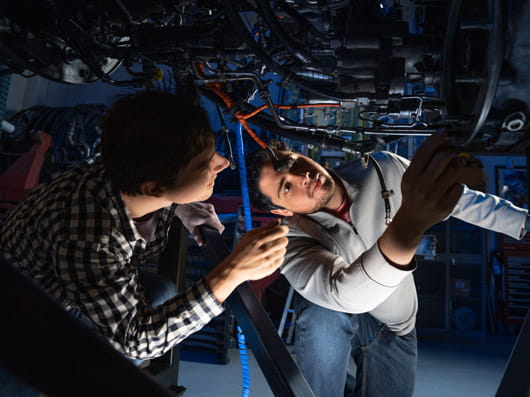
- The Gas Turbine Lab (GTL) at Embry‑Riddle supports computational and experimental research in the aero-thermal sciences applied to power and propulsion systems.
Related Resources
Contact Us
Dr. Mark A. RicklickAssociate Professor
Department of Aerospace Engineering