
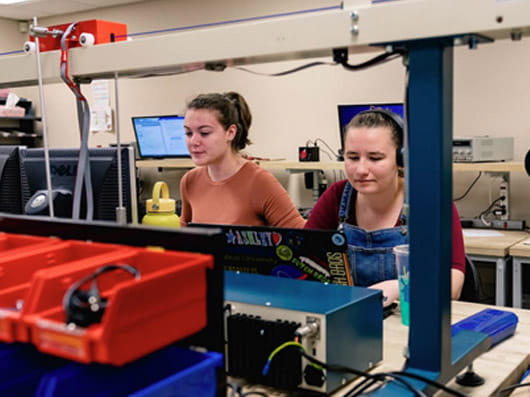
Students apply control theory to real systems using motors, dynamic platforms and hardware-in-the-loop tools. Hands-on experience prepares them for automation and robotics careers.
Control systems is the empowering technology behind the autopilot, self-driving car and other more mundane applications, such as your home’s heating and cooling system.
In the Control Systems Lab, students apply theoretical concepts introduced in class to relevant practical examples such as DC motor speed and position control. Lab experiments are sequenced to introduce and reinforce key concepts, such as modeling of dynamic systems, analysis of the system’s response to various inputs and finally, the design and implementation of controllers to modify (i.e., control) the system’s behavior.
More nuanced ideas, such as sensitivity and optimal control, are reinforced via experiments using more sophisticated systems, such as an inverted pendulum. Emerging techniques such as hardware-in-the-loop are employed throughout to afford students skills that readily translate to the current and future needs of industry.
Equipment
- 13 Dell Optiplex 7020 computers with Intel Core i7 processors and solid-state drives
- 13 Quanser Qube DC Servo systems with rotary pendulum attachment
- Matlab/Simulink real-time QUARC software
- 1 ECP translational three mass system
- 1 ECP rotational three disk system
- 1 Feedback Systems linear inverted pendulum
Lab Director
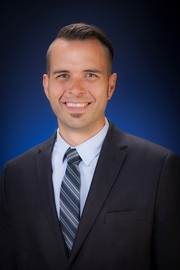
Associate Professor
- Department of Electrical, Computer and Software Engineering
- College of Engineering
Related Resources
Contact Us
Dr. John Matthew PavlinaKing Engineering and Technology Center, Room 122
Prescott, AZ 86301