

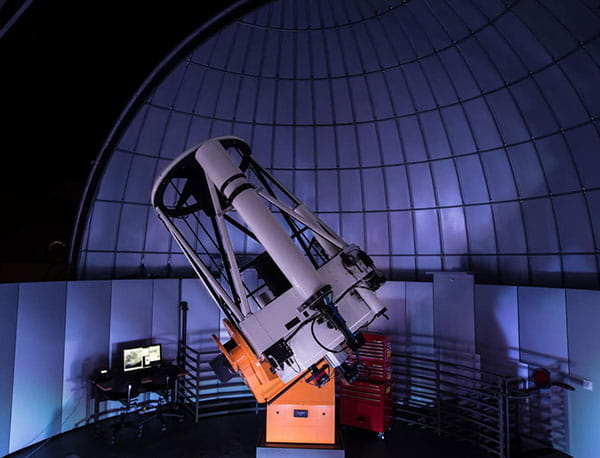
The centerpiece of the Astronomy and Astrophysics program is the one-meter diameter Ritchey-Chrétien reflecting telescope. This telescope, built in 2014 and housed atop the College of Arts & Sciences building, is the largest university-based research telescope in Florida, weighing around two tons.
The Ritchey-Chrétien telescope (RC) is a type of reflecting telescope that delivers a large-diameter, well-corrected field of view from its hyperbolic primary and secondary mirrors and field-flattening lens system. This telescope, along with its digital imaging cameras and spectrographs, gathers millions of times more light than the human eye.
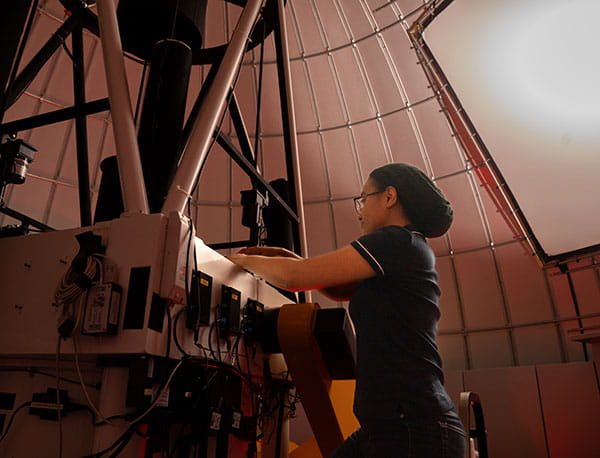
Faculty and students use the one-meter telescope to research planets, moons and asteroids in the Solar System, exoplanets, the structure and ages of stars and nearby galaxies.
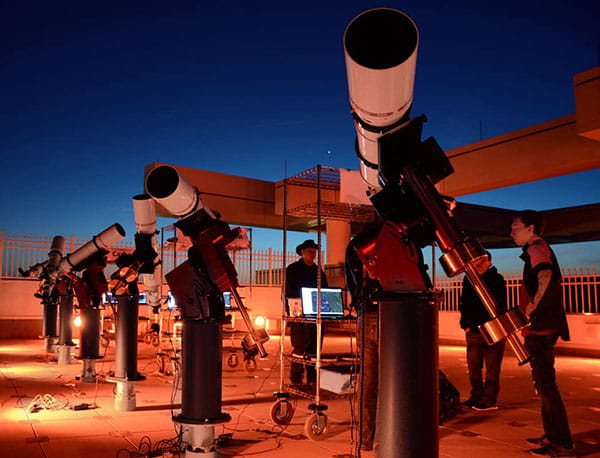
In addition to the one-meter telescope, the Observatory houses a dozen smaller portable telescopes mounted on the roof of the College of Arts & Sciences. These telescopes are used for student training in eyepiece observing, digital imaging and spectroscopy.
More About the Telescope
- Built by DFM Engineering in Longmont, Colorado
- Lifted five stories to its new home by a mobile crane, then gently lowered inside the 30-foot diameter dome of the observatory atop the roof of the College of Arts & Sciences building
- RC telescope designs like this one are found in other major research observatories around the world and in NASA's Hubble Space Telescope
Equipment
- Ritchey-Chrétien telescope
- 12 smaller telescopes
| Sept. 25, 2026 | Terry Oswalt, Embry-Riddle | Pluto: 20 Years as a Dwarf Planet |
| Oct. 30, 2026 | Bil Dullo, Embry-Riddle | Black Holes in Galaxies |
| Nov. 20, 2026 | TBD | TBD |
| Jan. 29, 2027 | TBD | TBD |
| Feb. 26, 2027 | TBD | TBD |
| March 26, 2027 | TBD | TBD |
Public Lecture at 7 p.m. (Willie Miller Auditorium)
Observations from 8-11 p.m. (College of Arts and Sciences)
Please join us for the Astronomical Observatory Open House nights at Embry-Riddle's Daytona Beach campus. These free events allow the campus community and members of the general public of all ages to view the night sky through the Observatory's telescopes, ask questions and learn about our universe. Weather permitting, celestial objects will be visible through a collection of telescopes from the roof-top observing deck and through our new 1-meter telescope from within the large dome.
There are typically several open house events during the fall and spring semesters hosted by Embry-Riddle's student Amateur Astronomy Club. Events are on selected Friday nights (see above). A public lecture is hosted at 7 p.m., just before the Astronomy Open House. Observations will follow from 8-11 p.m.
View the sky through many of the Observatory's telescopes and binoculars. We have step stools so kids can reach the eyepiece.
In addition to viewing the night sky through our telescopes, explore our astronomy posters and take a walking tour of the solar system. There is no fixed program for observations and no reservations are necessary. Just drop by to see the stars.
1-Meter Telescope Tickets
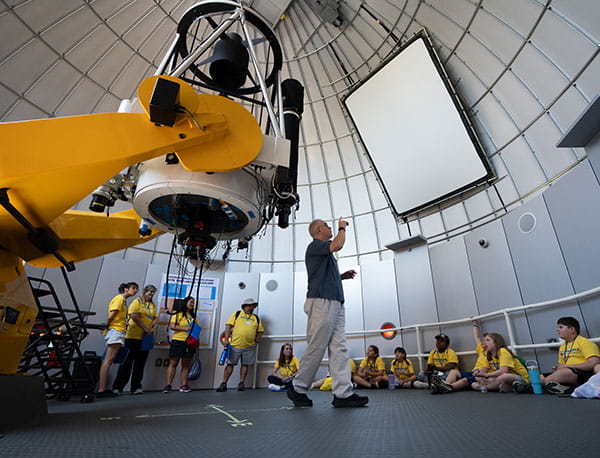
Free tickets with tour times are distributed first in the Lobby of the Willie Miller building starting at 6:45 p.m., before the lecture starts, on a first come, first served basis. After the lecture starts at 7 p.m., any remaining tickets will be available in the second-floor lobby of the College of Arts & Science building. Tickets are only available in person and are not distributed until 6:45 p.m. on the night of the event. Due to space limitations in the 1-meter dome, there is a limit to how many people can observe through the 1-meter in a single night.
There are many other activities to explore: view a 3D poster gallery of images from Mars, interact with different types of telescopes and learn how they work, take a walking guided tour of the solar system, interact with our gravity-well simulator, see microscopic meteorites, see rockets built by students, perform physics and chemistry demonstrations with students, view informational astronomy posters, view our astrophotography gallery and more. There is no fixed program for observations and no reservations are necessary. Astronomy Open House nights are proudly sponsored and supported by: Embry‑Riddle Observatories, Amateur Astronomy Club, and the Daytona Beach Campus Department of Physical Sciences.
Directions
The Astronomy Open House is no longer located behind the Lehman Engineering Building along the former creek. Please look for our new home in the College of Arts and Sciences Building with the 30-foot observatory dome on top. If you have questions regarding the open house and lecture series, please contact Dr. Jason Aufdenberg.
Lab Director
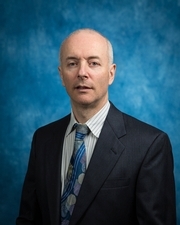
Professor and Director of the PS Department Observatory
- Department of Physical Sciences
- College of Arts and Sciences
Related Resources
Contact Us
Dr. Jason AufdenbergCollege of Arts & Sciences Observatory
Daytona Beach, FL 32114