
- Category
- Impact
- Date
- September 30, 2026
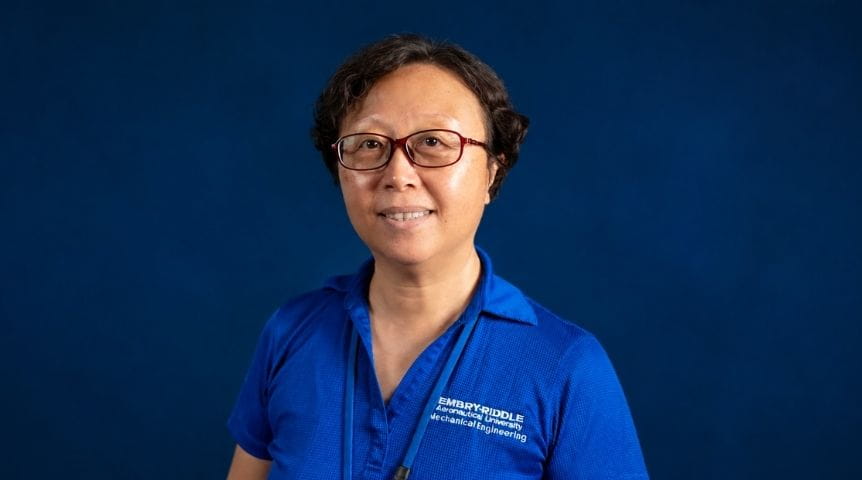
For Dr. Yan Tang, some of the most important questions in engineering education begin before a student ever reaches for a calculator.
How do students decide which equation to use? Do they understand what the symbols represent? Can they explain why an equation applies to a particular problem, or have they simply memorized a formula?
Those questions are at the center of Tang’s latest research at Embry-Riddle Aeronautical University, where she has received a National Science Foundation (NSF) Mid-Career Advancement Award to expand her work in engineering education and explore new ways to understand how students learn.
“Receiving this award is a great honor and an important opportunity to grow as an engineering education researcher,” Tang said. “My earlier NSF project helped me build a foundation in engineering education and increased my interest in how courses and exams are designed.”
The award marks an important milestone for both Tang and Embry-Riddle’s Department of Mechanical Engineering.
“The NSF Mid-Career Advancement Award is a significant recognition of Dr. Tang’s accomplishments as a researcher and educator, and we are incredibly proud to see her receive this honor,” said Dr. Patrick Currier, chair of the Department of Mechanical Engineering. “As the first faculty member in our department to receive this award, Dr. Tang is opening new opportunities for research at the intersection of engineering, education and emerging technology. Her work reflects the kind of innovation we value: research that advances our field while directly improving the way we prepare the next generation of engineers.”
Understanding What Happens Before the Answer
Tang’s project, “Supporting Equation Navigation and Sensemaking in Engineering with AI,” or SENSE, focuses on a deceptively simple problem: determining whether students truly understand the physical meaning behind the equations they use.
A student can arrive at the correct equation without necessarily understanding why it works, what its variables represent or whether the resulting answer makes physical sense. In engineering, where graduates must apply their knowledge to unfamiliar and complex problems, that distinction matters.
“The central question is: How can we tell whether students understand the physical meaning of an equation or are writing it from rote memorization without understanding?” Tang said.
Her research will examine how students choose, construct and explain equations before beginning calculations, particularly in challenging courses such as Dynamics and Thermodynamics. By listening to students describe their reasoning, Tang hopes to identify where understanding begins to break down — and what instructors can do to help students move forward.
The award will also allow Tang to expand her research methodology. While her previous NSF-supported work focused on designing instruction that improves learning, she now wants to better understand why the same instructional approach may work well for some students while others continue to struggle.
“A correct or incorrect answer alone cannot tell me what a student understands or what support they need,” she said.
Bringing AI Into the Learning Process
Artificial intelligence adds another dimension to Tang’s research.
She plans to explore how AI can help researchers identify patterns in student explanations and uncover learning difficulties that may otherwise go unnoticed. Ultimately, she also hopes to develop an AI-based tutoring tool designed not simply to provide answers but to guide students through questions and feedback.
The goal is to encourage students to move beyond memorizing formulas and procedures and instead understand why engineering principles work and when they should be applied.
That distinction may become increasingly important as AI becomes capable of handling more routine calculations.
Tang sees the technology as both an opportunity and a challenge for engineering educators. If AI can perform more of the computational work, students will need an even stronger conceptual foundation to evaluate results, solve unfamiliar problems and understand the physical systems behind the numbers.
Building Better Engineers by Understanding Learners
Tang’s interest in engineering education grew from her own experiences in the classroom.
Both of her parents were mechanical engineers, making engineering a natural career path. But while working as a teaching assistant during her doctoral studies, she discovered another passion: helping students understand difficult concepts.
She particularly enjoyed finding relatable analogies and breaking complicated ideas into manageable steps. After earning tenure, Tang shifted her research toward engineering education and began exploring how findings from cognitive science and the science of learning could be applied in engineering classrooms.
“Engineering professors bring deep subject knowledge and a strong commitment to their students, but our professional preparation does not always include formal study of learning and teaching,” Tang said. “As a result, valuable findings about how to introduce difficult ideas, structure practice and provide feedback do not always make their way into our classrooms.”
Her goal is to help bridge that gap.
One lesson her students have reinforced throughout her career is that learning requires more than presenting information.
Tang believes students need both intellectual and emotional support. That means breaking complex concepts into manageable pieces, connecting new material to what students already understand and gradually building independence. It also means helping students develop confidence and recognize that struggling with a difficult concept is often part of the learning process.

Experiencing the Struggle Herself
Tang has even taken that philosophy outside the classroom.
In her mid-40s, she began training for distance running despite, as she puts it, previously hating running. Part of the motivation was personal, but part was an experiment in learning.
“I wanted to experience being a struggling learner and explore how focused practice and manageable challenges could help me improve,” she said.
Over two years, Tang improved her 5K time from 35 minutes to 25 minutes and her half-marathon time from two hours and 43 minutes to one hour and 59 minutes. She eventually completed a marathon in four hours and 25 minutes.
The experience reinforced an idea that now influences her work with engineering students: People often learn best when they operate in a space where they are challenged enough to grow but not so overwhelmed that progress feels impossible.
Today, Tang continues to seek that balance herself. Her latest interests include pickleball and meditation — one keeping her active and engaged and the other giving her an opportunity to slow down.
Looking Beyond the Classroom
For Tang, the ultimate measure of the NSF project will not be the technology it produces or even the research findings alone. It will be whether the work helps educators better understand their students.
She hopes the project will lead to new approaches for teaching difficult engineering concepts, better ways to assess genuine understanding and tools that provide students with additional support beyond the classroom.
The potential reach extends well beyond Embry-Riddle. The challenges students encounter while learning Dynamics, Thermodynamics and other complex subjects are not unique to one university, making Tang’s findings potentially applicable across science, technology, engineering and mathematics education.
For Embry-Riddle students, however, that impact begins much closer to home.
“I hope this work will help Embry-Riddle students develop a deeper understanding of difficult engineering concepts and greater confidence in their ability to learn,” Tang said. “By understanding how students think and where they struggle, we can help instructors design lessons and support that better meet students’ needs.”
Related Stories


