

- Category
- Applied Aviation
- Date
- October 14, 2026
Lauren Báez Sepúlveda, a junior at Embry-Riddle Aeronautical University, just had the exhilarating — and apparently life-changing — experience of flying into a hurricane aboard a National Oceanic and Atmospheric Administration (NOAA) hurricane hunter aircraft.
“The bumpiest moments came before breaking through the eyewall,” Báez said. “Although visibility was low, we knew we were in the eye when the jolts stopped, and the radar showed us encircled by the hurricane. It was calm and quiet with the occasional lightning strike that gave us glimpses of what lay ahead.”
Báez, who is double-majoring in Meteorology and Aeronautical Science, flew into Hurricane Isaias on October 8 alongside a NOAA crew and her mentor, Dr. Josh Wadler, an assistant professor of Meteorology. The flight collected data that can help forecasters understand how a storm is developing and where it is headed — information that can save lives.
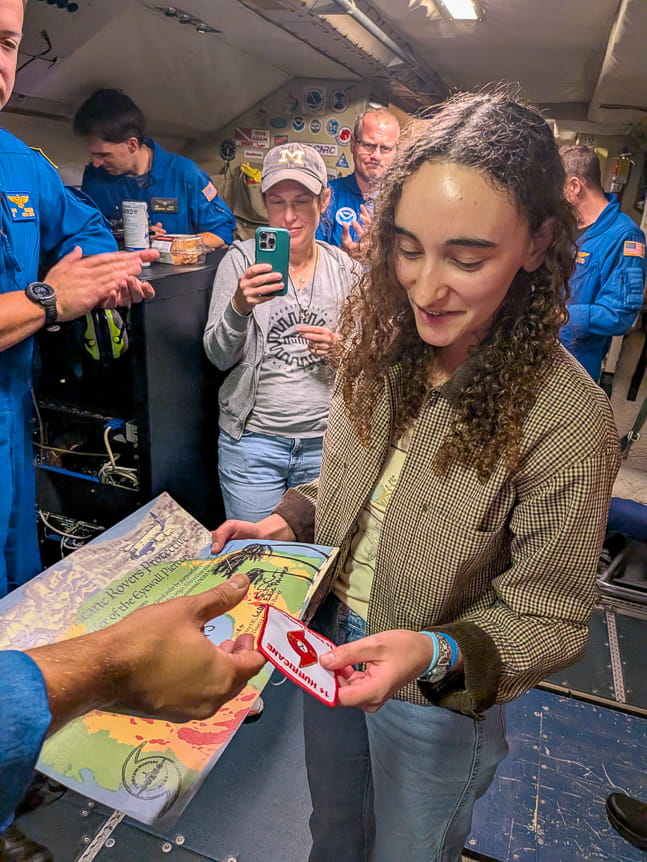
Luckily, the crew on board was welcoming and supportive.
“As they passed my seat, they checked in to see how I was doing, made jokes and offered to answer questions,” Báez said. “At times, I was so focused on asking questions and discovering the different roles in the mission that I completely forgot we were on an airplane headed for a hurricane.”
After taking off from Lakeland, Florida, the aircraft spent five hours in Isaias, making five passes through the eye. The hurricane developed into a Category 3 storm.
Wadler, a veteran hurricane researcher who has flown on many missions, continued his research of dropping uncrewed aerial systems (UAS), or drones, into the hurricanes to get hard-to-obtain information close to the surface of the ocean, where the storms form. Such information allows researchers to improve forecasting. On the Isaias mission, two drones transmitted data from just 30 meters above the ocean before splashing into the waves.
“It’s rare to get that near-surface data,” said Wadler, “since the storm can easily take the UAS out from those altitudes with a strong downdraft.”
Wadler also flew into Hurricane Polo on September 25, launching four drones into the storm. The mission confirmed the storm as a Category 5, the highest level on the Saffir-Simpson scale.
One drone flew around the storm's entire eyewall, mapping its structure. NOAA incorporated data from the drone flights into its models to determine the storm’s intensity. The data also contributed to the storm forecast, according to the National Hurricane Center.
Báez, an Office of Undergraduate Research AURA Scholar, has been working with Wadler on quality control and analysis of the UAS data for over a year.
“Lauren has been an exceptional research student. I believe that getting to see how the data is collected, along with the challenges of fieldwork, will give her a whole new perspective on how to approach the data analysis,” said Wadler.
On the flight into Isaias, Báez, who is a pilot, spent time in the flight deck. She said she enjoyed observing how the flight engineer monitored airspeed changes and adjusted the engines’ rpm to help the pilots manage sudden jolts of turbulence.
She also said watching the storm’s development from the aircraft was fascinating.
“Every time the aircraft broke through the eyewall, it was like meeting a different eye,” she said.
As the warm ocean temperatures fueled the storm’s development and upper-level winds appeared to be breaking it down, the hurricane was rapidly evolving and developing into new shapes, Báez said.
“These changes weren't just fascinating to watch,” she added. “They required constant mission reorganization and critical analysis, along with decisions made within minutes.”
Wadler said the chance to fly on a hurricane hunter aircraft as an undergraduate is extraordinary.
For her part, Báez is hooked.
“One of the highlights of the flight was inauguration into the ‘Order of the Eyewall Piercers,’ a tradition by the crew to welcome new hurricane hunters,” she said. “I hope to join them again in the future as a pilot!”
Related News


