

- Category
- Space
- Date
- October 30, 2026
Particles from space are helping Embry-Riddle Aeronautical University student Blake Anton Schuetz explore where physics could take him next.
Schuetz, a senior majoring in Space Physics, has led an effort to improve an on-campus cosmic-ray experiment while preparing for a career researching quantum computing applications in particle physics.
For the past year and a half, Schuetz has worked to build and install Cosmic Watch detectors in the Particle Physics Lab. The small, transportable device measures the flux of charged cosmic rays.
Cosmic rays are high-energy particles from the sun and other energetic events beyond our solar system. When those rays collide with particles in Earth’s upper atmosphere, they can produce secondary particles, including muons. When muons decay, they can produce Michel electrons.
“By measuring these energies, we can study how cosmic rays behave,” said Schuetz. “Our results can be compared to future results from around the world as scientists deploy similar detectors to study cosmic rays.”
With the detectors, Schuetz expects to measure muon energies, muon lifetimes and Michel electron energies by identifying individual muon events within a cylindrical, 10-gallon liquid-scintillator detector in the Particle Physics Lab. The detection system is designed to isolate events in which a Michel electron produces light entirely inside the detector.
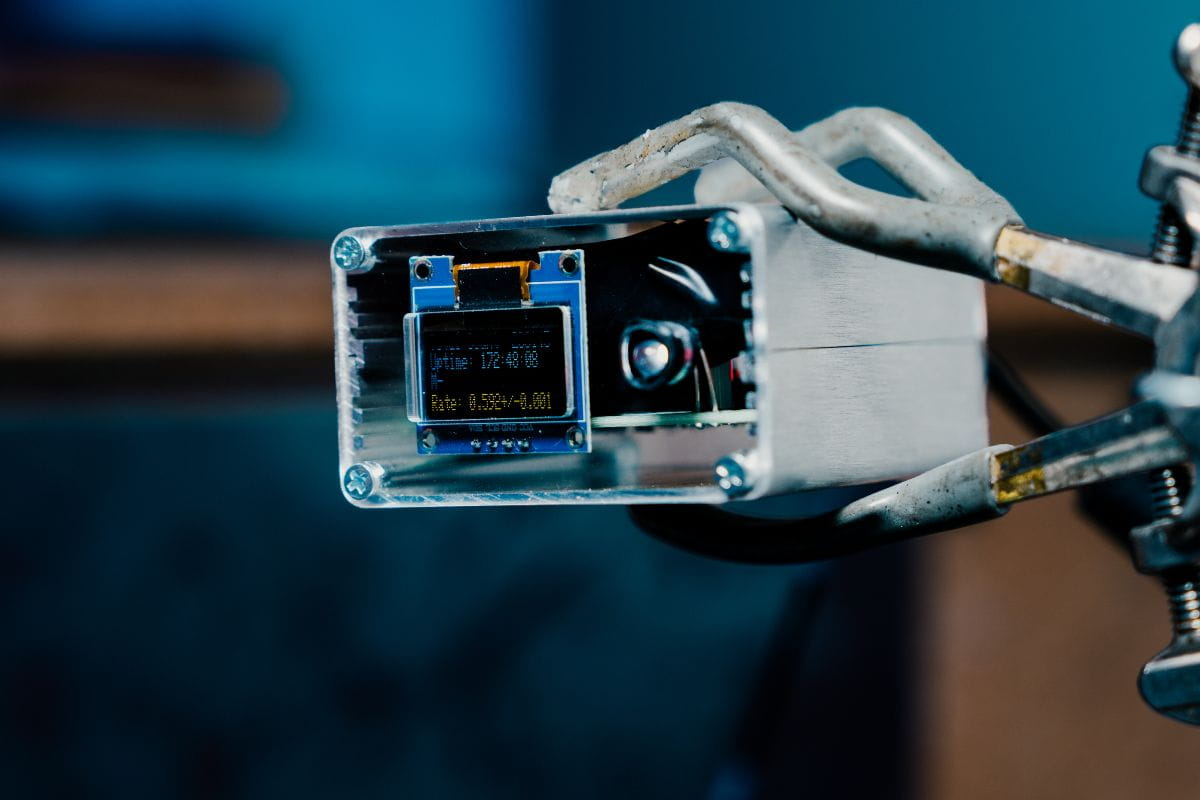
“The [Cosmic Watch Detectors], with our electronic setup, will provide coincidence counts that confirm whether a cosmic ray has truly traveled near the vertical axis of our cylindrical scintillator detector,” Schuetz said. “We will collect waveforms of decaying particles and analyze them to find their lifetimes and energies.”
Serving as the project lead, Schuetz prepared proposals for materials and soldered printed circuit board components. According to Schuetz, the detectors will improve the Particle Physics Lab’s capabilities. Future students could use the expanded system for calibration experiments that may support the search for dark matter.
“The goal of this work is to evaluate the optimal size for a university-scale detector system that can provide meaningful undergraduate research projects to study cosmic muons and Michel electrons,” Schuetz said.
Schuetz plans to take further measurements and compare results with previous studies to determine whether the upgrades improve Embry-Riddle’s measurements. Those comparisons may help the team evaluate the optimal detector size.
“Blake’s work on this project is a good example of how a motivated student can take advantage of the research environment developed by our Embry-Riddle faculty,” said Dr. Darrel Smith, a professor of Physics who mentored Schuetz.
Smith said the project gives Schuetz experience with high-speed electronics used in nuclear and particle physics laboratories around the world. Although the timing precision needed for the experiment is measured in hundreds of nanoseconds, the equipment can measure intervals down to a fraction of a nanosecond.
“The software and hardware techniques Blake is learning will serve him well in graduate school and for any technical career he hopes to pursue,” Smith said.
That work earned Schuetz a 2026 Phi Kappa Phi Pioneer Award. The $1,000 awards are presented to 50 recipients nationwide by the Honor Society of Phi Kappa Phi. The awards recognize outstanding undergraduate members who demonstrate academic achievement, leadership, service and research potential, and are designed to support students as they continue toward becoming successful scholars.
“Receiving this award helps give me more confidence in myself,” Schuetz said. “It provides acknowledgment that my pursuits are valued by the greater academic community and that there are people who believe in my career path.”
Assistant Professor Rachael Schmidt, president of Embry-Riddle’s Prescott chapter of Phi Kappa Phi, said Blake’s selection highlights his dedication as an undergraduate researcher.
“Blake’s selection for the Pioneer Award is a well-deserved recognition, reflecting his research and future goals,” Schmidt said. “His dedication to his studies, initiative in research, and commitment to academic growth make this recognition especially meaningful. We are thrilled that this award will help support him as he continues his education and works toward his goals.”
The Phi Kappa Phi Prescott chapter supports its members through scholarship opportunities, awards, community service and mentorship. It also helps students build on their accomplishments and connect with resources during their time at Embry-Riddle, Schmidt said.
The project is expected to form the basis of Schuetz’s senior research thesis and lead to a paper he and Smith aim to publish before Schuetz graduates in spring 2027.
“I am grateful to work under Dr. Smith,” he said. “He has expanded my knowledge of high-energy physics so that I can pursue quantum computing applications in my future career.”
Related News


