- Category
- Research
- Date
- November 5, 2026
Based on 27 years of research into a space weather phenomenon that creates powerful surges of energy — combined with brand-new images from the surface of the sun — Dr. Katariina Nykyri has proposed an answer to a long-standing mystery: how the sun’s corona, or outer atmosphere, is heated to more than a million degrees, hundreds of times hotter than its visible surface.
Interpreting this process is important to life here on Earth, said Nykyri, professor in the Department of Physical Sciences at Embry-Riddle Aeronautical University.
“The sun’s hot corona is the source of the solar wind and of the space weather that can disrupt satellites, GPS, radio communications and power grids,” Nykyri said. “Understanding how it is heated is key to understanding and eventually predicting our sun’s behavior.”
Nykyri's research was published today in The Astrophysical Journal Letters.
The phenomenon Nykyri has been studying since she was a Ph.D. student, and that was recently spotted on the sun’s surface by the U.S. National Science Foundation Daniel K. Inouye Solar Telescope, relates to Kelvin-Helmholtz (KH) waves. The waves are like whirlpools that form when two fluids flow past each other at different speeds, similar to the eddies that form in a river as the river’s faster main flow passes slower water along the river’s banks.
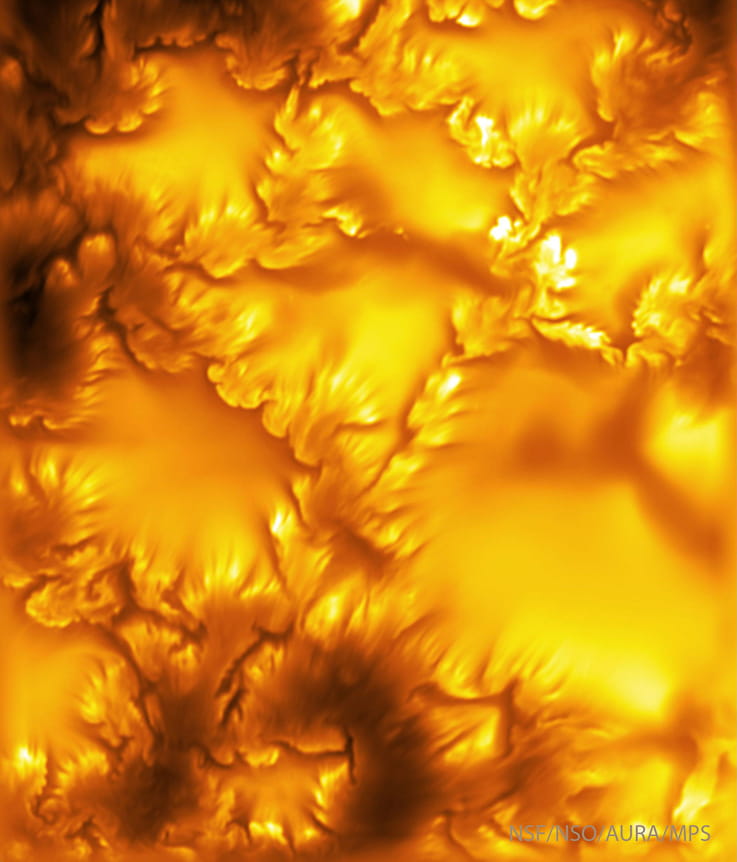
In a study published in August in the journal Nature by Kuridze et al., researchers released images and time-lapse video of never-before-seen KH waves on the visible surface of the sun (the photosphere) that had been recorded by the NSF Inouye Solar Telescope. Nykyri said that when she saw the images, she realized that what she had learned about the waves and reconnection closer to Earth could help explain coronal heating. Spacecraft cannot visit the lower corona where the heating begins, but “simple scaling laws,” derived from spacecraft measurements closer to Earth, show how effectively magnetic energy can be converted to heat in magnetic reconnection and seem to apply wherever reconnection takes place.
“Applying these laws to the properties of KH vortices Inouye observed lets us estimate coronal heating,” Nykyri said.
"The observed heating of the solar chromosphere, and the solar corona above, is a decades-old puzzle with several competing yet incomplete explanations invoking magnetized plasma waves, instabilities and magnetic reconnection phenomena," said NSF Plasma Physics Program Director Vyacheslav "Slava" Lukin, who is also an expert on magnetic reconnection. "By building on prior work in magnetospheric and laboratory-based plasma physics and using recent observations from the NSF Inouye Solar Telescope, this new model unifies these explanations into one cohesive whole."
The paper also tackles a key puzzle of scale: the observed whirlpools are tens of kilometers across, while reconnection ignites in magnetic layers that, at the sun’s surface, are nearly a million times thinner. Nykyri showed that a vortex’s swirling motion winds up the magnetic field and thins these layers exponentially fast, closing that million-fold gap within the lifetime of a single vortex. She also demonstrated, using a plasma simulation, how large-scale KH wave structures can collapse into thin current sheets where reconnection begins.
Dr. Aroh Barjatya, executive director of Embry-Riddle’s Center for Space and Atmospheric Research, said Dr. Nykyri’s work demonstrates how decades of sustained fundamental research in magnetospheric physics can unlock new insights into solar phenomena.
“We are immensely proud of her scientific achievement,” he said, “which exemplifies the innovative, interdisciplinary and tenacious pursuit of scientific discovery that we champion at Embry-Riddle.”
Nykyri said fusion energy could also advance from this research.
“Learning how nature turns magnetic energy into heat helps fusion research,” she said, adding that “the prize is large," as "the deuterium in a single glass of heavy water holds enough fusion energy to cover a person’s energy use for decades.”
The paper published in the Astrophysical Journal Letters is titled "Photospheric Kelvin–Helmholtz Vortices as Possible Drivers of Coronal Heating: Implications of the DKIST Observations" (https://doi.org/10.3847/2041-8213/aeb6c4).Though the paper was solely authored by Nykyri, she credited her students and colleagues for years of work on KH waves and reconnection, work that was supported by many NASA and NSF grants.
Related News