- Category
- Engineering
- Date
- November 24, 2026
Connie Soper’s career has taken her from studying Aerospace Engineering at Embry-Riddle Aeronautical University to leading teams building vehicles intended for the Moon.
When she returned last month to the Prescott Campus, she encouraged students to pursue opportunities even when the next step feels uncertain.
“You guys are just getting started,” said Soper, who graduated in 1998. “We are on the cusp of another golden age of space and aerospace. Your path will never be straight. It will never be perfect. Things will go wrong. It’s about how you learn from it, and how you leverage your support system to pick you up and keep going. You guys can do it.”
Soper, Blue Origin’s vice president of Lunar Permanence Manufacturing Operations, joined fellow Blue Origin colleagues Ian Dolge and William Carpenter — also Embry-Riddle alumni — for Blue Origin Night at the Prescott Campus. Founded by Jeff Bezos, Blue Origin is a commercial space company, with operations spanning launch services, rocket engines and government space programs.
Dolge, a senior software development engineer, graduated in 2010 with his Electrical Engineering degree, and Carpenter, a propulsion engineer, graduated in 2018 with his Mechanical Engineering degree. Together, the three offered students a look at the careers possible after graduation and the habits that help engineers succeed.
The visit also gave the three alumni a chance to see how the campus had changed since their time as students. Soper praised the caliber of the capstone projects she saw and the resources available to today’s students.
“There is so much that you guys have,” she said. “I’m so thankful for that, and I’m thankful to be a part of the university that’s creating this kind of legacy. Not just for the university, but for our industry, and those that come beyond.”
For Soper, her interest in aerospace started with her grandfather, who worked as a B-52 mechanic and took her to air shows. She recalled reading about space as a child and being determined to learn, even though her family could not afford to send her to space camp.
That curiosity eventually brought her to Embry-Riddle’s Prescott Campus.
“I’d never been here. I just knew that this was closer to my people, and my tribe, than anywhere else I could think of,” she said. “It took a lot for me to leave everything I knew to drive here. Sometimes, you’ll never be ready. Feel the fear. Do it anyway.”
In 2015, she earned an MBA in Aviation through Embry-Riddle’s Worldwide Campus.
“Your education can open the door, but it’s what you do with it afterward that determines where you go.”
Her career has included roles at Honeywell Aerospace, L3Harris and Virgin Galactic, and she has experience in engineering, testing, safety, supply chain and manufacturing. At Blue Origin, she led the team responsible for completing the first New Glenn launch vehicle and now leads manufacturing of lunar cargo vehicles.
Soper stressed that effective leadership requires enough technical understanding to ask useful questions while giving team members room to contribute.
“So, it’s a balance. You want to make sure that your team is empowered, and you have to know enough to know what questions to ask.”
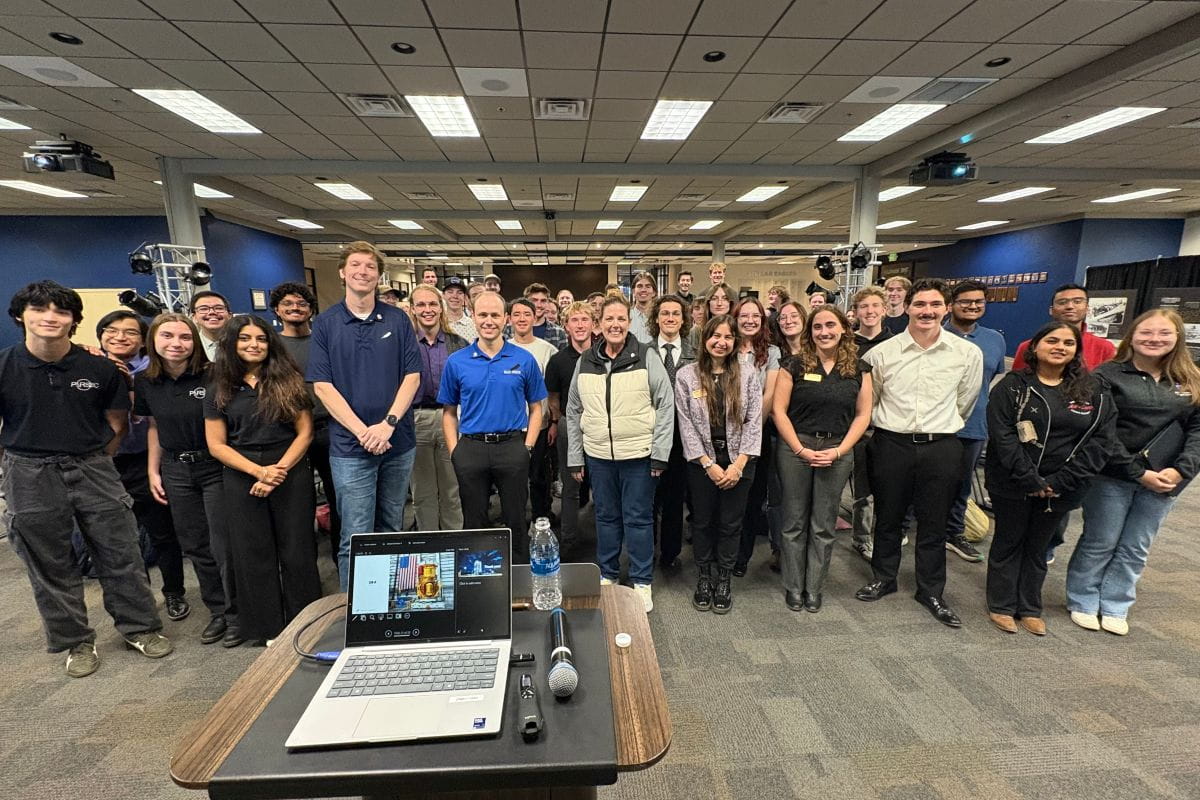
During the panel discussion, Dolge encouraged students to pursue opportunities beyond their coursework early in their college careers. Reflecting on his own experience at Embry-Riddle, he recalled postponing his search for internships and other opportunities until graduation was approaching.
“Looking here, I see capstone projects and all of these clubs,” he said. “That would be my advice to all of you. If you’re not getting involved, look out there and find something that inspires you to get into that.”
Carpenter emphasized curiosity as a quality that helps engineers solve difficult problems, encouraging students to keep questioning how things work.
“Not being quick to be satisfied with ‘that’s just the way it is,’ but always having the urge to go one little layer deeper, just to deepen your understanding of how something works or your understanding of what this problem could be,” he said, “that natural curiosity is what I look for.”
Related News