

- Category
- Space
- Date
- June 30, 2026
Embry-Riddle Aeronautical University post-doctoral researcher Dr. Marie Bals and her mentor, Dr. Alan Liu, spent more than 12 hours a day for a week installing a new high-powered laser at the Andes Lidar Observatory in Chile.
After long hours of careful alignment and calibration, their efforts were rewarded when a bright orange beam pierced the midnight sky.
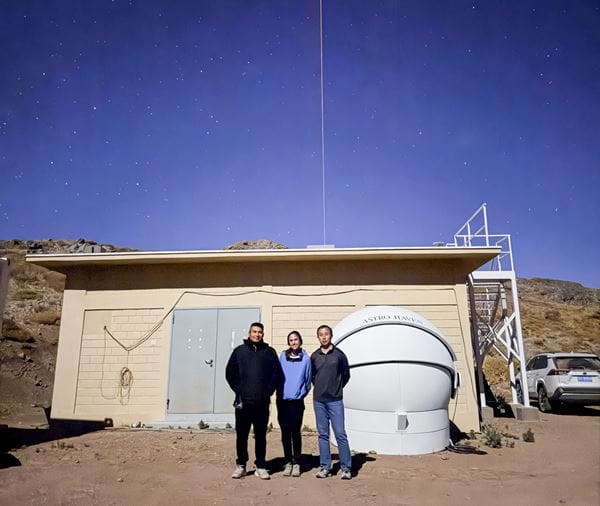
“When we finished, it looked so surreal. The laser beam is like something out of ‘Star Wars’ and goes up so high,” said Bals. “It looked amazing, and we were sort of quiet at that moment. Then we celebrated.”
For years, Liu, a professor in the Department of Physical Sciences and director of the university’s Space Physics Research Lab (SPRL), has been collecting data at sites high in the Andes Mountains, where clear skies, high elevations and dry conditions provide ideal viewing conditions.
His instruments investigate the upper atmosphere, the boundary between Earth and space. Bals said the new laser will enhance the lidar system and enable the collection of even more reliable data. It works by exciting a layer of sodium in the mesosphere, which allows the researchers to measure wind, temperature and other atmospheric parameters.
Subsequent observations and resulting data analysis will provide a better understanding of the upper atmosphere, and how it can influence critical infrastructure, such as communication and navigation systems, Bals said. Liu’s research also aims to better predict rapid changes in the region to improve the safety and success of future space exploration.
From Aerospace Engineering to Atmospheric Physics
For Bals, the project in Chile is the latest hands-on research opportunity she has been able to experience at Embry-Riddle. She has been working with the university’s professors for the past several years on space physics projects at both the Prescott and Daytona Beach campuses.
“Marie is a super energetic person and is interested in all aspects of the research from engineering work, field experiment, to science investigation,” Liu said.
In her native Germany, Bals studied aerospace engineering, earning her B.S. and M.S. at the University of Applied Sciences in Munich. She then came to Embry‑Riddle’s Prescott Campus to work on a research project involving gravitational waves with Dr. Michele Zanolin, a professor in the Department of Physics and Astronomy.
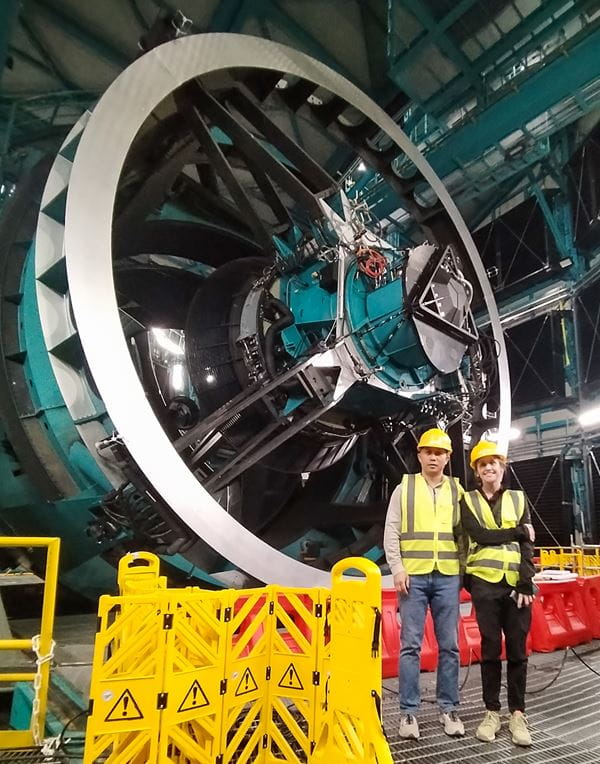
After moving to Embry-Riddle’s Daytona Beach Campus for graduate research in space physics, Bals worked with Dr. Kshitija Deshpande, an associate professor in the Department of Physical Sciences and lead of the Global Navigation Satellite Systems team, on projects applying machine learning techniques to GPS signal scintillation and ionospheric instabilities.
In 2025, Bals started working with Liu on atmospheric science projects focused on the mesosphere and ionosphere. She credited Liu with helping her gain experience with the instruments used in the research, teaching her how to configure and operate them to collect accurate measurements and maximize data collection.
“I really appreciate the experiences and opportunities I’ve had at Embry-Riddle, especially within the Department of Physical Sciences,” said Bals. “Students can become involved in hands-on research projects at every stage, and that collaborative environment is incredibly valuable.”
Related News


