
- Category
- Aviation
- Date
- July 30, 2026
Months before four Embry-Riddle Aeronautical University women lifted off in the nation's longest-running all-women air race, they pored over weather forecasts, refined flight procedures and honed strategies.
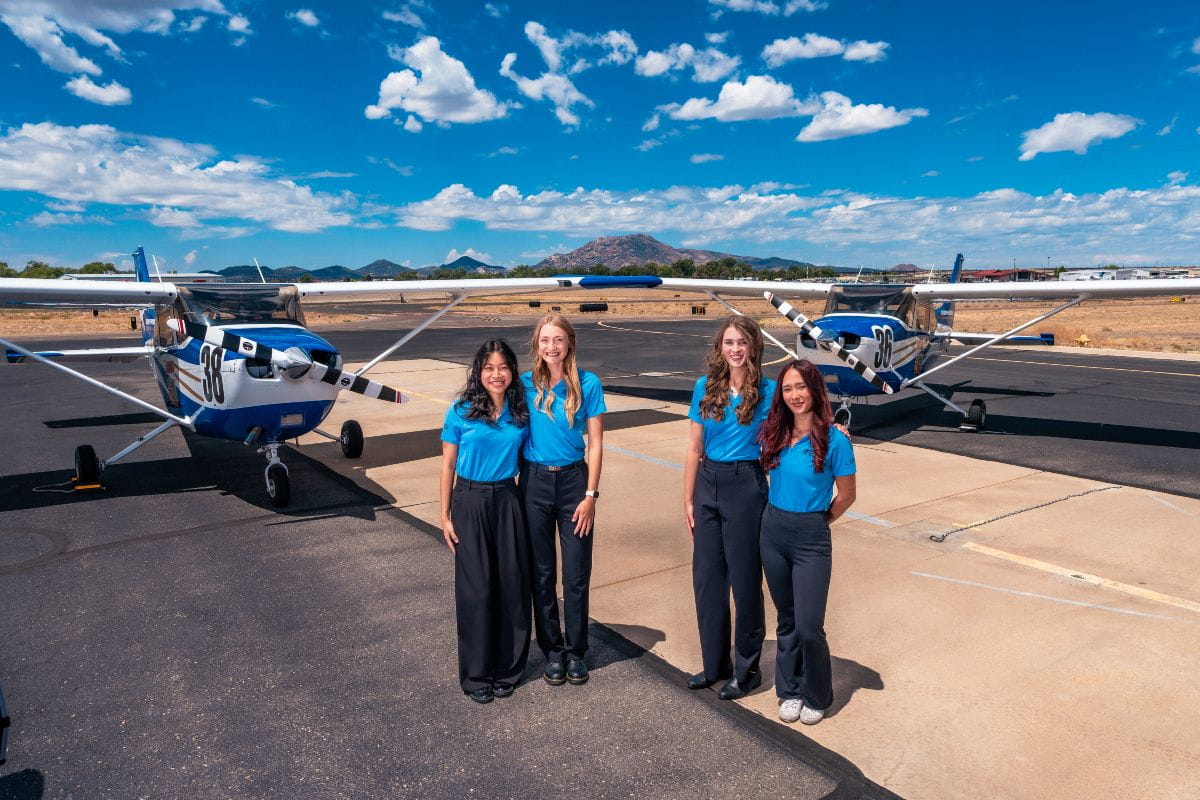
Their preparation paid off as they navigated 2,700 miles across ten states for the 49th Air Race Classic. The two Prescott Campus teams, known collectively as the Whiskey Row Racers, finished among the top five in the race’s collegiate division.
Team Saguaro—piloted by Aeronautical Science student Nguyen "Yen" Pham and 2025 Aeronautics graduate and instructor Kaetlin Halseth—finished fourth. Team Prickly Pear—piloted by Aeronautical Science student Sophia Grimm and 2025 Aeronautical Science graduate and instructor Liana Curcio—finished fifth. Both teams flew 2023 Cessna 172S Skyhawks.
For Pham, the results validated the premier flight education at Embry-Riddle.
“Throughout the race, we were constantly using aeronautical decision-making, weather analysis, fuel planning and teamwork — the same things we practice every day in training,” she said.
Halseth said the race let her “apply so many of those hypothetical scenarios” presented in classes and flight courses.
The two teams spent months preparing for competition under the coaching of Sophie DuBois, Bella Memeo and Yuka Noguchi, Embry-Riddle flight instructors and all former Air Race Classic competitors themselves.
“The Air Race Classic is extremely physically and mentally demanding, and our girls rose to the occasion,” DuBois said. “They put in months of hard work, and seeing it payoff is incredibly rewarding. We couldn’t be more proud of them for flying a safe and fast race.”
The teams’ preparation proved especially valuable as weather threatened to reshape the race. Before departing, the racers studied forecasts and identified worsening conditions expected on the race’s final day.
“Looking at the forecasts before the race, there were a lot of signs pointing toward significant weather on the fourth day,” Pham said. “So, we planned to get up early, fly until late and make as much progress as we safely could.”
Grimm attributed their success to disciplined crew coordination throughout each leg of the race as changing weather, unfamiliar airports and mounting fatigue demanded constant communication.
“My co-pilot Liana and I made a priority of open communication, verbalizing our thought processes and always double-checking each other,” Grimm said. “Having trust and confidence made this much smoother, allowing us to stay calm in stressful situations and make sound, safe decisions.”
Halseth said sharing responsibilities with her teammate became second nature.
“Yen did a lot of the flying, and I did navigating, radios, weather monitoring and other things,” she said. “We both understood our roles very well, and we did not have any conflicts together.”
Both teams said they found inspiration from the community and competitors involved in the race, which traces its roots to the Women’s Air Derby of 1929 and celebrates women in aviation. Grimm said it was thrilling to see so many women in a predominantly male field come together in such a rewarding endeavor.
For Pham, the full impact of their accomplishment came only after the final landing.
“When we landed, it finally hit us that we had flown over 2,700 miles in just three days,” she said. “We were both incredibly emotional because of how hard we had worked together. It almost didn’t feel real.”
Pham and Grimm said they hope their experience will encourage future Embry-Riddle pilots to continue the Whiskey Row Racers tradition.
Halseth offered encouragement to women considering future competitions. “My biggest advice is simple—apply!” she said. “Even if you think you don't have enough experience or that you won't get selected, take the chance.”
Related News


