
- Category
- Engineering
- Date
- September 22, 2026
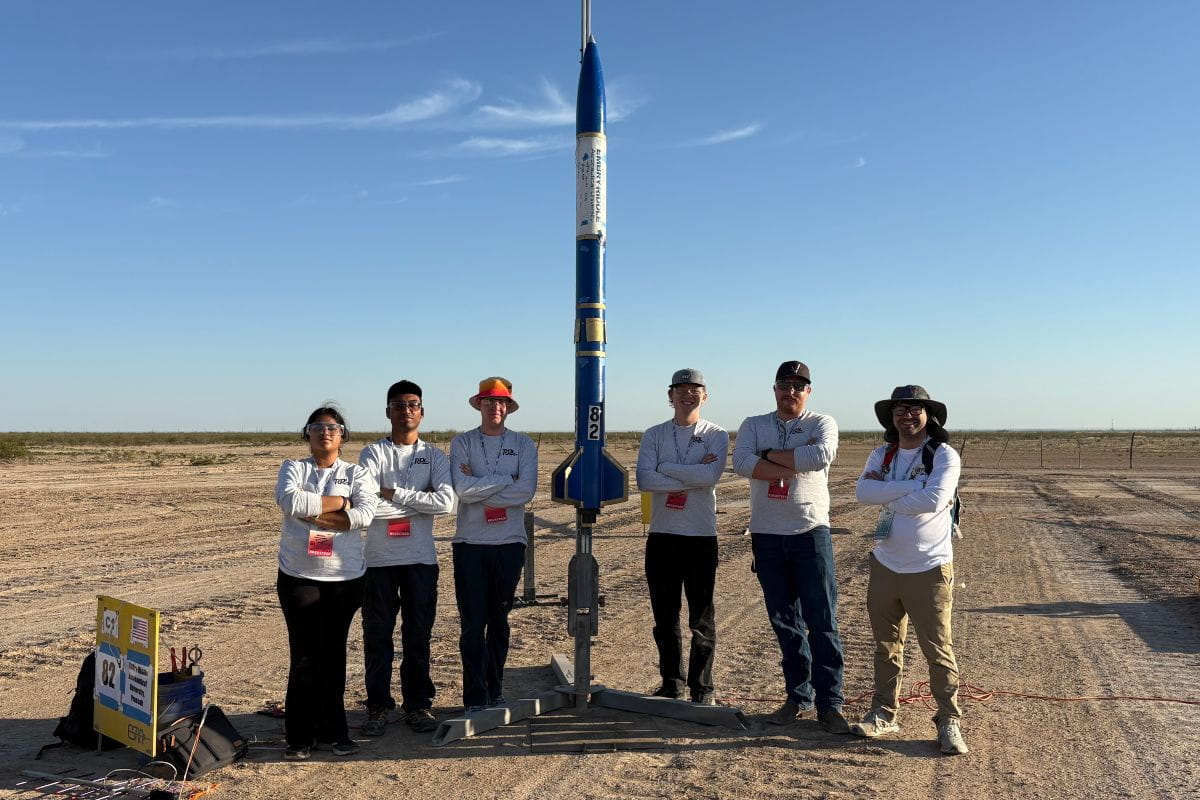
Embry-Riddle’s Rocket Development Laboratory (RDL) competed in the 2026 International Rocket Engineering Competition (IREC), held June 15–21 in Midland and Saragosa, Texas. The team finished 39th out of 64 teams in the 10,000-foot commercial off-the-shelf (COTS) category, and 58th out of 144 teams overall.
This year’s rocket featured an updated version of the team’s airbrake system, designed to control the rocket’s flight and guide it toward its goal of 10,000 feet above ground level.
“The team was incredibly prepared this year,” said Quentin Trull, a junior studying Mechanical Engineering robotics who served as the flyer of record and controls team lead. “After three test flights, the team could prepare the rocket for flight very efficiently. I think the team felt very confident on the day of the launch.”
This year, Embry-Riddle’s team launched on the first day of competition for the first time in several years. However, their flight did not go entirely as planned.
A software bug caused the launch-detection system to trigger prematurely, affecting the rocket’s flight performance and preventing its airbrakes from deploying. Traveling just beyond Mach 1, the rocket reached an apogee—or maximum altitude—of 11,755 feet, 1,755 feet above its target.
Because apogee accuracy accounted for 50% of the overall competition score, the airbrake malfunction impacted the team’s final placement.
“We usually have telemetry feedback to let us know what state our airbrake controller is in, but this radio link was not functioning,” said Trull. “Unfortunately, this prevented us from catching the issue that cost us most of our score.”
Despite the setbacks, the team earned full points for successfully recovering the rocket.
“Testing and competition can be very different,” said Dhanush Balusa, the team’s recovery lead and incoming project manager for 2027. “Through post-flight analysis, we found that other rockets launching around us triggered the launch-detect state for our airbrakes, causing them not to deploy.”
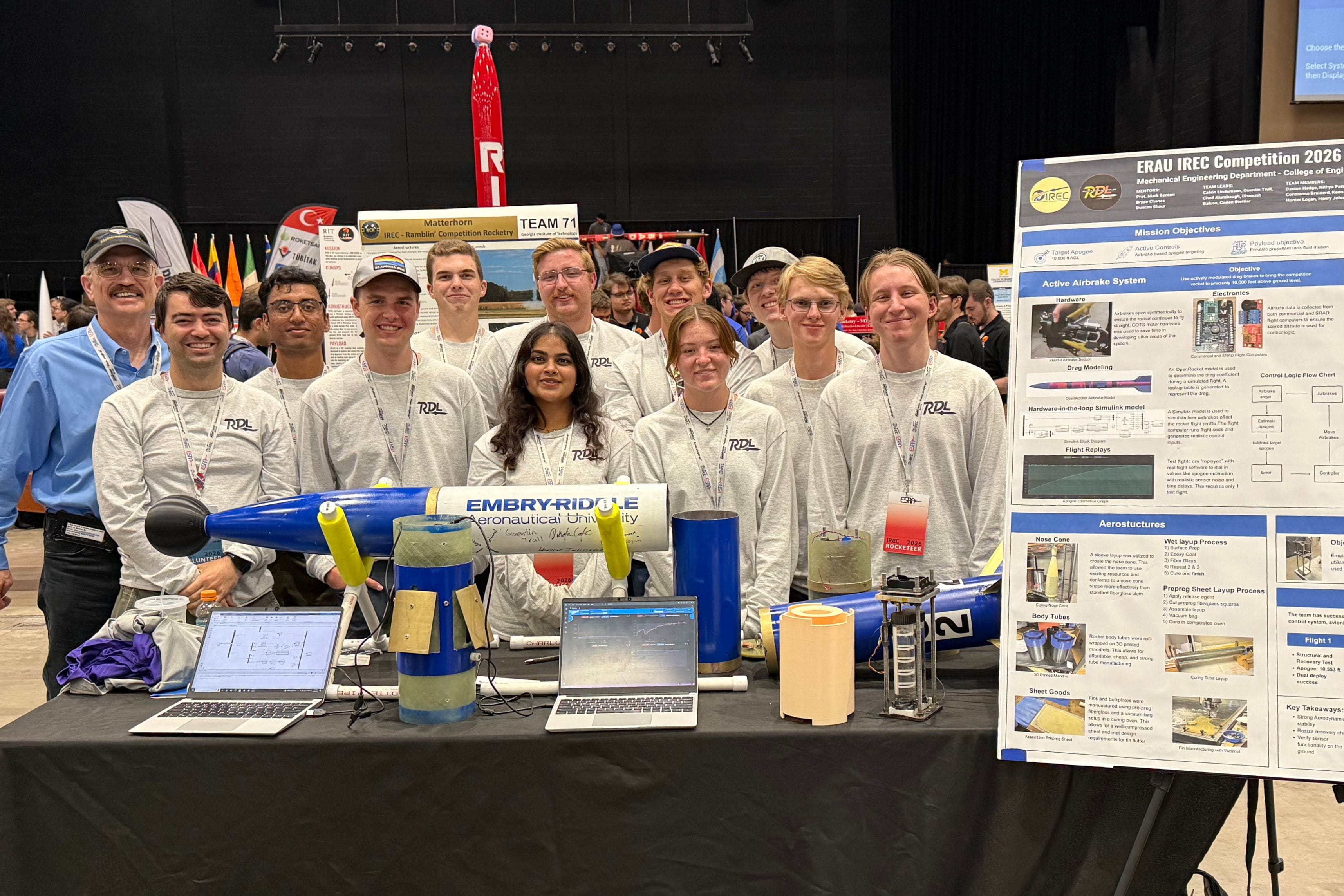
Looking ahead to IREC 2027, the team aims to address the launch-detection bug, improve its apogee-estimation method and redesign the payload, which was intended to measure liquid “sloshing” inside fuel tanks during flight. The team was unable to collect payload measurements this year, but future results could inform the RDL’s next rocket designs.
Team leaders included Calvin Lindemann, a Fall 2025 graduate in Cyber Intelligence and Security who served as project manager, and Chad Alumbaugh, an Aerospace Engineering student specializing in astronautics who served as structures lead. Dhanush Balusa, an Aerospace Engineering student specializing in astronautics, will serve as the team’s project manager at IREC 2027 following graduation in the spring.
“I am very proud of the outstanding rocket engineering design effort and teamwork demonstrated by our IREC 2026 team,” said Professor Mark Benton, faculty advisor for the team. “I look forward to helping this year's team achieve their goals at IREC 2027.”
The team expressed gratitude to the Undergraduate Research Institute and College of Engineering for their support, as well as to advisor Professor Mark Benton, mentor Bryce Chanes, a 2017 graduate, and all RDL members who contributed throughout the season, including:
- Quentin Trull (flyer of record/controls team lead) — Mechanical Engineering, Robotics
- Calvin Lindemann (project manager) — Cyber Intelligence and Security
- Chad Alumbaugh (structures lead) — Aerospace Engineering, Astronautics
- Dhanush Balusa (recovery lead) — Aerospace Engineering, Astronautics
- Caden Stettler (payload lead) — Mechanical Engineering, Propulsion
- Nithya Pattamatta — Aerospace Engineering, Astronautics
- Constance Brainerd — Mechanical Engineering, Energy
- Keenan Walsh — Aerospace Engineering, Astronautics
- Hunter Logan — Mechanical Engineering, Propulsion
- Daxton Hedge — Mechanical Engineering, Propulsion
- Henry Johnson — Mechanical Engineering, Propulsion
Related News


