

Your Future in Aviation Maintenance
and Technical Operations
Advance your aviation maintenance career and build the expertise to keep the world’s aircraft flying safely and efficiently. With a Bachelor of Science in Aviation Maintenance and Technical Operations from Embry‑Riddle, you’ll strengthen your leadership, safety management and technical competencies through advanced study in maintenance operations, emerging technologies and aviation systems.
Whether you’re pursuing a partnership pathway or continuing your education as an FAA-certificated Airframe and Powerplant (A&P) technician, you’ll develop the decision-making skills needed to lead maintenance operations and prepare for supervisory and management roles across the aviation industry.
Program Details
Offered at the Daytona Beach, Florida, campus
The B.S. in Aviation Maintenance and Technical Operations is offered at our Daytona Beach Campus in partnership with Daytona State College. Designed for aspiring and current aviation maintenance professionals, the program provides multiple pathways to earn a bachelor's degree while preparing students for careers in technical operations, maintenance leadership and aviation management.
Students build upon their technical foundation through advanced coursework in maintenance operations, aviation safety, business management, avionics systems, aircraft communications, cybersecurity and emerging aviation technologies. Graduates are prepared to lead maintenance organizations, improve operational performance and support the safe and efficient operation of today's aircraft fleets.
Partnership Pathways
The B.S. in Aviation Maintenance Science and Technical Operations offers two academic pathways designed to support students at different stages of their educational journey. Whether you're beginning college or transferring after earning an associate degree, each pathway provides a clear, structured route to completing your bachelor's degree through Embry-Riddle and Daytona State College.
Explore the pathway below that best aligns with your academic background and career goals.
1+2+1 Pathway
The 1+2+1 pathway allows students to begin their studies at Embry-Riddle, complete aviation maintenance coursework at Daytona State College, and return to Embry-Riddle to complete their bachelor's degree.
The sample plan of study below outlines the recommended course sequence for this pathway. Students should work closely with their academic advisor to develop a personalized plan based on transfer credits, course availability, and academic progress.
Pathway Timeline:
- Year 1: Embry-Riddle Aeronautical University
- Years 2-3: Daytona State College
- Year 4: Embry-Riddle Aeronautical University
2+2 Pathway
The 2+2 pathway is designed for students who complete the Associate of Science in Aviation Maintenance Management at Daytona State College and want to continue their education at Embry-Riddle. Students transfer directly into the bachelor's program and complete the remaining upper-level coursework required for the degree.
Pathway Timeline:
- Years 1-2: Daytona State College
- Years 3-4: Embry-Riddle Aeronautical University
View the requirements and course info below.
-
Credits122
-
Methods of Study
- In-Person
Note: Subject to change — expected for 2027 catalog.
Daytona Beach Program Requirements
| General Education Requirements | 37 |
| Airframe and Powerplant Certification (awarded as AMST core course credit) |
48 |
| Advanced Course Requirements (AMST 362, 374, 380, 384, 388; AMSA 420, 490) |
21 |
| Program Support Courses (AVSF 210, MGMT 201, SCLM 452) |
10 |
| Open Upper-Level Electives | 6 |
| Total Credits | 122 |
Credit for A&P certification: Students holding FAA Airframe and Powerplant certification are awarded 48 semester credits recorded as the equivalents of Embry-Riddle Aeronautical University's AMST professional core courses (AMST 115-376). Four of these courses (AMST 365, AMST 366, AMST 375 and AMST 376) are upper level, contributing 12 upper-level credits toward the degree.
Upper-level requirement: (40 credits minimum). All routes satisfy the requirement as follows: A&P certification block (AMST 365/366/375/376), 12 credits; Advanced Course Requirements, 21 credits; SCLM 452, 3 credits; Open Upper-Level Electives, 6 credits; Upper-Level Humanities/Social Sciences, 3 credits. Total of 45 upper-level credits.
Course sequencing: AMST 380 and AMST 384 are co-requisites and both are prerequisites for AMST 388; each plan schedules AMST 380 and AMST 384 in the same semester with AMST 388 in a later semester. COMM 221 is scheduled prior to AMSA 490, which applies its concepts. COMM 122 precedes COMM 221 in every plan. No term in any plan schedules more than three of the seven Advanced Course Requirements, so that laboratory- and project-intensive coursework is distributed rather than concentrated.
Summer terms: Plan A requires no summer enrollment at Embry-Riddle; its only summer term falls at DSC, within the A&P sequence. Plan B includes one Embry-Riddle summer term of six credits on the Daytona Beach campus, taken after A&P completion and distributed across the six-week Session A and Session B blocks at three credits each. Summer placement assumes availability in the published schedule; students confirm offerings with an academic advisor before registering. Embry-Riddle summer tuition is assessed per credit hour rather than under the flat-rate full-time band, and students should confirm summer financial aid eligibility before committing.
AMST 201: Professional Foundations in Aviation Maintenance is a one-credit online course required in every plan and delivered without tuition charge. It is scheduled in the first fall term in which a student is enrolled at Embry-Riddle or, in Plan B, concurrently with the first term of DSC enrollment. The course carries no prerequisite and no laboratory component, and is offered on the Daytona Beach fall calendar or through Worldwide in a September term.
Calendar assumptions: Each plan's semester headings show the term in which that semester falls. The DSC sequence follows the prescribed five-consecutive-semester curriculum published in the DSC 2026-2027 catalog, which runs fall, spring, summer, fall, spring, and confers the A.S. two years after entry. Plan A begins that sequence in the fall of Year 1 and enters Embry-Riddle the following fall. Plan B begins it in the fall of Year 2. Both plans therefore depend on DSC delivering the summer term within the A&P sequence as published. The DSC program is listed as pending final external approval; confirm the published sequence with DSC before relying on the completion times stated.
Residency requirement (30 credits minimum): Students complete 59 (2+2), 68 (1+2+1), or 74 (standalone) credits at Embry-Riddle.
Applied versus transferred credit: The credit figures in each plan are credits applied to the 122-credit degree. Students transfer additional DSC credit that does not apply: in Plan A, ENC 1101 (3 credits) and AVM 1931 (6 credits); in Plan B, AVM 1931 (6 credits) and one credit of MAC 2311 or EGN 2045. That course carries four credits and the Mathematics general education category is six — MATH 111 at three credits and MATH 112 at three — so pairing MATH 111 with a four-credit calculus delivers seven and leaves one credit in excess of the requirement. In both plans, the DSC A&P course sequence totals 60 credits and is received as the 48-credit AMST professional core block. Transfer evaluations will therefore show a higher credit count than the plan tables.
Approved DSC course equivalencies: The following determinations apply where a student has already completed the DSC course. ENC 1102 is received as COMM 122, while ENC 1101 is received as lower-level open elective credit. SPC 2608 satisfies COMM 219. MAN 2021 satisfies MGMT 201. MAC 1105 satisfies the MATH 111 requirement. Among the approved lower-level humanities options, ARH 1000 is received as HUMN 144, LIT 2000 as HUMN 142, MUL 1010 as HUMN 146, and PHI 2010 as HUMN 341. Among the civic literacy options, AMH 2020 is received as HIST 120 and POS 2041 as GOVT 320.
Florida civic literacy and general education approval: Plans A and B both confer the Daytona State College A.S., so students in those plans complete one of POS 2041, AMH 2020 or AMH 2010 and pass the Florida civic literacy examination as a condition of A.S. graduation (F.S. 1007.25; F.A.C. 6A-10.02413). Where a student in Plan B satisfies a DSC general education requirement with Embry-Riddle coursework, the Embry-Riddle course is selected to align with DSC's board-approved general education list, as required by F.S. 1007.55 and F.A.C. 6A-14.303.
DSC course numbers and titles conform to the appendices of the Embry-Riddle/DSC articulation agreements and to the DSC 2026-2027 catalog. Where a general education slot is unspecified, approved options appear on the Embry-Riddle General Education course list. Note on AVM 1931: These plans record Aviation Capstone at six credits, as listed in the DSC 2026-2027 catalog course tables. The same catalog states a program-specific subtotal of 68 credits and a degree total of 83 credits, both of which are consistent only with a five-credit capstone; at six credits, the DSC A.S. totals 84. AVM 1931 does not apply toward the Embry-Riddle degree, so the credit figures in these plans are unaffected either way, but the inconsistency should be resolved with DSC before publication.
General Education Requirements
| Communication | 9 |
| COMM 122 English Composition | |
| COMM 219 Speech | |
| COMM 221 Technical Commiunication | |
| Humanitites - Lower Level | 3 |
| Social Sciences - Lower Level | 3 |
| PSYC 101 Introduction to Psychology | |
| Humanities/Social Sciences - Lower or Upper Level | 3 |
| Humanitites/Social Sciences - Upper Level | 3 |
| Computer Science/Information Technology | 3 |
| Mathematics | 6 |
| MATH 111 Pre-Calculus for Aviation | |
| MATH 112 Applied Calculus for Aviation | |
| Physical/Life Sciences | 7 |
| PHYS 113 Introductory Physics I | |
| 1 Credit Hour Lab Required | |
| Total Credits | 37 |
Airframe and Powerplant Certification
| FAA certification from prior education or industry | |
| 36 Lower-Level credits | |
| 12 Upper-Level credits | |
| Total Credits | 48 |
Advanced Course Requirements
| AMST 362 Advanced Composite Structures | 3 |
| AMST 374 Advanced Turbine Engine Systems | 3 |
| AMST 380 Advanced A/C Communications Applications & Certifications | 3 |
| AMST 384 Advanced Avionics Systems Integration & Management | 3 |
| AMST 388 Air Transport Connectivity and Cybersecurity | 3 |
| AMSA 420 Electronic Documentation and Aircraft Systems Troubleshooting | 3 |
| AMSA 490 Aviation Technical Operations | 3 |
| Total Credits | 21 |
Program Support Courses
| AVSF 210 Introduction to Aerospace Safety | 3 |
| MGMT 201 Principles of Management | 3 |
| SCLM 452 Lean Six Sigma | 3 |
| Total Credits | 9 |
Suggested Plan of Study
Plan A — 1+2+1 Pathway (Embry-Riddle to DSC to Embry-Riddle) Students complete Year 1 at Embry-Riddle (Semesters 1-2), enter DSC in the fall of Year 2 and complete A&P training and the A.S. across five consecutive semesters (Semesters 3-7, including one summer term), and return to Embry-Riddle for one summer term and two semesters (Semesters 8-9 and the preceding summer). Students remain enrolled at Embry-Riddle in Semester 3 through AMST 201, taken online concurrently with DSC coursework. 68 credits are completed at Embry-Riddle; 54 credits from DSC apply to the degree (48 A&P plus 6 general education). DSC accepts 12 Embry-Riddle credits toward the A.S., all completed before DSC entry. The A.S. is conferred in May of Year 3, and the sequence completes the degree in four years, with graduation in May.
Semester 1 - Embry-Riddle Aeronautical University (Fall, Year 1)
BUAN 125 or BUAN 222
Foundations in Business Data Analytics, or Business Analytics Tools
3
Physical/Life Science with laboratory (PHYS 113 and PHYS 113L recommended;
the laboratory is a separate registration)4
AVSF 210
Introduction to Aerospace Safety
3
MATH 111
Pre-Calculus for Aviation (satisfies DSC MAC 1105)
3
COMM 122
English Composition (satisfies DSC ENC 1101)
3
Semester Total
16
Semester 2 - Embry-Riddle Aeronautical University (Spring, Year 1)
COMM 219
Speech
3
Humanities — Lower Level (approved options per articulation agreement)
3
PSYC 101
Introduction to Psychology (satisfies DSC PSY 1012)
3
Humanities/Social Sciences — Lower or Upper Level (HIST 120 or GOVT 320 recommended;
satisfies DSC social sciences core or civic literacy requirement)3
MGMT 201
Principles of Management
3
Semester Total
15
Semester 3 - Daytona State College and Embry-Riddle Aeronautical University (Fall, Year 2)
AMT 1751C
General I
6
AMT 1752C
General II
6
ENC 1101 satisfied by Embry-Riddle COMM 122 (Semester 1)
AMST 201
Professional Foundations in Aviation Maintenance (Embry-Riddle online,
taken concurrently with DSC enrollment; no tuition charges)1
Semester Total
13
Semester 4 - Daytona State College (Spring, Year 2)
AMT 1781C
Airframe I
6
AMT 1782C
Airframe II
6
MAC 231 or EGN 2045
Calculus I, or Engineering and Technology Calculus I
(per articulation agreement; transfers to Embry-Riddle as Applied Calculus GE)4
Semester Total
16
Semester 5 - Daytona State College (Summer, Year 2)
AMT 1783C
Airframe III
6
AMT 1784C
Airframe IV
6
PHY 1020
Conceptual Physics (transfers as lower-level GE Physical/Life Science)
3
Social sciences core satisfied by Embry-Riddle coursework (Semester 2)
Semester Total
15
Semester 6 - Daytona State College (Fall, Year 2)
AMT 1785C
Powerplant I
6
AMT 1786C
Powerplant II
6
PSY 1012 satisfied by Embry-Riddle PSYC 101 (Semester 2)
Semester Total
12
Semester 7 - Daytona State College (Spring, Year 3)
AMT 1787C
Powerplant III
6
AMT 1788C
Powerplant IV
6
Humanities core satisfied by Embry-Riddle coursework (Semester 2)
AVM 1931
Aviation Capstone (A.S. requirement; see note on AVM 1931 credit value)
7
Semester Total
18
Summer Term - Embry-Riddle Aeronautical University (Summer, Year 3; Sessions A and B)
AMSA 420
Electronic Documentation and Aircraft Systems Troubleshooting (Session A)
3
Open Upper-Level Elective (Session B)
3
Semester Total
6
Semester 8 - Embry-Riddle Aeronautical University (Fall, Year 4)
COMM 221
Technical Communication
3
AMST 362
Advanced Composite Structures
3
AMST 380
Advanced A/C Communications Applications & Certifications
3
AMST 384
Advanced Avionics Systems Integration & Management
3
Humanities/Social Sciences - Upper-Level (see GE list)
3
Semester Total
15
Semester 9 -Embry-Riddle Aeronautical University (Spring, Year 4)
AMST 388
Air Transport Connectivity and Cybersecurity
3
AMST 374
Advanced Turbine Engine Systems
3
AMSA 490
Aviation Technical Operations
3
SCLM 452
Lean Six Sigma
3
Open Upper-Level Elective
3
Semester Total
15
Credits completed at Embry-Riddle (31 in Semesters 1-2; 1 in Semester 3; 36 in Semesters 8-9 and one summer term)
68
Credits transferred from DSC (48 A&P + 6 general education)
54
Degree total
122
Plan B — 2+2 Pathway (DSC A.S. to Embry-Riddle B.S.)
Students complete the A.S. in Aviation Maintenance Management at DSC across five consecutive semesters (Semesters 1-5, fall through the following spring and including one summer term), then apply 63 credits toward the Embry-Riddle degree: 48 A&P professional credits plus 15 general education credits. The A.S. is conferred in May and Embry-Riddle study begins the following fall. The remaining 59 credits are completed in residence at Embry-Riddle across four semesters (Semesters 6-9), for degree completion in four years with graduation in May. No summer enrollment at Embry-Riddle is required.
| Semester 1 - Daytona State College (Fall, Year 1) | ||
|---|---|---|
| AMT 1751C | General I | 6 |
| AMT 1752C | General II | 6 |
| ENC 1101 | English Composition (A.S. requirement; transfers to Embry-Riddle as lower-level open elective credit) |
3 |
| Semester Total | 15 | |
| Semester 2 - Daytona State College (Spring, Year 1) | ||
|---|---|---|
| AMT 1781C | Airframe I | 6 |
| AMT 1782C | Airframe II | 6 |
| MAC 1105 | College Algebra (transfers as MATH 140; satisfies the MATH 111 requirement per Embry-Riddle equivalency determination) |
3 |
| Semester Total | 15 |
|
| Semester 3 - Daytona State College (Summer, Year 1) | ||
|---|---|---|
| AMT 1783C | Airframe III | 6 |
| AMT 1784C | Airframe IV | 6 |
| PHY 1020 | Conceptual Physics (transfers as lower-level GE Physical/Life Science) | 3 |
| POS 2041 / AMH 2020 / AMH 2010 | Social Sciences core: American Federal Government, or U.S. History 1865-present, or U.S. History to 1877 (transfers as lower-level Humanities/Social Sciences GE) |
3 |
| Semester Total | 18 | |
| Semester 4 - Daytona State College (Fall, Year 2) | ||
|---|---|---|
| AMT 1785C | Powerplant I | 6 |
| AMT 1786C | Powerplant II | 6 |
| PSY 1012 |
General Psychology (transfers as PSYC 101) | 3 |
| Semester Total | 15 | |
| Semester 5 - Daytona State College (Spring, Year 2) | ||
|---|---|---|
| AMT 1787C | Powerplant III | 6 |
| AMT 1788C | Powerplant IV | 6 |
| ARH 1000 / HUM 2020 / LIT 2000 / MUL 1010 / PHI 2010 / THE 1000 |
Humanities core: approved option (transfers as lower-level Humanities GE) | 3 |
| AVM 1931 | Aviation Capstone (A.S. requirement; see note on AVM 1931 credit value) | 6 |
| Semester Total | 21 | |
| Semester 6 - Embry-Riddle Aeronautical University (Fall, Year 3) | ||
|---|---|---|
| COMM 122 | English Composition | 3 |
| Physical/Life Science with laboratory (PHYS 113 and PHYS 113L recommended; the laboratory is a separate registration) |
4 | |
| MATH 112 |
Applied Calculus for Aviation (recommended mathematics GE) | 3 |
| AVSF 210 | Introduction to Aerospace Safety | 3 |
| BUAN 125 or BUAN 222 | Foundations in Business Data Analytics, or Business Analytics Tools | 3 |
| AMST 201 | Professiona Fondations in Aviation Maintenance (Embry-Riddle online; no tuition charge) | 1 |
| Semester Total | 17 |
|
| Semester 7 - Embry-Riddle Aeronautical University (Spring, Year 3) | ||
|---|---|---|
| COMM 219 | Speech | 3 |
| MGMT 201 | Principles of Management | 3 |
| AMST 362 | Advanced Composite Structures | 3 |
| Open Upper-Level Elective | 3 | |
| Humanities/Social Sciences — Upper Level (see GE list) | 3 | |
| Semester Total | 15 |
|
| Semester 8 - Embry-Riddle Aeronautical University (Fall, Year 4) | ||
|---|---|---|
| AMST 380 | Advanced A/C Communications Applications & Certifications | 3 |
| AMST 384 | Advanced Avionics Systems Integration & Management | 3 |
| AMSA 420 | Electronic Documentation and Aircraft Systems Troubleshooting | 3 |
| SCLM 452 | Lean Six Sigma | 3 |
| COMM 221 | Technical Communication | 3 |
| Semester Total | 15 | |
| Semester 9 - Embry-Riddle Aeronautical University (Spring, Year 4) | ||
|---|---|---|
| AMST 388 | Air Transport Connectivity and Cybersecurity | 3 |
| AMST 374 | Advanced Turbine Engine Systems | 3 |
| AMSA 490 | Aviation Technical Operations | 3 |
| Open Upper-Level Elective | 3 | |
| Semester Total | 12 | |
| Credits completed at Embry-Riddle (Semesters 6-9) | 59 |
| Credits transferred from DSC (48 A&P + 15 general education) | 63 |
| Degree total |
122 |
Plan C — Standalone Completion Route (A&P from another Part 147 program)
FAA-certificated A&P technicians from other Part 147 programs receive 48 credits for certification and complete the remaining 73 credits at Embry-Riddle. The sequence below assumes no transferable general education coursework; transfer credit accelerates the plan accordingly.
| Semester 1 - Embry-Riddle Aeronautical University | ||
|---|---|---|
| COMM 122 | English Composition | 3 |
| MATH 111 | Pre-Calculus for Aviation | 3 |
| PSYC 101 | Introduction to Psychology | 3 |
| BUAN 125 or BUAN 222 | Foundations in Business Data Analytics, or Business Analytics Tools | 3 |
| AVSF 210 | Introduction to Aerospace Safety | 3 |
| AMST 201` | Professional Foundations in Aviation Maintenance (Embry-Riddle online; no tuition charge) | 1 |
| Semester Total | 16 |
|
| Semester 2 - Embry-Riddle Aeronautical University | ||
|---|---|---|
| COMM 219 | Speech | 3 |
| MATH 112 | Applied Calculus for Aviation | 3 |
| PHYS 113 | Introductory Physics I | 3 |
| HYS 113L | Introductory Physics I Laboratory | 1 |
| Humanities — Lower Level (see GE list) | 3 | |
| MGMT 201 | Principles of Management | 3 |
| Semester Total | 16 |
|
| Semester 3 - Embry-Riddle Aeronautical University | ||
|---|---|---|
| COMM 221 | Technical Communication | 3 |
| Physical/Life Science (see GE list) | 3 | |
| AMST 362 | Advanced Composite Structures | 3 |
| AMST 380 | Advanced A/C Communications Applications & Certifications | 3 |
| AMST 384 | Advanced Avionics Systems Integration & Management | 3 |
| Semester Total | 15 |
|
| Semester 4 - Embry-Riddle Aeronautical University | ||
|---|---|---|
| AMST 374 | Advanced Turbine Engine Systems | 3 |
| Humanities/Social Sciences — Lower or Upper Level (see GE list) | 3 | |
| AMSA 420 | Electronic Documentation and Aircraft Systems Troubleshooting | 3 |
| Humanities/Social Sciences — Upper Level (see GE list) | 3 | |
| Open Upper-Level Elective | 3 | |
| Semester Total | 15 |
|
| Semester 5 - Embry-Riddle Aeronautical University | ||
|---|---|---|
| AMST 388 | Air Transport Connectivity and Cybersecurity | 3 |
| AMSA 490 | Aviation Technical Operations | 3 |
| SCLM 452 | Lean Six Sigma | 3 |
| Open Upper-Level Elective | 3 | |
| Semester Total | 12 |
|
| Credits completed at Embry-Riddle | 74 |
| Credits awarded for A&P certification | 48 |
| Degree total |
122 |
Note: Course sequencing within the Standalone Completion Route is illustrative; students register per prerequisite requirements and course availability in consultation with an academic advisor.
Campus Resources
Career Opportunities
The demand for aviation maintenance specialists has never been greater, with the 2026 Boeing Pilot & Technician Outlook projecting a global need for 728,000 new maintenance technicians over the next 20 years.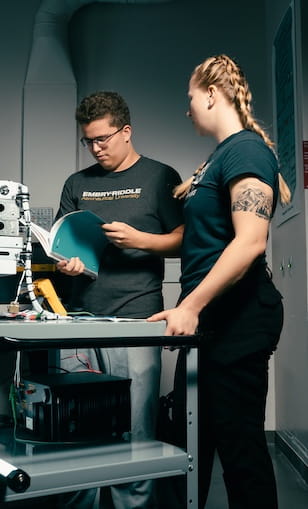


From the Marines to Aviation Maintenance
Related Degrees
Still exploring your future options? Here are some other programs that might interest you.

News and Stories


