- Category
- Insights
- Date
- October 23, 2026
What sets an Embry-Riddle Aeronautical University education apart is the opportunity to put engineering into practice. Students aren’t just learning the technical concepts, but they're applying them through research, hands-on projects, specialized facilities and experiences connected to aviation, aerospace, technology and beyond.
Students can explore engineering across a range of disciplines at residential campuses in Daytona Beach, Florida, and Prescott, Arizona. They learn from faculty with industry and research expertise while gaining experience with the tools, technologies and challenges they may encounter in their careers.
Here are five reasons you should study engineering at Embry-Riddle.
1. Gain Practical Engineering Experience
Engineering is a hands-on field, and your education should be, too.
At Embry-Riddle, students apply what they learn through design projects, experiments, competitions, research and other team-based challenges. Whether you’re designing a system, testing a prototype, programming a solution or solving a complex problem, these experiences give you the chance to put engineering principles into action.
Along the way, you can develop technical, problem-solving and collaboration skills that will prepare you for the demands of an engineering career.
2. Learn in Specialized Labs and Facilities
The right environment can make a difference in how you learn engineering concepts.
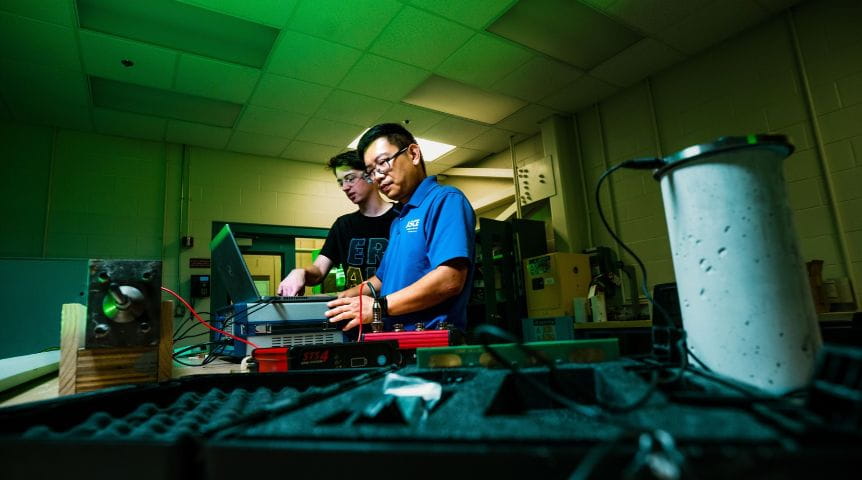
Embry-Riddle's residential campuses feature specialized laboratories and facilities where students can experiment with technologies and systems that extend learning beyond the classroom.


Engineering Physics Propulsion Laboratory (EPPL)
The EPPL is a cutting-edge research facility that engages in high-tech projects supported by both industry partners and government grants. The lab provides a unique opportunity for students to gain hands-on experience in innovative research. Students actively participate in a wide variety of scientific projects, many of which incorporate groundbreaking technological advancements.
Rocket Development Lab (RDL)
Inside the RDL, undergraduate students research, design, build and test advanced rocket technologies typically associated with graduate-level programs or industry research facilities. From liquid bi-propellant engines to full-scale flight vehicles, students at Embry‑Riddle are transforming classroom theory into real-world aerospace innovation, one engine test at a time.3. Get Involved in Research and Innovation
What if your education could take you beyond the classroom — and all the way to the moon or Mars?
Students can participate in research alongside faculty and industry partners, exploring questions across engineering, aerospace, computing and other technical fields.
Nearly 90% of Embry-Riddle students are directly connected with faculty members and industry partners through research, capstone projects and internships. Some students have even contributed to projects that have reached far beyond campus.
To the moon: EagleCam was designed and built by Embry-Riddle students and traveled aboard a SpaceX Falcon 9 rocket, becoming the first university student-built payload to land on the Moon in February 2024. The interdisciplinary team included students studying Aerospace Engineering, Computer Science, Electrical and Software Engineering and Business.
To Mars: Embry-Riddle students and faculty designed and built Langmuir probes for NASA's ESCAPADE mission. The instruments are designed to study Mars' upper atmosphere and help researchers understand how solar storms and space weather interact with the planet.
Into human spaceflight: Students also helped develop LLAMAS, a multi-camera system designed and built at Embry-Riddle to capture video of crew operations during the Polaris Dawn mission. The system flew aboard the 2024 mission, which included the first commercial spacewalk.
These projects give students a chance to contribute to engineering work connected to actual missions and merging technology. Research may also help you discover areas you may want to pursue after graduation, whether that means entering the workforce, continuing your education or exploring advanced areas of technology and innovation.
4. Build Connections to Industry
Engineering careers are built on more than what you learn in a classroom.
That’s why Embry-Riddle's connection to industry is an important part of the engineering experience.
Embry-Riddle creates opportunities for industry partners to engage with students, faculty, labs and more. Students can begin building professional connections and experience while they are still in school.
Through internships, industry-focused projects, research, student organizations and capstone experiences, students can apply concepts they study in class to professional engineering environments.
That preparation translates into real outcomes. 93% of Embry-Riddle graduates are employed or continuing their education within one year of graduation (Institutional Research, 2023-24 cohort).
5. Choose a Campus That Fits Your Goals
Your college experience is about more than your major. It is also about where you learn and the community around you.
Embry-Riddle's two residential campuses offer distinct environments for students pursuing engineering.
The Daytona Beach Campus places students near the coast of Florida’s Space Triangle with strong connections to aviation, aerospace and technology. The campus offers an active residential experience with opportunities to get involved in research, student organizations, competitions and hands-on projects.
The Prescott Campus provides a different setting in the scenic mountains of northern Arizona. Students can experience a close-knit campus environment while pursuing engineering and participating in hands-on learning, research and student activities.
Each campus’ unique characteristics offer resources for students to build technical skills, collaborate with others and prepare for their futures in engineering.
Build What’s Next
At Embry-Riddle, you can explore where your interests in engineering can take you — from the lab to research projects, industry and beyond.
Ready to explore where engineering can take you? Discover engineering programs at Embry-Riddle Aeronautical University.
Related Stories