- Category
- Impact
- Date
- October 20, 2026
You’ll turn theory into discovery and graduate ready to contribute to applied research and advance the dynamic field of space exploration. Home of the nation’s only undergraduate Space Physics program of its kind, Embry-Riddle Aeronautical University combines rigorous coursework and mentorship from research-active faculty.
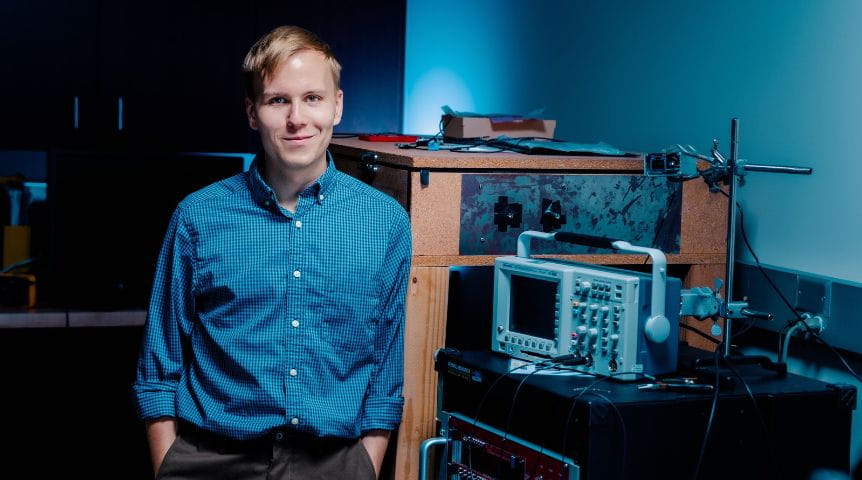
Meet Space Physics Student Blake Schuetz
Learn more about Embry-Riddle, the program and the benefits of a close-knit academic community from Blake Schuetz (’27), a Space Physics student at the Prescott Campus whose classroom and research experiences are earning national recognition.
In 2026, Blake was selected for a Phi Kappa Phi Pioneer Award, which recognizes undergraduate students who are building the research, engagement and leadership skills needed for scholarly success.
Why did you choose Space Physics at Embry-Riddle?
I was certain in high school that I wanted to pursue a STEM career in physics, as it allowed me to apply my computational skills. Embry-Riddle's Space Physics program is one of a kind and offers me the training to build the mathematical and physics background I need to pursue a meaningful career as a physicist.
In addition to the challenging coursework, Embry-Riddle allows me to pursue undergraduate research relevant to my field — an opportunity not provided by most colleges. This will give me a significant advantage when applying for graduate school.
I’ve been given problems that truly test my knowledge and understanding, and I’ve found a community of peers and professors that are there to support me through my challenges.
How does the Prescott Campus’ community impact you?
The support system I’ve found here has made me more confident in my capabilities, and I trust in the path I’m pursuing through STEM. The community gives me opportunities to grow as an independent problem-solver and reflect upon what I want out of my career.
And I love that the Prescott Campus is near various hiking trails that allow me to take time away from my studies and go out into nature.
I’m grateful for the Undergraduate Research Institute, which allows me to pursue my undergraduate research projects, attend conferences, present my research and network with individuals who share my passions.
The primary goal of my research is to determine the optimal size for a university-scale detector system that can support undergraduate research projects studying cosmic muons and Michel electrons. By running calibrations in small-scale experiments, we hope to provide useful information for future dark matter searches at universities and labs.
What have you learned that you'll carry for life?
The most valuable lesson I’ve learned personally is that there are many paths to get to the career that I am most excited about. If I just follow my passion for knowledge and trust in the process, I can let go of stress and move easily toward my goals. That’s also my best advice for other students: Let go of stress and enjoy the process.
What are your future plans?
The first science speaker series I attended at Embry-Riddle, “Introduction to Quantum Computing and Quantinuum” by Katherin Sendier, inspired me to consider a career in the quantum computing industry, specifically for its scientific research applications.
Embry-Riddle’s courses have given me the mathematical and physics foundation to pursue that interest, transitioning from experimental astroparticle physics to theoretical and computational research.
After graduation, I plan to pursue a Physics Ph.D. and become a quantum computing application scientist at a national lab. I envision myself pursuing research that leads to designing and applying quantum algorithms to questions in fundamental physics research, specifically High-Energy Physics.
Study Space Physics in Arizona or Florida
Earn your B.S. in Space Physics and find your ideal college experience at one of our two residential campuses — in the mountains or along the coast.


The Prescott Campus is nestled in the beautiful Bradshaw Mountains between Phoenix and the Grand Canyon. Renowned for its excellent seasonal weather, Prescott offers 100+ miles of scenic trails for hiking and biking, serene waters for kayaking and plenty of natural beauty for inspiration and relaxation.
Our western campus offers hands-on research and publication experience through a mile-high observatory complex with exceptional night-sky viewing, as well as the Laser Interferometer Gravitational-Wave Observatory (LIGO). Four of the Prescott Campus Physics and Astronomy faculty are members of a worldwide gravitational wave collaboration, searching for gravitational waves from inspiraling black holes and neutron stars. Other faculty work on tests of General Relativity, stellar and Xray astrophysics and nonchemical propulsion.
The Daytona Beach Campus sits at the northern anchor of Florida’s Space Coast Triangle, a short drive from Cape Canaveral and halfway between Orlando’s popular amusement parks and St. Augustine’s rich history. Immerse yourself in our dynamic student life and enjoy beautiful beaches just minutes away.
At our East Coast campus, you’ll have access to the Southeast’s largest university research telescope and funded research opportunities with faculty in theoretical, computational and experimental space science research.
The Embry-Riddle Advantage
With a strong foundation in physics, hands-on research experience and a clear vision for the future, Blake and Eagles like him are preparing to help shape the next frontier of scientific discovery.
Are you ready to launch your own future with a B.S. in Space Physics? Apply today!
Related Stories