
- Category
- Research
- Date
- June 4, 2026
Embry-Riddle Aeronautical University researchers are using artificial intelligence and machine learning techniques to accelerate the design of a device aimed at saving the lives of children and young adults who were born with a heart defect that prevents normal cardiovascular circulation.
“Machine learning and data-driven models have become a meaningful part of this research, and this is now explicitly reflected” in two recent recognitions, said Dr. Arka Das, assistant professor of Mechanical Engineering and co-director of Embry-Riddle’s Cardiovascular Engineering Research Laboratory. Das was named a Rising Star by the Academy of Science, Engineering and Medicine of Florida. His Ph.D. student mentee, Anthony Damon, earned a prestigious National Science Foundation (NSF) Graduate Research Fellowship Program award.
“In practical terms, machine learning saves time, reduces trial and error and helps us decide much more quickly which experiment or design should come next,” Das said.
Affecting one in 4,000 babies, the heart defect the researchers are addressing occurs when a person is born with only one functioning ventricle. The human body usually has two lower heart chambers, a left ventricle to pump oxygenated blood throughout the body and a right ventricle to send deoxygenated blood from the body back to the lungs to be replenished.
To survive, babies with this condition undergo rerouting surgeries so that the single ventricle pumps oxygenated blood to the body. Deoxygenated blood returning from the body, instead of passing through the single functioning ventricle to be pumped to the lungs, is sent directly to the lungs. This method, known as the Fontan Procedure, requires that the pressure in the body’s veins be raised to drive the deoxygenated blood forward.
The problem with the procedure is that elevated pressure in the veins can damage organs such as the liver and kidneys, which can be fatal. Artificial pumps can be used to assist the blood flow, allowing a lower pressure in the veins. But these pumps require an external energy source. They can also cause blood clots and often require replacement.
Dr. Eduardo Divo, vice provost for faculty affairs, professor of Mechanical Engineering and principal investigator on the research, explained that the solution being investigated by the researchers is a device called an Injection Jet Shunt (IJS), which employs a concept borrowed from aerospace engineering, namely from jet engines. Requiring no outside power source, the heart device taps into the single functioning ventricle’s own mechanical energy. Dr. William DeCampli, surgeon and director of the Heart Institute at Arnold Palmer Hospital for Children, conceived of the idea, Divo said, and “our team at Embry-Riddle has incorporated the jet engine analogy to study and optimize the device to improve survivability in patients with this highly debilitating condition.”
The Injection Jet Shunt works by channeling some of the fast-moving oxygenated blood — pumped back out to the body from the aorta — to join with the deoxygenated blood headed to the lungs. It transfers momentum to the slower blood flow, causing it to speed up through a process known as entrainment, explained Damon who is working on the project under Das. Damon is also advised by Divo.
“A simple way to think about this is to imagine a crowded room where people are trying to exit through a door,” he said. “If someone runs quickly through the crowd, they create a path that others can follow, helping more people move toward the exit. In the same way, the injection jet helps move blood more efficiently toward the lungs.”
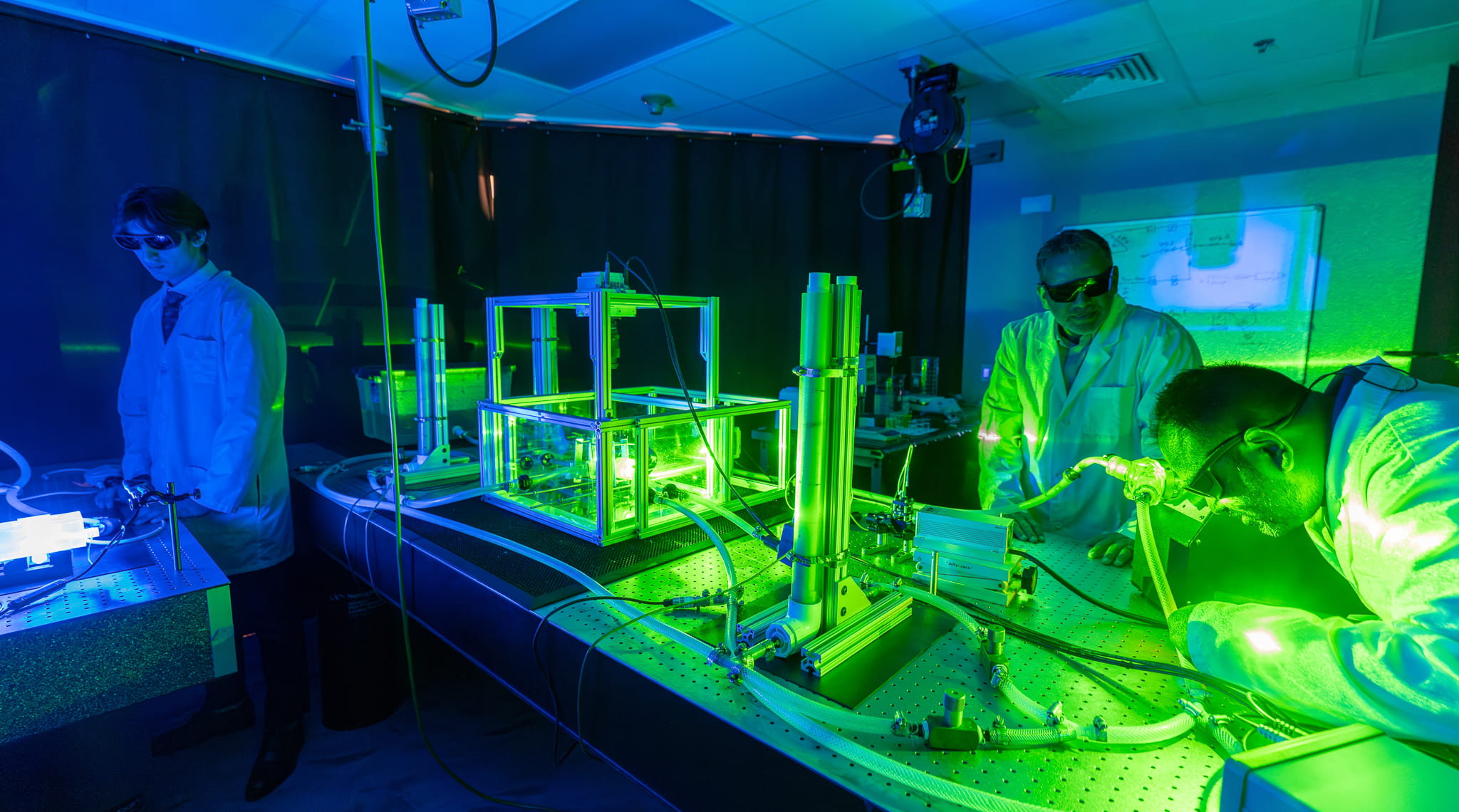
The researchers’ aim to investigate how the shunt can be optimally designed and modified to function in different Fontan configurations and in varying patient sizes and anatomies. They are using both a benchtop model called a mock flow loop and computer modeling based on fluid dynamics. The device has not been implanted yet in a human or an animal.
Machine learning allows the team to convert a limited collection of benchtop results and computational fluid dynamics simulations into much broader predictions.
“Instead of testing every possible surgical variation in the lab, we perform a smaller set of key in vitro runs,” Das said. “It allows us to estimate how different Fontan anatomies, vasculature sizes, injection shunt sizes and placement choices are likely to perform without physically testing every case.”
Damon’s part of the research, for which he was named an NSF graduate fellow, focuses on how the shunt would function in young adults during exercise. Young adults who have undergone a Fontan Procedure often suffer Fontan failure, resulting in limited exercise capacity, illness and even death.
“Once the effects and performance of the Injection Jet Shunt across different physical conditions and age groups are better understood, we will have a clearer idea of how much it can improve patient lifespan,” Damon said. “Fontan physiology remains a complex and challenging condition, with no existing cure. This presents itself as an unanswered problem that requires further research to improve patient outcomes.”
The IJS-powered Fontan circulation research is also funded by the Children’s Heart Foundation, Additional Ventures and the American Heart Association.
Related News


