
- Category
- Uncrewed Systems
- Date
- July 28, 2026
Mechanical Engineering students at Embry-Riddle Aeronautical University teamed up to retrofit a fixed-wing drone with a hydrogen fuel cell system — a technically complex and ambitious undertaking.
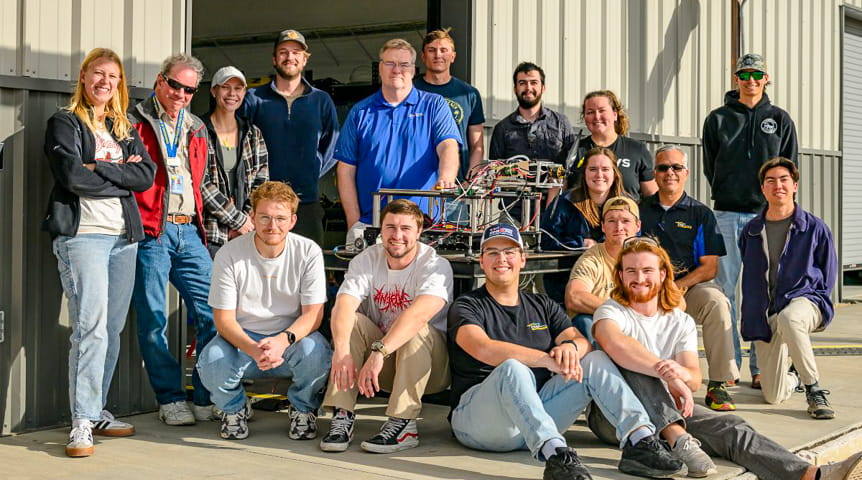
For the project, known as GHOST and sponsored by Honeywell Aerospace, the students — from both the Daytona Beach and Prescott campuses — used fuel cell technology still in a prototype phase. “We had all these questions and no answers,” said Joshua Siegler, the team lead at Prescott. “That kind of set the tone for the rest of the project.”
Whether hydrogen can become a viable propulsion source for uncrewed aircraft systems (UAS) is an open question. As an alternative to traditional battery and gasoline-powered systems, hydrogen fuel cells offer the possibility of longer endurance, quieter operation and reduced emissions. But significant challenges remain, particularly in fuel storage and system integration.
Ian Martin, an advanced project engineer with Honeywell Aerospace and the project’s industry advisor, said the project exposed students to the realities of introducing new technology into a developing market.
“The requirements were broad, and I encouraged the students to perform their own market research to think critically about the needs of the customer when choosing the platform,” he said.
The Prescott team handled fuel cell integration and testing, while their counterparts in Daytona Beach focused on aircraft systems and performance modeling for the drone platform, known as Penguin C.

Though the groups worked on separate components, their designs had to function as a single system.
“The entire basis of the project was to have our pieces fall into place and fit together to complete our mission,” said Carter Bitz, the Daytona Beach team lead involved in aircraft modeling and simulation.
That came with challenges. Students worked across time zones and relied heavily on virtual collaboration tools to stay aligned. Weekly meetings and constant communication became essential to keeping the project moving.
“At first, you have to figure out how to take pre-existing vehicles and modify them,” Siegler said. “If you have to convince airframers to manufacture vehicles specifically designed for hydrogen when there’s no market for that, nobody’s going to go along with that.”
Students had to manage weight, center of gravity, thermal systems and compressed hydrogen storage. They were also tasked with determining whether the modified aircraft could realistically fly using hydrogen propulsion, especially in the more challenging takeoff phase.
Despite those challenges, the team successfully integrated the hydrogen fuel cell system into the aircraft and validated its functionality through ground-based testing. While a full flight test remains for future teams to attempt, the project exceeded its core objective of demonstrating a viable integration.
There are plans for the project to resume in the upcoming academic year, with a new team of students building on the foundation established by the original team. Siegler and Bitz, who both graduated this spring, said the project’s next phase will focus on refining the system, integrating it fully with flight controls and moving closer to a successful flight demonstration.
Martin, of Honeywell Aerospace, said the two teams have already exceeded expectations.
“The students went above and beyond in response to a difficult, but real-world example of system integration and cross-team collaboration,” he said. “I’m very proud of their ability to tackle the ambiguity and put together a product that is representative of the system integration work we do internally.”
Related News


