
- Category
- Engineering
- Date
- September 28, 2026
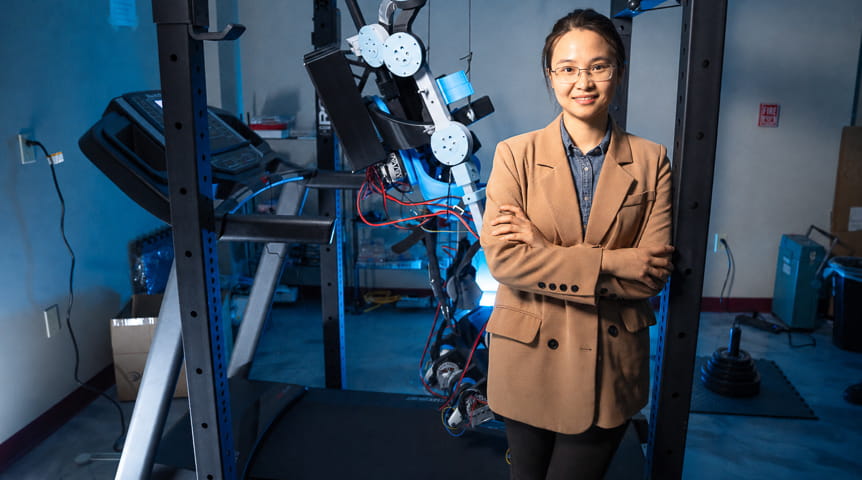
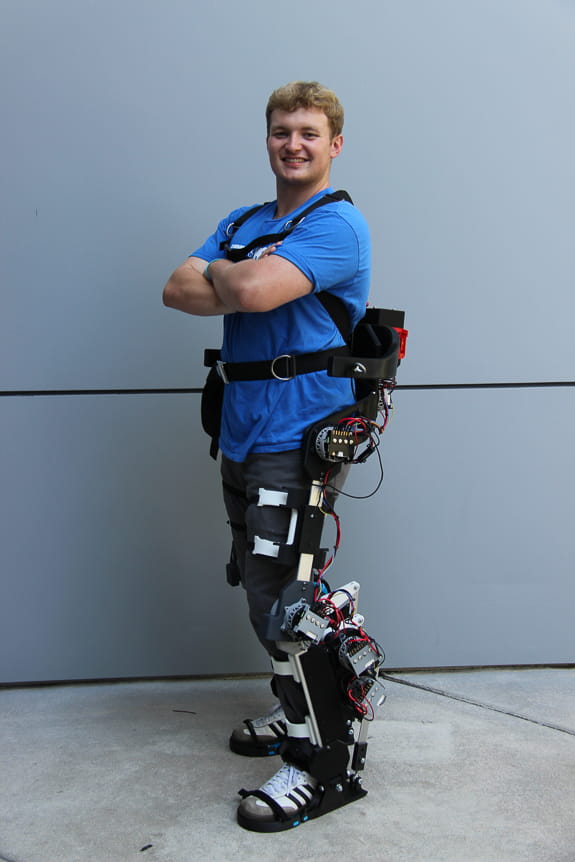
People who have trouble walking could get comfortable, customized assistance from a wearable robotic device, known as an exoskeleton, developed by Embry-Riddle researchers with a $523,000 grant from the National Institutes of Health (NIH).
The exoskeleton would allow users to walk with more ease, adjusting the assistance it provides according to the wearer’s movement and terrain by using motion sensors and an algorithms-based controller, said Dr. Shuzhen Luo, assistant professor in the Department of Mechanical Engineering.
“The wearer does not need to manually control the exoskeleton,” Luo said. “The assistance is provided automatically as the person walks.”
The design of each exoskeleton will be developed individually with simulation and manufacturing technologies that can customize the device to its wearer as it is being created, rather than needing extensive fitting after it is produced, Luo said.
“Instead of relying on a one-size-fits-all device and hours of human-involved tuning, our approach combines machine learning and 3D printing to develop a lightweight, personalized hip exoskeleton based on an individual’s body dimensions and walking characteristics,” Luo said.
Ph.D. student Ke Feng became involved with the research after her cousin suffered a stroke that left her with mobility challenges.
“I saw how difficult it could be for her to go out and participate in everyday activities — even taking a simple walk could be challenging for her physically and mentally,” Feng said. “I saw the potential for this technology to help people like my cousin become more mobile and independent.”
The device being developed by the researchers is intended to perform reliably in community settings, where conditions such as walking surfaces vary. The researchers say it will operate even more easily in controlled private settings.
“Our goal is not only to support physical mobility but also to improve people’s overall quality of life,” Feng said. “Improving mobility can encourage older adults to participate more actively in community life, which can contribute to greater social engagement and well-being.”
Dr. Jim Gregory, dean of the College of Engineering, noted that securing support from NIH is especially competitive, adding that the grant for this project “is clearly moving us forward as we branch out to build technical depth in a wider array of disciplines.”
Other researchers involved in the exoskeleton development are Dr. Yue Zhou, assistant professor in the Department of Aerospace Engineering, who will provide expertise in 3D printing and structural design, and Ramakanth Yakkanti, M.D., of the Rothman Orthopedic Institute at AdventHealth.
The project is also supported by members of Luo’s Robotics and Intelligent Learning Lab, where Ph.D., master’s, and undergraduate students contribute to exoskeleton design, control and testing. Team members include Ph.D. students Mingyi Wang and Feng, master’s student Rachel Chuaunsu, and undergraduates Killian Embler, Manuel Buenrostro Macedo, Salvatore Pizzurro and Cole Finney.
Related News


