

- Category
- Security, Intelligence and Safety
- Date
- October 16, 2026
At the recent DEF CON cybersecurity conference, Embry-Riddle Aeronautical University graduate student Enzo Gonzalez challenged participants to test the security of an airport kiosk.
Gonzalez developed the challenge as part of Embry-Riddle’s aerospace-focused capture-the-flag, where teams compete in offensive and defensive objectives. Students from Embry-Riddle’s Department of Cyber Intelligence and Security have presented the challenges in person at DEF CONsince 2023. The challenges are updated every year.
“Classes like ethical hacking, coding classes and aviation cybersecurity have helped me in building the [capture-the-flag] challenges that I run,” said Gonzalez, who expects to graduate in May 2027 with his master’s in Cyber Intelligence and Security.
He said DEF CON has also shaped his interests in cybersecurity, particularly embedded systems. Most importantly, the conference led to a job offer after graduation. At DEF CON 34, he connected with a cybersecurity executive at RTX. A week later, he signed an offer to join Collins Aerospace, where he plans to work as an embedded systems security engineer.
Gonzalez, from Camas, Washington, was one of 13 students from the Prescott Campus who took part in DEF CON 34, held this past August in Las Vegas. At the conference, students networked with industry professionals, led the capture-the-flag challenges and presented research.
Through collaboration with Aviation ISAC, a global non-profit organization focused on aviation cybersecurity, Prescott Campus students have participated in the conference’s Aerospace Village since 2020.
“Our focus is on giving students opportunities to move beyond the classroom and engage directly with the cybersecurity community in aviation, space and beyond,” said Dr. Krishna Sampigethaya, professor and chair of the Department of Cyber Intelligence and Security. “For DEF CON, they are not simply attending – they are building challenges, presenting research, sharing their expertise and passion and developing relationships with professionals in the field from around the world.”
A challenge in the Aerospace Village centered on an AI-resistant system created by Lockheed Martin’s elite cybersecurity team interested Kyle Wheaton, who is on track to earn his master’s in Cyber Intelligence and Security in May 2027.
“Getting exposure to new areas allows students to try out new things as well as find out what their true passion is,” said Wheaton.
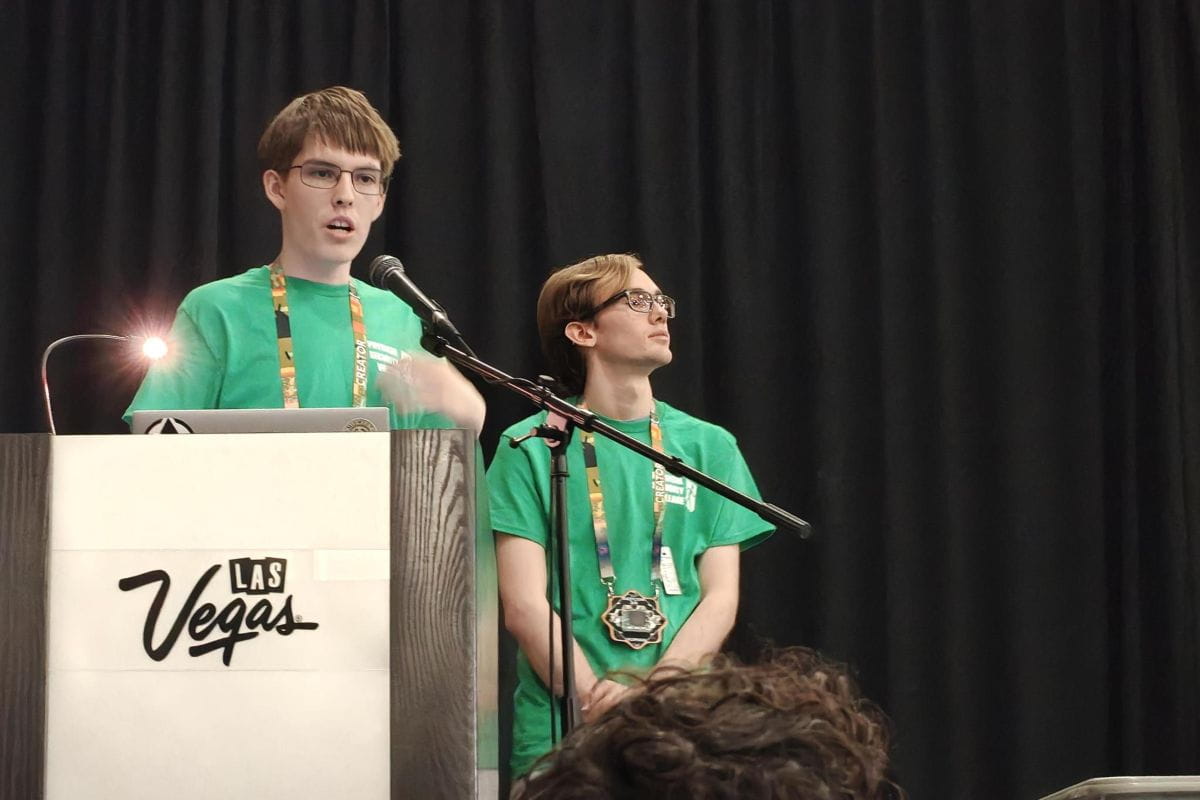
At the Physical Security Village, juniors Benjamin Higgins and Aaron Tulino presented their research on how an attacker could exploit electronic hotel locks without a room key card.
Higgins said he focused on access control and radio-frequency identification (RFID), a wireless technology used to identify access cards and badges, while Tulino brought experience in reverse engineering, software development and software security to the project.
“Coursework helped us with the research aspect, especially cryptography,” Higgins said. “In general, the hands-on environment the cyber program offers, as well as the presentation-focused approach offered by the global security program, has been very helpful throughout this process.”
By presenting their findings, Higgins and Tulino hope that hotel chains will update their security systems.
Related News


