Skip Navigation
  • Online
  • On-Campus
Embry-Riddle logo
  • Get Info
  • Visit
  • Apply
  • Admissions and Financial Aid
    • Explore Embry-Riddle
      • Request Info
      • Visit Campus
      • Virtual Tours
      • Virtual Info Sessions
      • Admissions Events
      • Chat With Admissions
      • Your Degree Path
    • Undergraduate Admissions
      • First Time Students
      • High School Graduates
      • Returning Students
      • Transfer Students
    • Graduate Admissions
      • First-Time and Transfer Students
      • Bachelor's to Master's Students
      • Doctoral Students
      • Returning Students
    • International Admissions
      • International Students
      • Embry-Riddle Language Institute (ERLI)
        • How to Apply
          • Arabic Language Application Process
          • Chinese Language Application Process
          • Japanese Language Application Process
          • Portuguese Language Application Process
          • Russian Language Application Process
          • Spanish Language Application Process
        • Academic Calendars
        • Estimated Costs
        • Housing Information
        • Courses, Achievement Scales and Sample Class Schedules
        • Student Information and Handbook
        • Pathway Program
        • Frequently Asked Questions
        • Admitted Student Checklist
        • College Prep Academies for International High School Students
    • Estimate Your Transfer Credit
    • Tuition and Costs
    • Financial Aid
      • Getting Started
        • Apply for Financial Aid
        • Net Price Calculator
          • Daytona Beach
          • Prescott
          • Worldwide & Online
        • Financial Aid FAQs
      • Types of Aid
        • Grants
          • Pell Grant Lifetime Eligibility Used
        • Loans
        • Scholarships
          • Boeing Scholars Program
          • International Scholarships and Financial Aid
        • Military and VA Benefits
          • Active Duty, National Guard and Reserves
          • Veterans
          • Military Scholarships
          • ROTC Scholarships
        • Student Employment and Work Study
      • Processes and Eligibility
        • Specialty Programs
          • Combined and Accelerated Bachelor's to Master's Programs
          • Understanding Flight Budgets and Borrowing for Flight
        • Academic Eligibility
          • Return of Title IV Funds Policy
          • Standards of Academic Progress Policy
        • Professional Judgment
        • Verification
        • Terms and Conditions
        • Code of Conduct
      • Resources
        • FATV Video Library
        • Forms
        • Glossary
        • Important Financial Aid Dates
    • Future Eagle Parents
    • School Counselors
    • Applied Students
    • Admissions FAQs
  • Academics and Faculty
    • Degrees and Programs
      • Degree and Program Directory
      • Areas of Study
        • Applied Science
        • Aviation
        • Business
        • Computers and Technology
        • Engineering
        • Security, Intelligence and Safety
        • Space
      • Program Minors
      • Combined and Accelerated Programs
      • Professional Education
      • Military Programs
        • Army Credentialing Assistance Program
        • SkillBridge for Transitioning Military
          • Aviation Maintenance Technology SkillBridge Program
        • USNCC Partnership
          • USNCC Associate of Science in Aviation Maintenance
          • USNCC Associate of Science in Uncrewed and Autonomous Systems
          • USNCC Associate of Science in Emergency Management
          • USNCC Associate of Science in Engineering Fundamentals
        • Air University Associate-to-Baccalaureate Cooperative (AU-ABC)
          • BSA
          • BSES
          • BSIS
          • BSLSCM
          • BSPM
          • BSSM
          • BSTM
          • BSUAS
        • General Education Mobile Courses
      • Free Online Courses
        • Aviation 101
        • Private Pilot 101
        • Remote Pilot 101
      • K-12 Programs
    • Colleges
      • Daytona Beach College of Arts & Sciences
        • Department of Human Factors and Behavioral Neurobiology
        • Department of Humanities and Communication
        • Department of Mathematics
        • Department of Physical Sciences
        • Department of Security Studies and International Affairs
      • Daytona Beach College of Aviation
        • Department of Aeronautical Science
        • Department of Applied Aviation Sciences
        • Department of Aviation Maintenance Science
        • Aviation Safety Department
        • Aviation Sustainability Initiative
        • Eagles Flight Team
        • Aviation Week
        • FAA Testing Center
        • Department of Flight
          • ATP-R Information
          • Aviation Medical Information
          • Flight Course Costs and Payment
          • Flight Courses and Ratings
          • International Students Information
          • Pre-Flight Checklist
        • School of Graduate Studies
      • Daytona Beach David B. O'Maley College of Business
        • Department of Accounting, Economics, Finance and Information Sciences
        • Department of Management, Marketing and Operations
      • Daytona Beach College of Engineering
        • Department of Aerospace Engineering
        • Department of Civil Engineering
        • Department of Electrical Engineering and Computer Science
        • Department of Engineering Fundamentals
        • Department of Mechanical Engineering
        • Engineers Week
      • Prescott College of Arts & Sciences
        • Department of Behavioral and Social Sciences
        • Department of Biology and Chemistry
        • Department of Humanities and Communication
        • Department of Mathematics
        • Department of Physics and Astronomy
      • Prescott College of Aviation
        • Department of Aeronautical Science
        • Department of Applied Aviation Sciences
          • Applied Meteorology Weather Models
        • Department of Flight
        • Department of Safety Science
        • Golden Eagles Flight Team
        • Aviation Safety Department
      • Prescott College of Business, Security and Intelligence
        • Department of Cyber Intelligence and Security
        • Department of Global Security and Intelligence Studies
        • School of Business
      • Prescott College of Engineering
        • Department of Aerospace Engineering
        • Department of Computer, Electrical and Software Engineering
        • Department of Mechanical Engineering
      • Worldwide College of Arts & Sciences
        • Department of Emergency, Disaster and Global Security Studies
        • Department of Human Factors, Safety and Social Sciences
        • Department of Humanities and Communication
        • Department of Mathematics, Science and Technology
        • PATHWAYS
      • Worldwide College of Aviation
        • Department of Aeronautics
        • Department of Applied Aerospace Science
        • Department of Aviation English
        • Department of Flight
        • School of Engineering
      • Worldwide College of Business
        • Department of Business Administration
        • Department of Decision Science and Analytics
        • Department of Management
    • Faculty
      • Faculty Directory
      • Fulbright Scholar and Specialist Programs
    • Academic Experience
      • Aircraft Fleet and Flight Simulators
      • Industry Advisory Boards
        • Daytona Beach College of Arts & Sciences
        • Daytona Beach College of Aviation
        • Daytona Beach David B. O'Malley College of Business
        • Daytona Beach College of Engineering
        • Prescott College of Arts & Sciences
        • Prescott College of Aviation
        • Prescott College of Business, Security and Intelligence
        • Prescott College of Engineering
        • Worldwide Industry Advisory Board
        • Worldwide College of Arts & Sciences
        • Worldwide College of Aviation
        • Worldwide College of Business
        • Asia Campus
      • Daytona Beach Honors Program
      • Awards and Fellowships
      • Libraries
      • Office of the Registrar
      • Academic Calendars
      • Artificial Intelligence
  • Student Experience
    • Campus and Community
      • Housing
        • Housing Calendars
        • Housing Rates
        • Daytona Beach Residence Halls
          • Adams and Wood Halls
          • Apollo Hall
          • Chanute Complex
          • Doolittle Hall
          • O'Connor Hall
          • Residence Hall 1 and 2
          • Residence Hall 3
          • Stimpson Hall
        • Prescott Residence Halls
          • Mingus Mountain
          • Thumb Butte
          • Village Complex
      • Dining
      • Fitness and Recreation
      • Health and Wellness
        • Counseling
      • Athletics
        • Daytona Beach Athletics Email Newsletter Signup
      • Clubs and Organizations
      • Faith and Spirituality
      • New Student Orientation
      • Graduation Ceremonies
        • Daytona Beach
        • Prescott
        • Worldwide
    • Online Learning
    • Student Services
      • Academic Advising
      • Career Services
      • Tutoring and Academic Support
      • Student Financial Services
      • Student Accessibility Services
        • Documentation and Disclosure
      • Bookstore
    • Safety and Policies
      • Safety and Security
        • Daytona Beach
        • Prescott
        • Asia
        • Campus Hazing Transparency Report
      • Student Code of Conduct
      • Student Grievances, Feedback and Reporting
      • Title IX
        • Non-Discrimination Policy
        • Sexual Harassment Policy
        • Sexual Misconduct Policy
    • Military and Veterans
      • ROTC
        • Daytona Beach
          • Air Force
          • Army
          • Naval
        • Prescott
          • Air Force
          • Army
        • Marine Corps Platoon Leaders Program
      • Military and Veteran Students
        • Residential
          • Request Information
        • Worldwide and Online
          • U.S. Military in Europe
          • PACOM
    • International Programs
      • Study Abroad
      • Center for International Education
        • International Student and Scholar Services
        • International Engagement
        • Incoming Exchange and Visiting Scholars
  • Research and Innovation
    • Centers and Institutes
      • ASSURE
      • Aviation and Space Data Analytics
      • Aviation Safety and Security Archives
      • Boeing Center for Aviation and Aerospace Safety
      • Center for Advanced Air Mobility
      • Center for Aerospace Resilient Systems
      • Center for Innovation and Entrepreneurship
      • Center for Space and Atmospheric Research
      • Florida Test Bed
      • Robertson Safety Institute
      • Jim and Linda Lee Planetarium
        • Fulldome Productions
      • STEM Education Center
    • Research Labs Directory
    • Research Groups Directory
    • Research Projects Directory
    • Undergraduate Research
      • Daytona Beach
      • Prescott
      • Undergraduate Research Scholars Program
    • Research Park
      • MicaPlex
        • Launch Your Venture
    • Service Centers
    • Technology Transfer and Commercialization
      • Patents
    • Institutional Review Board
  • About
    • Who We Are
      • Leadership
        • President
          • Presidential Speaker Series
          • State of the University
          • Thought Leadership
          • Dr. Audrey Butler
        • University Leadership
        • Board of Trustees
          • Message From the Chairman
          • Meet the Trustees
          • Meet the Delegates
          • Trustees in the News
      • Our People
        • Faculty Directory
        • Eagle Authors
      • History
      • Accreditation
        • Program-Level Student Achievement Data
          • Daytona Beach Campus
          • Prescott Campus
          • Worldwide & Online Campus
        • State Authorizations
          • California Disclosures
            • Annual Report
        • University-Level Student Achievement Data
        • Continuous Improvement
    • Why Embry-Riddle
      • The Embry-Riddle Experience
      • Facts and Rankings
      • Partnerships
        • AeroSECURE Consortium
        • Airline Transport Pilot School
        • Asia Partnerships
        • Boeing Learning Together Program
        • Breaking Down Barriers
        • Embry‑Riddle and Panhandle Helicopter Academy
        • Lunken Flight Training Center
        • Women and Drones
        • Government Relations
      • Conference Services
    • News and Stories
      • News
      • Stories
      • Podcasts
      • Media Experts
      • Media Resources
    • Locations
      • Daytona Beach Campus
        • Daytona Beach Campus Map
        • Conference Services
      • Prescott Campus
        • Prescott Campus Map
        • Conference Services
      • Worldwide & Online Campus
      • Asia Campus
      • Europe Campus
      • Central and South America
    • Contact Us
  • Get Info
  • Visit
  • Apply
  • Online
  • On-Campus

Discover More

  • Newsroom
  • Give to Embry-Riddle
  • Alumni Engagement
  • Industry Partners
  • Athletics
  1. Home
  2. About Embry-Riddle
  3. News and Stories
  4. News

Better Than a Blockbuster Movie: New James Webb Space Telescope Imagery Explained

Star system called SMACS 0723.
The James Webb Space Telescope’s first deep-field image captured a system called SMACS 0723. It was one of five new, full-color images recently released by NASA. (Photos: NASA, ESA, CSA and STScI)
  • Author
  • Mike Cavaliere
  • Date
  • July 18, 2022
  • Share
  • Facebook
  • Twitter
  • Linkedin

The recent release of never-before-seen imagery from the James Webb Space Telescope — which featured glimpses of colliding galaxies and nebulas up to 13 billion light years away — was a huge deal. The photos were the sharpest ever recorded in human history. And you couldn’t miss them: They ran in seemingly every news publication around the world, in all of their full-color glory.

Still, even as you admired those shots of deep space, and even if they put you in a state of awe, you might have also been wondering — “What am I actually looking at?”

Dr. Terry Oswalt, associate dean for research and professor in Embry-Riddle Aeronautical University’s College of Arts and Sciences, is here to help. He’s an astronomer, but he says that you don’t have to be one, too, in order to appreciate the science contained in these images.

“Humans have always wondered about our place in the cosmos, whether we are alone and what’s out there,” he said. “Personally, that visceral sense of wonder is what attracted me to astronomy as a kid.”

As a scientist, he wants to understand how life and its endless array of moving parts work together and evolve over time. As a person, though, he just wants to be wowed like anyone else. These images, he says, satisfy both of those cravings.

After all, the photos captured thousands of galaxies as well as black holes so massive that references to their size lose all meaning when described to scale (one is 24 million times the mass of our sun, for instance). But here’s the thing: What we see in these shots is a just tiny, near-microscopic piece of the Southern Hemisphere sky — equal to a single grain of sand, if you held that grain between your fingers and stretched your arm out toward the stars.

“Images like these are far more interesting to me than the latest blockbuster movie,” Oswalt said. “Astronomy is a visual science, and a picture is worth more than a thousand words.”

Specs of Dust: A Breakdown

Although Oswalt notes that the first few of the images released by the James Webb Space Telescope are of already well-studied objects, the higher quality of the shots, thanks to the telescope’s infrared technology and size, offer more detailed pictures than ever before. The more we can see, the more we can learn.

“Apart from the ‘wow’ factor, taxpayers deserve to know what NASA does with their money,” Oswalt said. “And the stream of images and findings that this program is beginning to provide will offer some much-needed perspective on how science works and why the public should trust the scientific methods we use.”

A breakdown of each of the first five photos released is below.

SMACS 0723

Pictured above, this system could be called James Webb Space Telescope’s first deep-field image, Oswalt said. 

“The huge mass of this cluster, which is about 4.6 billion light years away, focuses and magnifies the light of far more distant galaxies behind it that could not be seen otherwise — all those orange- and reddish-smeared blobs,” he said. “Some of those background objects are about 13 billion light years away — almost at the earliest stage, when galaxies first began to form after the big bang.” 

That’s one of the main goals of the James Webb Space Telescope: to image the first generation of galaxies and help us understand how the universe formed. (Side note: The reddest and faintest galaxies pictured are the farthest away.)

“The sharp whitish points with eight spikes that are sprinkled sparsely around this image — the brightest is near the center — are stars here in our Milky Way galaxy,” Oswalt added. “We are looking through our own ‘back door screen’ at the distant universe!”
The Southern Ring Nebula.

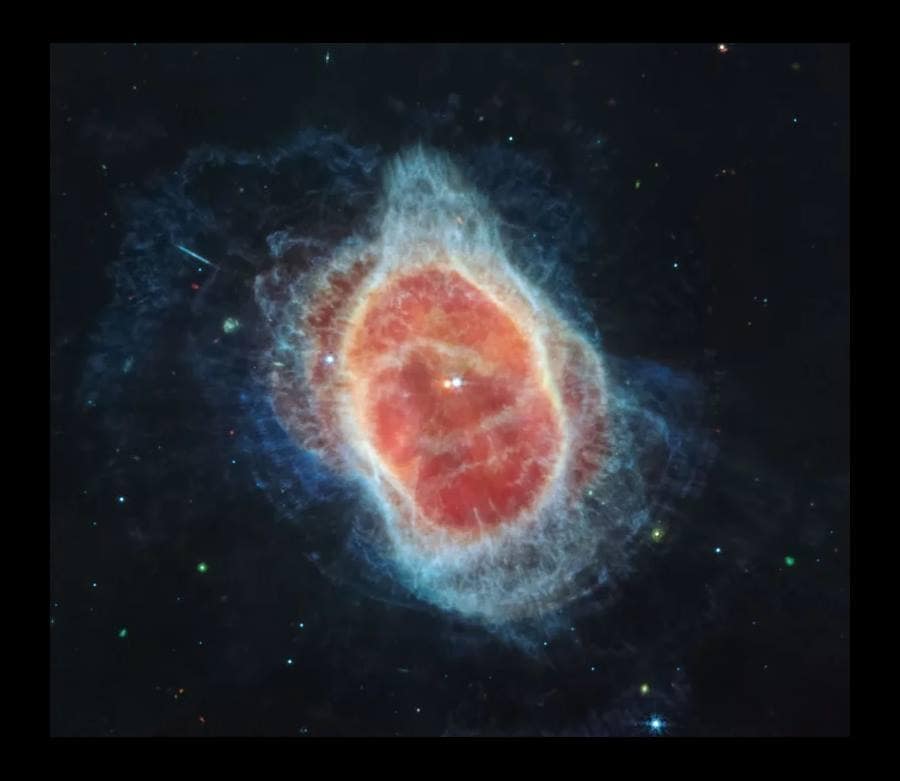
The Southern Ring Nebula

According to Oswalt, this image offers a glimpse into the future.

“In a billion years or so, the sun will begin ballooning up into a red giant, losing its atmosphere and probably engulfing the inner planets, maybe even the Earth,” he said. “The expansion will continue until the material is so spread out it becomes partly transparent, glowing by the light emitted by the chemical elements in the gas until the tiny, hot, bluish-white core of the sun becomes visible.”

There’s one key difference here compared to our sun, however.

“As you can see, at the center of this image are two stars — they are orbiting each other,” Oswalt added. “One of them — the blueish one — is the one that has lost its envelope. Eventually, all that is left will be the hot dim core, called a white dwarf star.”
Stephan’s Quintet star system.

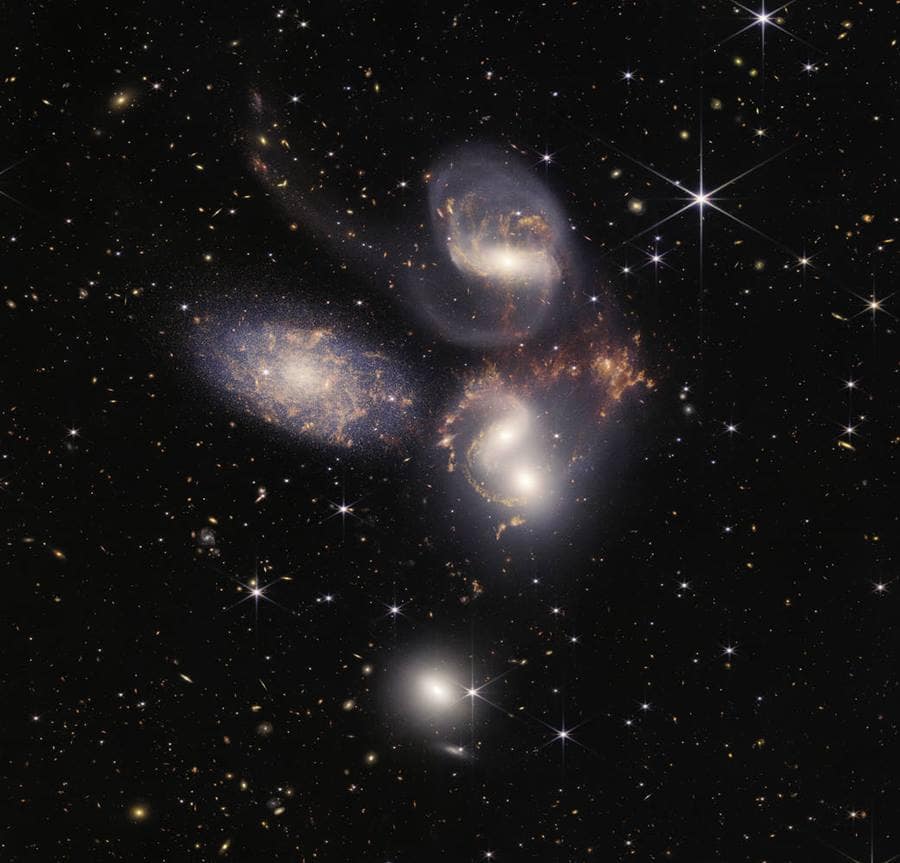
Stephan’s Quintet

“Here is a cosmic train wreck in progress,” Oswalt said. “Five galaxies are crashing into each other. This stimulates furious star formation. That, and gravity’s tidal effects, distorts the symmetry of the original spiral structure of each galaxy.”

In about a billion years, at least some parts of this system will merge into one giant elliptical galaxy.

“The rest of the galaxies’ material will be flung off into space,” he added. “You can see that two of these galaxies are already in the process of merging.”

Carina Nebula.

Carina Nebula

“This is a vast ‘stellar nursery’ where many thousands of stars and their planetary systems are forming right now,” Oswalt said.

Think of the James Webb Space Telescope as something like an MRI or sonogram imager. It can see “through” objects that visible light cannot penetrate, allowing astronomers to study how stars and their systems form.

“The glowing gas and opaque dust hides proto-stars at optical wavelengths,” he said. In other words: These proto-stars would impossible to capture by a normal telescope — but the James Webb device can “see” their heat.
WASP-96b

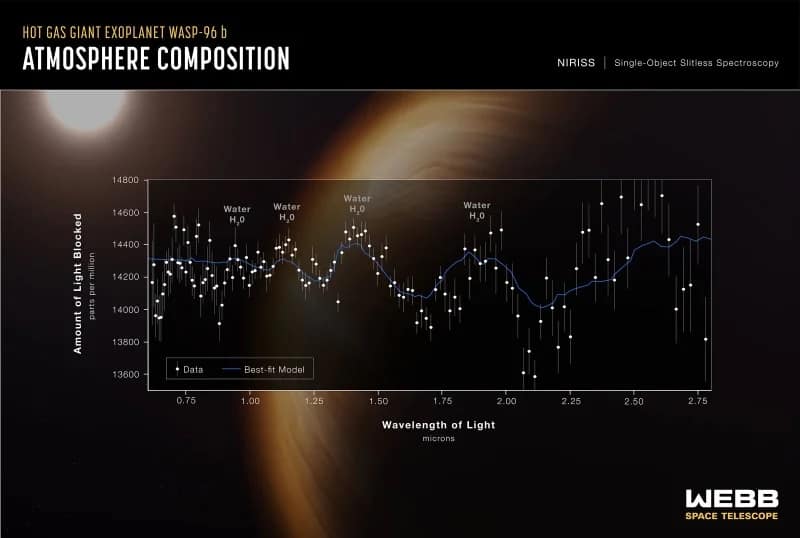
A graph may not be as exciting to look at as distant constellations, but this spectrum maps one of the first exoplanets discovered to transit its host star — and it hints at even grander discoveries.

“The peaks in this spectrum show that the planet’s atmosphere has water, which is one of the key requirements for life as we know it,” Oswalt said. “However, WASP-96b surely isn’t much like Earth. It is a planet about half the mass of Jupiter and it orbits its star in only about 3.4 days. It’s what astronomers call a ‘hot Jupiter,’ and that water is actually steam. Not a likely place for life, but this spectrum demonstrates one of the key goals of the James Webb Space Telescope: to obtain spectra for as many exoplanets as possible, and to identify as many that are Earth-like in the habitable zone around their host stars.”

Embry-Riddle’s Daytona Beach Campus is home to the largest university research telescope in the southeastern United States. Its Bachelor of Science in Astronomy and Astrophysics program has produced more graduates than 85% of other undergraduate astronomy programs in the country.

Related News

A group of students pose in front of the Prescott Campus.
From Campus to Cosmos: NASA Selects Two Embry-Riddle Teams to Present at National Competition
June 22, 2026
Kayla Taylor
Embry-Riddle Doctoral Student Honored for Her Advocacy for Women in STEM
June 18, 2026
Students in caps and gowns at commencement
An Education That Yields High Dividends: Embry-Riddle Tops List of Graduate Pay Rankings in Florida and Arizona
June 17, 2026
Graphic of a solar system
Embry-Riddle Professor Spies Stellar System’s Orbit Using NASA’s Chandra X-ray Observatory
June 16, 2026
Explore More News

Take the Next Steps

  • Get Info
  • Visit
  • Apply
Embry-Riddle logo

Daytona Beach Campus
1 Aerospace Boulevard
Daytona Beach, FL 32114-3900 

Prescott Campus
3700 Willow Creek Road
Prescott, AZ 86301-3720 

Worldwide & Online Campus
1 Aerospace Boulevard
Daytona Beach, FL 32114-3900 

Asia Campus
70 Seletar Aerospace View; #02-01
Air 7 Asia Building
Singapore, 797564 

  • Parents and Family
  • Faculty Directory
  • Alumni
  • Giving
  • Scholarly Commons
  • Course Catalog
  • News and Stories
  • Accreditation
  • Consumer Information
  • Financial Disclosures
  • Institutional Research
  • Working at Embry-Riddle
Log in to ERNIE
© Embry‑Riddle Aeronautical University. All Rights Reserved.
  • Accessibility
  • Nondiscrimination & Title IX
  • Privacy Statement & GDPR
  • Terms of Use
  • Web Feedback
  • Technology Support