
- Category
- Institutional News
- Date
- October 16, 2026
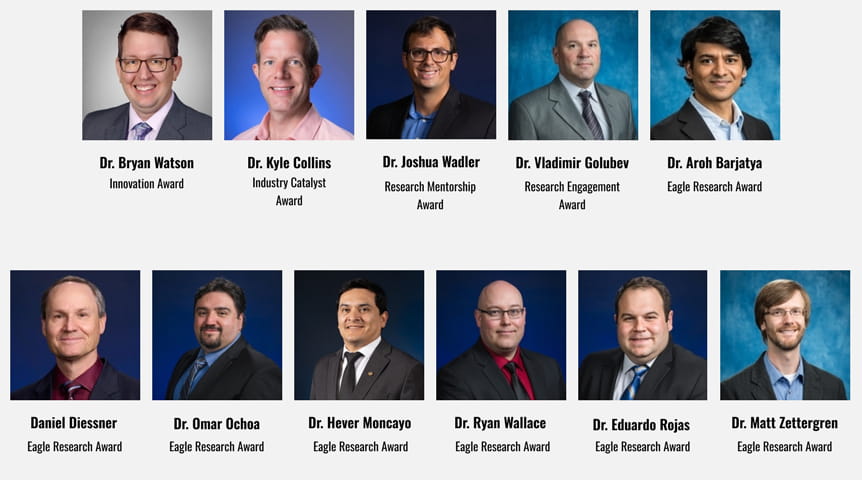
Eleven Embry‑Riddle Aeronautical University faculty members have been recognized for their research accomplishments through the university’s Research Awards Program. The program named as its 2026 awardees: Dr. Bryan Watson, Dr. Kyle Collins, Dr. Joshua Wadler, Dr. Vladimir Golubev, Dr. Matthew Zettergren, Dr. Eduardo Rojas, Dr. Aroh Barjatya, Dr. Hever Moncayo, Daniel Diessner, Dr. Ryan Wallace and Dr. Omar Ochoa.
The awards represent five types of research achievement reached over the 2026 fiscal year. The categories include earning the highest number of intellectual property disclosures or patent applications, securing industry funding for research, mentoring undergraduate researchers, nurturing doctoral research and receiving funding of more than $1 million in research expenditures.
“At Embry‑Riddle, we are committed to recognizing academic excellence, which is why we are proud to celebrate the innovation and impact of these outstanding faculty members and research scientists,” said Embry‑Riddle President P. Barry Butler, Ph.D. “Their accomplishments include advancing science, technology and engineering, generating industry partnerships and solutions, securing significant research funding and inspiring our Eagles to pursue high-level research. My congratulations to them on these well-deserved awards.”
Dr. Jeremy Ernst, vice president for Research and Doctoral Programs, said that the ERAU Research Awards Program is designed to promote the highest achievements in research and innovation as outlined in Embry‑Riddle’s 2023-2028 Strategic Plan.
“These recognitions are in direct alignment with critical goals set by the university,” Ernst said.
Innovation Award
Dr. Bryan Watson, assistant professor and program coordinator in the Department of Electrical Engineering and Computer Science, is being recognized for demonstrating exceptional innovation and commercialization of research.
In fiscal year 2026, he led four invention disclosures, which focused on leveraging biologically inspired design to improve the performance of multi-agent systems, such as drone swarms, sensor networks and satellite constellations. The inventions drew on diverse sources of inspiration, including ant colonies, bio-films, and sandpipers to address problems such as intruder detection, spreading cyber faults and network formation.
Through Embry-Riddle’s Biologically Inspired Design-for-Resilience Lab, Watson leads research applying biological strategies, design theory, graph theory and computational modeling to improve aerospace, energy, manufacturing, infrastructure and other complex systems. His work has been supported by agencies including the National Science Foundation (NSF), the Florida Department of Transportation and the University Nanosatellite Program.
Industry Catalyst Award
Dr. Kyle Collins, assistant professor in the Department of Aeronautical Science, has earned the Industry Catalyst Award for fostering industry partnerships and securing the highest amount of external funding from industry during fiscal year 2026. He led four industry-sponsored initiatives, totaling about $300,000.
Collins specializes in utilizing advanced rotorcraft analysis tools, combining computational fluid dynamics, computational structural dynamics and aeroacoustic analysis to accurately predict helicopter rotor performance, load and noise during flight.
His sponsored projects have centered on integrated propulsion and control of rotorcraft, as well as exploring electric vertical takeoff and landing technologies. An aerobatic pilot, he has begun developing a project on the effects of G-forces during aerobatic flight, research that would connect aviation operations, human physiology, wearable technology and flight-test data.
Research Mentorship Award
Dr. Joshua Wadler, assistant professor of Meteorology, has been recognized with the Research Mentorship Award for providing exceptional undergraduate mentorship. Wadler involved seven students in hurricane hunter research missions. He supported three peer-reviewed publications and shepherded students toward national presentations, competitive internships, graduate placements and professional opportunities.
His current research focuses on understanding hurricane intensity changes. One of his main projects uses emerging technologies such as uncrewed aerial systems, or drones, to take measurements inside hurricanes; another focuses on studying how precipitation processes in hurricanes impact intensity change.
Research Engagement Award
Dr. Vladimir Golubev, professor of Aerospace Engineering, is the recipient of the Research Engagement Award, which goes to a faculty member or research scientist who has “effectively engaged doctoral students in research and supported their development as scholars.” In fiscal year 2026, Golubev provided approximately $200,000 in support for doctoral research assistants, enabling advanced research in aerodynamics, aeroacoustics, propulsion, flow control and uncrewed aircraft integration.
Golubev is the founding director of the Propulsion and Aerodynamics Computational Laboratory. His primary research interests include analytical and high-fidelity numerical analyses of unsteady flow-structure interactions, with a focus on applications in aerodynamics, aeroacoustics, aeroelasticity, propulsion and flow control. His research efforts have been supported by NASA, NSF, the Air Force Research Laboratory, the Air Force Office of Scientific Research, Florida Center for Advanced Aero Propulsion and United Launch Alliance.
Eagle Research Awards
Seven faculty members have earned the Eagle Research Award distinction, which is granted to faculty members or research scientists who have secured and implemented $1 million or more in research projects. The awardees represent a range of institutional commitments, including space weather and atmospheric science, electromagnetic systems, space instrumentation, intelligent flight control, aerospace cybersecurity, uncrewed aircraft systems, software engineering and artificial intelligence.
Dr. Aroh Barjatya’s research expenditures included contributions from his sounding rocket and instrument development projects. These include the Sporadic-E ElectroDynamics sounding rocket mission, which investigated cloud-like layers in the ionosphere that can disrupt communications, and a NASA-funded project to develop novel instrumentation that can detect micrometeoroid orbital debris.
Barjatya is a professor in the Department of Physical Sciences and the associate dean for research and graduate studies in the College of Arts and Sciences. He leads research in the Space and Atmospheric Instrumentation Lab and is the interim executive director of the Center for Space and Atmospheric Research (CSAR). He was awarded NASA’s Outstanding Public Leadership Medal in December. Barjatya has written or co-written more than a dozen successful proposals over the last 15 years to various federal funding agencies, and he has overseen 11 space flight projects from proposal through launch and commissioning. He is currently part of three additional missions, including ESCAPADE, a NASA mission to Mars.
Daniel Diessner, executive director of the Center for Aerospace Resilient Systems, was awarded an Eagle Research Award for his role overseeing aviation cybersecurity grants and contracts.
Diessner’s focus is on the cybersecurity and cyber resilience of the aerospace ecosystem, both domestically and abroad. Through the investigation of new technology and product development for both commercial and military transport aircraft, he has worked to advance innovation in airplane systems, product cybersecurity, network systems, mission communications and data systems.
Dr. Hever Moncayo, professor of Aerospace Engineering, directs the Advanced Dynamics and Control Group, which focuses on the investigation of technologies to integrate advanced air mobility (AAM) into the National Airspace System, intelligent systems to increase aviation flight safety, robotic technologies for future aero and space missions and a wide range of other topics.
Moncayo is the principal investigator on a four-year NASA University Leadership Initiative project to enhance the safety of advanced air mobility aircraft by developing their capability to recognize unexpected events and emergencies and safely respond in real time using learning and evolving mechanisms.
Ochoa, associate professor and program coordinator for the master’s in Computer Science and the master’s in Software Engineering, led federally funded training and development projects aimed at expanding the number of cybersecurity professionals and increasing the STEM workforce in the United States.
Ochoa is a principal investigator on the Scholarships to Accelerate Graduates in Engineering for STEM program, which aims to strengthen the engineering workforce by supporting students through mentoring, academic advising, learning communities, professional development and opportunities for internships and research. This project has provided scholarship support for more than 25 Embry‑Riddle students to date.
His Cyber Eagles project aims to strengthen the nation’s aviation and aerospace cybersecurity workforce through scholarships, specialized education, mentorship and research opportunities. To date, the program has funded more than 20 scholars and supports the scholars’ transition into cybersecurity careers in federal, state, local, or tribal government agencies following graduation.
Dr. Eduardo Rojas, chair and professor in the Department of Electrical Engineering and Computer Science, is the director of the Wireless Devices and Electromagnetics Laboratory.
Rojas’ research advances the next generation of resilient, secure and connected aerospace systems through additive manufacturing of electronics for extreme environments, hardware security, and hybrid millimeter-wave and optical communications. His work brings together innovations in electronic fabrication, trusted hardware and high-performance connectivity to address critical challenges in advanced air mobility and space missions, where reliability, security and performance are essential.
Dr. Ryan Wallace, professor of Aeronautical Science and executive director of the Center for Advanced Air Mobility, researches drone traffic safety and airspace integration.
Wallace is the principal investigator on a number of grants for federal agencies in the areas of uncrewed aircraft systems operations, National Airspace System safety and advanced air mobility integration. His work provides student opportunities to participate in applied research addressing emerging challenges in aviation.
Zettergren, a professor and research fellow in the Department of Physical Sciences and CSAR, is leading an Office of Naval Research project developing simulations and data analysis tools to understand connections between weather and high-altitude disturbances in the space environment.
Dr. Matthew Zettergren also focuses on high-resolution modeling of auroral processes, in which energetic particles interact with various layers of the atmosphere to produce a wide variety of effects, including auroras, nightglow and atmospheric heating or cooling. Detailed observations of the light emitted by the atmosphere, combined with theoretical models, provide insights into how the sun and its activity impact Earth's atmosphere.
Related News


