- Date
- October 1, 2026
Following Embry-Riddle Aeronautical University’s historic centennial year, President P. Barry Butler, Ph.D., chartered a course for the university’s next century during his 2026 State of the University address.
His priorities included student success, faculty excellence, advanced research and signature programs in aviation and aerospace fields, as well as a foundational strategy and campaign to support long-term growth and transformation.
“We want to continually get better at who we are and what we do, while simultaneously embracing the future of aviation and aerospace,” Butler told faculty and staff during presentations to Embry‑Riddle’s Daytona Beach, Florida; Prescott, Arizona; and Worldwide campuses.
Envisioning Embry-Riddle’s next 100 years, Butler outlined the initiatives that have emerged from Embry-Riddle’s long-range planning process set by university leadership and the Board of Trustees.
Embry-Riddle will further expand its Research Park, adding state-of-the-art facilities where global companies and start-ups can drive innovation, economic growth and high-wage job creation. Additionally, the university continues to invest in its Centers of Excellence, which foster industry partnerships in critical domains, such as next-generation aircraft, cybersecurity, aviation safety and space research.
These investments enhance the educational experience for students while strengthening the value of an Embry-Riddle degree, Butler said. He pointed to a recent Business Insider ranking showing that Embry-Riddle produces the highest-earning new graduates in Arizona and Florida.
Such initiatives are possible because the university remains financially strong, with Embry-Riddle’s total revenue and endowments continuing to show “upward growth,” he said.
At a time when many universities are having financial troubles, careful stewardship of Embry-Riddle’s finances has allowed the university “to invest with foresight,” Butler said. He noted that the Board of Trustees will have invested $1.5 billion in capital projects from 2015 through 2030.
Embry-Riddle Board of Trustees Chairman Mori Hosseini shared in a statement that, guided by the vision of the trustees and President Butler, the future of Embry-Riddle is bright.
“The university’s continued success is upheld by the dedication of an exceptional cohort of faculty and staff, whose commitment creates an elevated and hands-on learning environment for every student,” Hosseini said. “Embry-Riddle is poised to define the next 100 years of excellence in aviation, aerospace and the limitless future of our next generation of explorers and leaders.”
Building for the Future
Major building projects are reshaping the university’s residential campuses.
At the Daytona Beach Campus, a new residence hall — designed to double as a hangar during hurricanes — is under construction. At the Prescott Campus, another new hall and a dramatically modernized student union — both nearly complete — will serve as cornerstones of a redesigned quadrangle.
Butler also shared a rendering of a new 28,000-square-foot, two-story building that will serve Embry-Riddle’s growing Air Force, Army and Navy ROTC programs at the Daytona Beach Campus. These programs are repeatedly rated among the best in the nation and “add significant value to our institution,” Butler said.
The Research Park is adding a third building adjacent to the Cici and Hyatt Brown Center for Aerospace Technology. The facility will house laboratories focused on hypersonics research and testing, a key technology for the U.S. government and the aerospace industry.
Additionally, the Florida Department of Transportation is supporting Embry-Riddle’s Daytona Beach Campus by accelerating construction of enhancements to Clyde Morris Boulevard, the campus's main thoroughfare. The work includes a pedestrian tunnel, which will benefit students, faculty and staff traversing the busy roadway. “This is really important to us for the safety and the long-term success of our students,” Butler said.
Celebrating Student Success
Butler continued to stress the importance of student success as a top priority. Recent achievements include six students named to the Aviation Week Network 20 Twenties Class of 2026, which recognizes outstanding aerospace-focused university students.
He also noted a team of Worldwide Campus students who came together at NASA’s Revolutionary Aerospace Systems Concepts–Academic Linkage (RASC-AL) competition, where they earned honors for proposing a novel system to store energy on the moon. The team met in person for the first time at the competition.
“They had faculty mentors who prepared them to work in that kind of environment,” Butler said. “And there is a good chance they will work in similar environments, collaborating virtually with people all over the world.”
Butler also recognized the global reach and educational impact of the Worldwide Campus, which recently awarded its 100,000th degree. The work of the Worldwide Campus supports an integrated commitment to the university’s global mission.
Creating an Innovation Hub
Embry-Riddle continues to attract top talent to its faculty. This year, two new deans joined the Daytona Beach Campus: mathematician Dr. Ayşe Şahin, dean of the College of Arts and Sciences, and aviation executive Joe Gibney, dean of the David B. O’Maley College of Business.
Two new deans also joined the Prescott Campus: academic leader Dr. Jeffrey Miller, dean of the College of Engineering, and Maj. Gen. Jeannie Leavitt, dean of the College of Aviation, who came to Embry-Riddle after a trailblazing U.S. Air Force career.
As another example of faculty excellence, Butler pointed to Robert Sumwalt, executive director of Embry-Riddle’s Boeing Center for Aviation and Aerospace Safety. Sumwalt was recently named the 2026 recipient of the Wright Brothers Memorial Trophy, one of aviation’s highest awards.
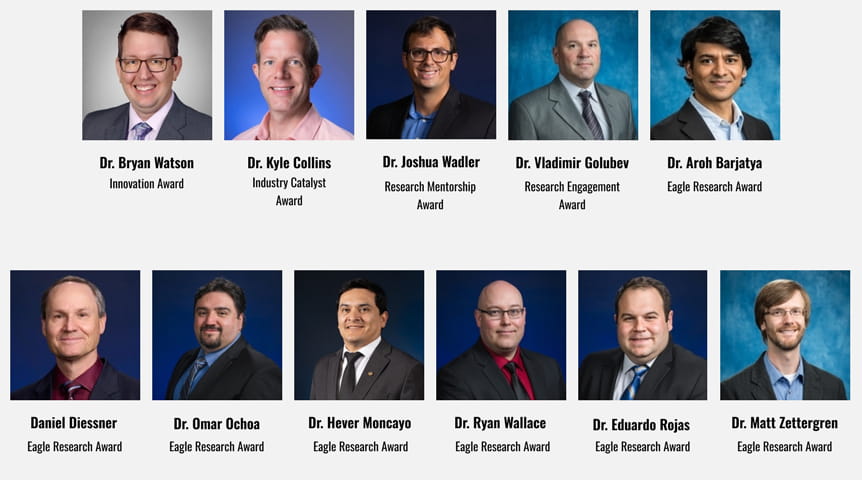
Late last year, NASA honored Dr. Aroh Barjatya, professor in the Department of Physical Sciences and director of the Space and Atmospheric Instrumentation Lab, for leading the launch of six sounding rockets during two solar eclipses. The space agency awarded him the Outstanding Public Leadership Medal.
Butler also recognized Dr. Krishna Sampigethaya, chair of the Department of Cyber Intelligence and Security, who earned a $1.85 million grant to educate the next generation of cyber defenders.
To convene experts across disciplines and support industry in signature fields, Embry-Riddle has continued to develop its Centers of Excellence, including the Boeing Center for Aviation and Aerospace Safety, the Center for Aerospace Resilient Systems and the Center for Space and Atmospheric Research.
A hangar in the Research Park is now home to Embry-Riddle’s new Center for Advanced Air Mobility, which will conduct research in next-generation aircraft and prepare students for high-wage careers in the emerging ecosystem.
Butler said the university regularly secures more than $60 million in annual research funding, and he anticipates $90 million in funding by 2031.
Launching What’s Next
Embry-Riddle has set a transformational $300 million goal for its recently launched capital campaign, Imagine What’s Next: The Campaign for Embry-Riddle.
Foundational to the campaign and to setting Embry-Riddle’s philanthropic agenda were two benefactors from Embry-Riddle’s Board of Trustees: Chairman Mori Hosseini and Trustee Kenn Ricci, Butler said.
The campaign has generated nearly $192 million to date in support of four key growth areas: scholarships and student success, experiential learning, faculty excellence and centers of excellence.
“We continue to gain momentum,” Butler said, “as we bring more alumni, friends, and industry into the fold.”
Butler underscored that Embry-Riddle's overarching vision is to remain “the unquestioned global leader in aviation and aerospace higher education, with a reputation for personal attention to the success of all students.”
He emphasized faculty excellence and team efforts to grow research programs and earn major grants. Most importantly, he encouraged faculty and staff to pay personal attention to students to ensure they reach graduation day. The university, he said, is working hard on scholarships to alleviate students’ financial constraints.
“It’s about us working as a community to help them,” Butler said. “The return on investment is there, but they have to get to that finish line. They have to get that degree.”
Related News